Is your high-capacity battery actually a solution, or just another piece of clutter? You likely own at least one power bank that is currently buried under a nest of tangled cables on your nightstand. It's a common frustration. By May 2026, the global market for these portable batteries has climbed toward $21.72 billion, yet our workspaces remain chaotic. We often buy more capacity to compensate for a lack of order, settling for cheap hardware that loses its efficiency within a single season.
You deserve a strategy that values your time and your aesthetic. This article explores whether you truly need more mobile juice or if it's time to transition to a modular docking station. We'll help you navigate the choice between the flight-restricted 100 Wh portable unit and the permanent, clutter-free relief of a professional charging rail. We will examine the April 2026 EU USB-C mandates and the latest Qi2 standards to ensure your next investment is entirely future-proof. Discover how German engineering can transform your daily ritual from a cable-laden chore into a seamless, sophisticated experience.
Key Takeaways
- Distinguish between transient energy for travel and permanent power for your professional workspace.
- Identify the 'Clutter Paradox' and why a high-capacity power bank often adds more cord chaos to your desk than it solves.
- Evaluate the durability of fixed connectors over loose cables to ensure a reliable charge every time.
- Future-proof your environment with modular systems that adapt to changing connector standards without requiring total replacement.
- Discover how patented German engineering transforms chaotic charging areas into minimalist, high-performance docking stations.
The Evolution of the Power Bank: Transient Power vs. Permanent Order
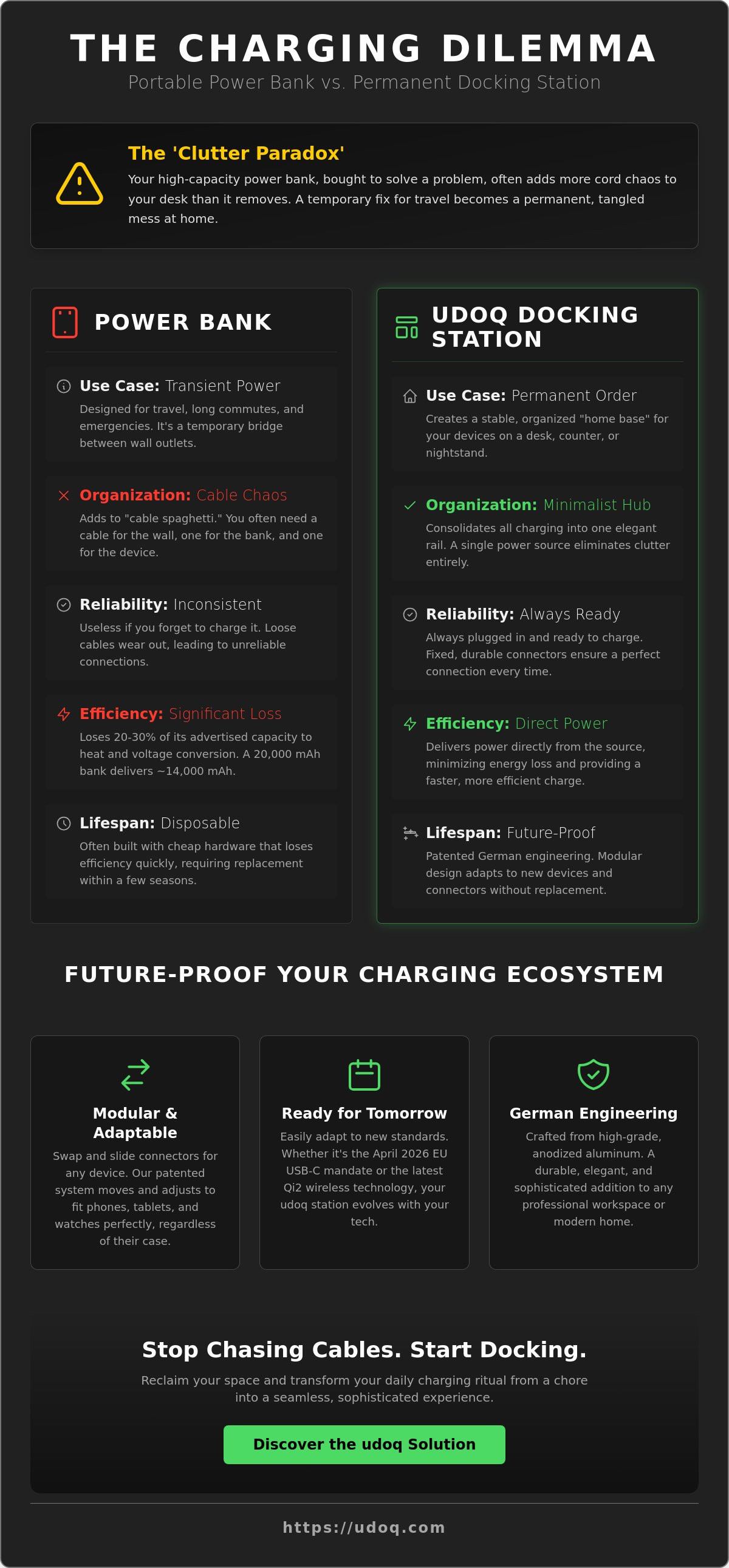
Mobility defines the modern professional. We rely on a portable battery pack to survive long commutes or back to back meetings. But a power bank is inherently transient. It's a temporary bridge between wall outlets, designed for the "in-between" moments of a device-heavy lifestyle. While useful for travel, it fails as a foundation for a structured workspace. It's a survival tool, not an organizational one.
To better understand how these portable solutions have evolved, watch this helpful guide:
The udoq philosophy suggests that charging shouldn't be an afterthought. It should be a seamless, elegant part of your environment. Contrast the "temporary fix" of a loose battery with the "permanent base" of a modular dock. One is a gadget you're constantly chasing; the other is a reliable station that's always ready. By shifting your perspective from transient power to permanent order, you reclaim your desk from the chaos of modern tech.
Understanding mAh and Charging Efficiency
Capacity is often a misleading metric. While a power bank might boast 20,000 mAh, you'll never see that full amount in your phone. Energy loss is inevitable. Voltage conversion and heat dissipation typically waste 20% to 30% of the total capacity. Furthermore, high-capacity batteries are bulkier than expected. A device large enough to charge a laptop often weighs over 500 grams. This weight makes it a burden for daily desk use, where physical space is at a premium and stability matters more than raw, portable volume.
The Transient Power Problem
The most frustrating flaw of portable charging is the human element. You frequently forget to charge the backup battery itself. This leads to a frantic scramble where you plug the battery into the wall and your phone into the battery. The result is "cable spaghetti." Your nightstand or desk becomes a graveyard of tangled wires. These portable chargers actually increase clutter rather than reducing it. They solve a mobility problem but create a storage nightmare. You can explore how we transitioned away from this mess in our guide on The Evolution of the Charger. For a more stable environment, consider the relief of professional charging stations designed to stay put.
Power Bank vs. Docking Station: Which Fits Your Lifestyle?
Choosing the right charging strategy depends on where your day begins and ends. If you spend your time between airport terminals and remote trails, a power bank is an essential companion. It provides the freedom to move without fear of a dead battery. However, when you return to your desk or nightstand, that same portability becomes a liability. A portable battery lacks the weight and structure needed to anchor your digital life.
The Portability Trade-off
A portable battery is the correct choice for specific, high-movement scenarios. This includes international flights, long-distance hiking, or extended commutes. You must follow FAA guidance on power banks, which strictly limits lithium-ion batteries to carry-on luggage and usually caps individual capacity at 100 watt-hours. While these rules ensure safety in the air, they don't solve the chaos on the ground. Using a portable battery at your desk creates a cluttered, unstable environment where devices are often knocked over or left unplugged. For those seeking a more permanent solution, our Ultimate Guide to Choosing a Charging Station in 2026 breaks down how to select a fixed base that matches your specific hardware.
Stability and Device Visibility
A docking station serves as the dedicated home for your technology. It prevents "dead device syndrome" by establishing a clear, physical ritual. You don't have to hunt for a cable or check if the power bank itself has a charge. Instead, you slide your device into a fixed track. The udoq 400, for example, offers a mid-sized footprint that keeps multiple smartphones and tablets upright and visible. This vertical orientation allows you to monitor notifications without picking up the device, reducing distractions while maintaining connectivity.
The patented sliding track system enables one-handed docking. This is a significant ergonomic advantage over fumbling with loose cables or holding a heavy battery pack against the back of your phone. When you use a tethered battery, you're forced to manage two objects simultaneously. A dock simplifies this into a single, effortless motion. By choosing a stationary system, you transform your charging area from a messy pile of plastic into a minimalist, high-end display. It's about more than power; it's about creating a clutter-free environment that reflects your standards of order and quality.
The Clutter Paradox: Why Portable Batteries Can’t Solve Desk Chaos
Many users believe they can solve their workspace mess by simply purchasing a multi-port power bank. It seems logical. One battery, several ports, one central location. However, this creates the Clutter Paradox. While the battery is a single unit, it still requires a separate cable for every device you intend to charge. Instead of a clean desk, you end up with a tangled spider of wires radiating from a plastic brick. This isn't organization; it's just a different form of chaos. Portable solutions are designed for bags, not for mahogany or glass surfaces.
The true future of charging lies in systems that eliminate the need for these external wires entirely. A professional docking station, such as the udoq 700 POWER, uses a single wall outlet to energize up to ten devices simultaneously. All cables are hidden within the patented track system. You gain a minimalist aesthetic without sacrificing the high-speed delivery your hardware demands. It transforms a pile of plastic and wires into a sophisticated display of your technology.
The Hidden Risks of Cheap Power Banks
Thermal runaway occurs when a battery cell enters an uncontrollable, self-heating state that can lead to fire or explosion. This is a genuine risk for low-quality, plastic-cased chargers that lack sophisticated heat management. Unlike a cheap power bank, udoq utilizes high-grade anodized aluminum for its rails. This material acts as a natural heat sink, wicking warmth away from your devices and circuitry. German engineering ensures that safety is built into the industrial design, not added as an afterthought. It's a long-term investment in the security of your home and your expensive electronics.
Sustainability: Future-Proof vs. Disposable
Portable batteries are inherently disposable products. Lithium-ion cells typically degrade significantly after 300 to 500 charge cycles, eventually rendering the entire unit useless. This creates a cycle of waste that is neither elegant nor sustainable. A modular docking station breaks this pattern. When connector standards change, you don't replace the station. You simply swap a single C-CABLE or L-CABLE within the track. This modularity ensures your hardware remains relevant for years, regardless of how mobile standards evolve. Learn more about refining your workspace in our guide on how to create a minimalist desk setup. Choose longevity over the disposable trends of the mass market.
Choosing Your Charging Ecosystem: Connectors, Standards, and Speed
The transition from Lightning to USB-C is no longer a suggestion; it's a global mandate. By April 28, 2026, even laptops sold in the EU must include a USB-C charging port. This shift simplifies your gear but demands higher quality from your connectors. A standard power bank often relies on loose cables that fray or lose connection at the neck. In contrast, a fixed connector within a docking system provides a stable, reinforced point of contact. It eliminates the mechanical stress that typically destroys portable cords within six months of use.
Auditing your device list is the first step toward a functional ecosystem. Count your smartphones, tablets, and wearable tech. Determine which require high-speed Power Delivery (PD) and which can utilize wireless charging. While a power bank is a reactive solution to a low battery, a docked environment is a proactive strategy. It integrates Qi, MagSafe, and wired connections into a single, cohesive rail. This setup ensures every device receives its optimal voltage without a struggle for the last available outlet on your power strip.
The USB-C Standard in 2026
High-speed charging requires more than just a plug. It requires sophisticated circuitry capable of handling modern Power Delivery standards. Using an inferior cable with a high-output battery can lead to throttled speeds or even hardware damage. The udoq C-CABLE is engineered to meet these 2026 requirements, providing the necessary bandwidth for both tablets and laptops. You can dive deeper into the technical specifics in The Ultimate Guide to USB-C. Precision matters when protecting your premium hardware.
Modular Adjustability for Every Device
Device dimensions change every year. Most charging solutions fail because they can't accommodate protective cases or new form factors. The udoq sliding track solves this by allowing you to adjust the height and position of each connector. For those with a diverse collection, the udoq 400 Premium Watch dock offers a dedicated space for your smartwatch alongside your phone. You can mix wireless adapters with physical L-CABLE or C-CABLE units in one unified aluminum rail. This modularity ensures your station remains relevant as your device list grows. Organize your digital life today with a system that adapts to you.
udoq: The Sophisticated Alternative to the Traditional Power Bank
A portable power bank is a reactive tool. It's what you reach for when you've failed to plan or when you're miles from civilization. While a battery pack is a necessary evil for long-haul flights, it lacks the architectural presence required for a professional desk. udoq represents a shift from transient gadgets to permanent infrastructure. Our patented system uses high-grade anodized aluminum to create a stable, elegant rail for all your devices. This isn't just another charger. It's a statement of order and a commitment to quality.
Transition from transient charging to organized power. By choosing a stationary system, you eliminate the constant hunt for cables and the anxiety of a half-charged backup battery. You don't need a power bank to manage your daily workflow; you need a reliable anchor. udoq provides that foundation, combining the precision of German engineering with a minimalist aesthetic that complements any modern interior. It's time to stop surviving on temporary charges and start powering up in style.
Engineered for Longevity
Most consumer electronics are built for obsolescence. They're designed to be replaced within twenty-four months. udoq breaks this cycle with a "one for all" narrative. The modular design ensures that as your technology evolves, your station stays relevant. You can swap connectors, move adapters, and reconfigure the rail in seconds. Aluminum is the superior choice here, offering a durability and heat management that plastic alternatives can't match. This sustainable approach means you're investing in a piece of hardware that grows with your tech ecosystem. If you're looking to streamline your wearables, explore our insights on Apple Watch charger solutions for a truly unified setup.
Organize Your World
The emotional relief of a clutter-free desk shouldn't be underestimated. Chaos in your physical environment leads to friction in your digital life. When every smartphone, tablet, and e-reader has a dedicated, upright home, your workspace transforms. You gain clarity. You gain efficiency. A single power source behind the udoq rail replaces the nest of wires and plastic blocks that typically dominate a nightstand. Experience the difference that professional organization makes in your daily ritual. Discover the udoq charging station collection and choose the modular rail that fits your lifestyle. Invest in order. Invest in udoq.
Master Your Workspace with Organized Power
Navigating the charging landscape of 2026 requires a clear distinction between temporary survival and permanent order. While a power bank remains a vital companion for travel, it cannot provide the structural foundation your professional environment demands. We have explored how the global transition to USB-C and Qi2 standards necessitates a hardware solution that is as adaptable as the technology it supports. Choosing a system built with high-grade anodized aluminum ensures your setup withstands the test of time and manages heat effectively.
Patented German Engineering provides the reliability you need for a device-heavy lifestyle. A modular and future-proof design means you don't need to replace your entire station when the next connector standard arrives. You deserve a workspace that reflects your own standards of precision and minimalist elegance. Stop chasing loose cables and start experiencing the relief of a clutter-free environment. Upgrade to a professional udoq charging station today and reclaim your desk space. Your digital life is complex; your charging strategy should be simple.
Frequently Asked Questions
Can a power bank replace a home charging station?
No, a power bank is designed for transient mobility rather than stationary efficiency. It lacks the continuous power supply and organized layout of a dedicated dock. Using one at home leads to "cable spaghetti" and the constant chore of recharging the battery itself. A docking station provides a permanent, reliable base that is always ready to energize your devices without the clutter of loose wires.
What is the most sustainable way to charge multiple devices?
Invest in modular hardware that allows you to replace individual components. Most multi-device chargers are disposable plastic units that become obsolete when connector standards change. The most sustainable approach involves a system where you swap only the connector, such as a C-CABLE or L-CABLE, rather than the entire station. This reduces electronic waste and ensures your hardware investment lasts for several years.
Is it safe to leave my phone on a docking station overnight?
Yes, it's safe if the station uses high-quality heat management materials. Modern smartphones have built-in circuits to prevent overcharging. udoq stations use anodized aluminum rails to dissipate heat 40% more effectively than plastic alternatives. This protects your battery health while you sleep, ensuring a full charge by morning without the thermal stress that often degrades mobile batteries over time.
How do I know if my power bank is TSA-approved for travel?
Check the watt-hour (Wh) rating printed on the device casing. As of March 19, 2026, the TSA allows batteries up to 100 Wh in carry-on luggage without prior airline approval. If your battery is rated between 101 and 160 Wh, you must obtain permission from the airline before boarding. Any portable battery exceeding 160 Wh is strictly prohibited on all commercial flights.
Why does my power bank charge so slowly compared to a wall outlet?
Slow charging usually stems from limited output wattage or energy conversion loss. A standard power bank often outputs only 5W to 10W, whereas a PD-enabled wall outlet can deliver 20W to 100W. Additionally, transferring energy from one battery to another involves a 20% to 30% loss in efficiency. This physical limitation results in significantly longer wait times compared to a direct wall connection.
Can I use a docking station for both Apple and Android devices simultaneously?
Yes, provided the system utilizes a modular track. A fixed-track docking station allows you to slide in different connectors, such as a Lightning L-CABLE and a USB-C C-CABLE, side by side. This flexibility creates a "one for all" solution that accommodates every brand in your household on a single, elegant rail. It eliminates the need for separate charging bricks for different manufacturers.
What happens to my docking station when Apple changes its charging port again?
You simply swap the internal cable within the track. Unlike static chargers, a modular system is entirely future-proof. When standards shift, you slide out the old connector and insert the new one into the patented track system. This saves you from buying a completely new station every time a manufacturer updates their hardware, protecting your long-term investment in your home or office.
Are multi-device chargers a fire hazard?
Only if they lack proper thermal protection and high-quality certification. Cheap plastic chargers can overheat when powering several devices at once. Systems engineered with aluminum heat-sinks and high-quality circuitry minimize this risk significantly. Always look for German-engineered standards to ensure your home remains safe from thermal runaway events. Quality construction is the best defense against the risks of multi-device power delivery.