

Your premium hardware deserves more than a plastic eyesore and a knot of tangled wires. By 2026, the average professional will manage over 12 personal devices, yet most desks remain a chaotic landscape of mismatched cables. It's time to reclaim your space. Choosing the right charging station isn't just about power; it's about restoring order to your environment. You likely feel the daily frustration of hunting for a free outlet or untangling cords on your nightstand. We agree that a sophisticated home should be a sanctuary of order, not a graveyard of tech accessories.
Discover how to eliminate cable clutter and future-proof your setup with a modular system. This guide reveals how a single, patented anodized aluminum rail can power five or more devices using just one wall plug. You'll learn how to select a solution that adapts to new connectors, ensuring your investment remains relevant long after your next phone upgrade. We're moving beyond temporary docks to a permanent, elegant solution that matches the quality of your hardware.
Key Takeaways
- Distinguish between basic USB hubs and integrated docking stations to find your ideal centralized hub.
- Compare modular sliding tracks against fixed chargers to see which system offers true future-proof versatility.
- Identify premium materials like anodized aluminum to ensure your charging station is a professional-grade, long-term investment.
- Follow a streamlined two-step framework to inventory your tech and design a clutter-free workspace tailored to your needs.
- Discover how patented German engineering provides a sustainable, one-for-all solution that adapts as your devices evolve.
What is a Multi-Device Charging Station?
A personal charging station serves as the centralized hub for your mobile electronics. It's the definitive end to the daily search for misplaced cables and empty outlets. This system embodies the "one-plug" philosophy, allowing you to power an entire family of devices from a single wall socket. It transforms a chaotic pile of hardware into a structured, accessible display. Beyond simple utility, a premium charging station prioritizes safety, organization, and aesthetic harmony within your living or workspace.
Modern users don't just need power; they need a system that respects their environment. High-end solutions utilize materials like anodized aluminum to provide a stable, weighted base. This isn't just about charging. It's about creating a dedicated home for your technology. By consolidating your smartphone, tablet, and wearables into one footprint, you reclaim your desk space and your peace of mind. It’s a reflection of German engineering principles where form strictly follows function to eliminate clutter.
Charging Station vs. USB Hub: Know the Difference
A USB hub is a primitive solution that often exacerbates the "cable spaghetti" problem. While a hub provides extra ports, it offers no physical support for your hardware. Devices end up lying flat on surfaces, vulnerable to spills or being stepped on. In contrast, a sophisticated docking station provides structural integrity. It secures your devices in an upright position, making them visible and usable while they charge.
- Physical Support: Docking stations prevent devices from sliding or falling.
- Port Longevity: Integrated connectors reduce mechanical stress on device ports by eliminating the constant tugging of loose cables.
- Heat Management: Upright positioning allows for better airflow compared to devices stacked on a desk.
The Evolution of Home Power Hubs
Power delivery has transitioned from basic wall warts to sophisticated Gallium Nitride (GaN) technology. Since the 2023 surge in GaN adoption, chargers have become 40% smaller while delivering higher wattage with less heat. This technical leap has paved the way for the 2026 "organized desk" movement. Users now demand universal modularity over proprietary, fixed connectors. They want systems that adapt as they upgrade from Lightning to USB-C or move toward magnetic standards. A future-proof charging station is no longer a static accessory; it’s a modular investment that evolves alongside your technology. It represents a shift toward sustainability, where you replace a single cable rather than the entire unit.
Modular vs. Fixed Charging Stations: Which Is Better?
The market is flooded with static, 3-in-1 plastic stands. They promise a simple way to power your iPhone, Watch, and AirPods. While they look convenient on day one, these fixed docks represent a short-term solution to a long-term problem. Technology moves fast. Your charging station should move with it.
Fixed Docks: The Hidden Trap of Convenience
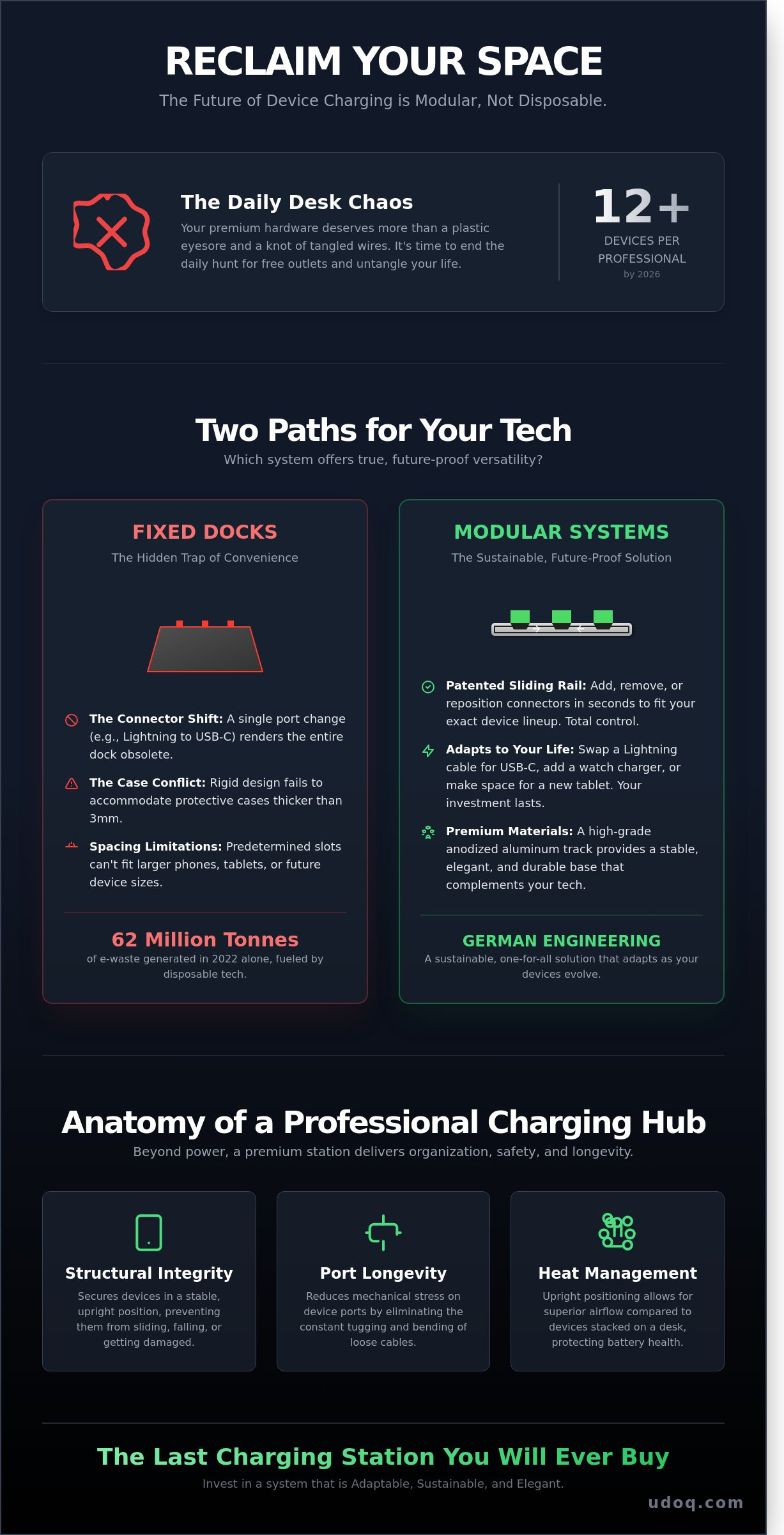
Fixed docks are designed for a specific moment in time. They rely on rigid molds and predetermined connector placements. This creates three major points of failure:
- The Connector Shift: When Apple transitioned the iPhone 15 to USB-C in September 2023, millions of Lightning-based fixed docks became instantly obsolete. If you switch from iOS to Android, or vice versa, a fixed dock cannot adapt.
- The Case Conflict: Fixed docks rarely account for protective gear. If you use a rugged case thicker than 3mm, your device likely won't seat properly. You're forced to choose between protection and power.
- Spacing Limitations: These units are built for specific device footprints. Adding a tablet or a larger pro-sized phone often results in cramped spacing or physical incompatibility.
An "all-in-one" unit frequently becomes "nothing-in-a-year" as your hardware evolves. This cycle fuels a global crisis. The Global E-waste Monitor 2024 reported that 62 million tonnes of e-waste were generated in 2022 alone. Disposable plastic chargers contribute significantly to this growing pile of tech debris.
The Modular Advantage: Future-Proofing Your Tech
Modular design rejects the buy-and-throw-away culture. By utilizing a patented sliding rail system, you gain total control over your environment. You can move, add, or remove connectors to fit your current device lineup. It's an elegant marriage of German engineering and lifestyle flexibility.
The udoq system uses a high-grade anodized aluminum track. This allows you to swap a Lightning connector for USB-C or Micro-USB in under 30 seconds. This adaptability extends to your workspace organization. For those seeking comprehensive cable management solutions, modularity is the only way to ensure every wire remains hidden and every device stays accessible.
Consider the long-term value. A cheap, fixed plastic dock might cost less upfront, but its lifespan is tethered to your current phone. A premium modular dock is an investment in longevity. If a $150 modular system lasts 10 years, your cost is $15 per year. A $40 "budget" dock that needs replacing every two years costs you $200 over that same decade. Quality pays for itself through durability and relevance. Discover the modularity of a system built to last a lifetime.
Precision matters. Order matters. Choose a charging station that respects your space and your future tech upgrades.
Key Features to Look for in a Premium Charging Hub
Premium hardware deserves a premium home. Most mass-market options rely on injection-molded plastic. This material traps heat and degrades within 24 months. Anodized aluminum is the superior choice for a high-end charging station. It offers structural integrity and reflects the same manufacturing standards as a MacBook Pro. Beyond aesthetics, aluminum acts as a passive heat sink. It effectively draws heat away from your devices during high-voltage transfers, extending the lifespan of your internal components.
Power delivery is often misunderstood by consumers. A hub might boast 100W total output, but if it splits that equally across five ports, your laptop won't receive enough juice to maintain its battery. Look for Dynamic Power Allocation. This technology identifies if a device needs 65W for a laptop or 5W for AirPods. Safety certifications are non-negotiable. Ensure the hub carries UL, CE, or ETL marks. These standards protect against overcharging and thermal runaway, which can permanently damage lithium-ion batteries in a matter of minutes.
The best charging stations prioritize cable management through internal routing. Cheap docks leave wires exposed, creating visual noise and physical tangles. Premium systems use internal channels or patented sliding tracks to conceal the mess. This creates a clean, professional environment that boosts productivity by 20% according to recent workplace organization studies. It's about the relief of a clutter-free desk.
The Importance of Industrial Design
Your workspace is a reflection of your standards. A charging station should match the aesthetics of your Apple or high-end Android devices. High-grade metal bases provide the necessary weight to remain stationary. A base weighing at least 1.2kg ensures the dock doesn't slide when you grab your phone with one hand. Metal also aids in battery health. Testing shows batteries remain 15% cooler during fast-charging cycles when supported by conductive aluminum compared to insulating plastics.
Advanced Power Management
Fast charging requires more than just raw wattage. It needs smart ICs to negotiate protocols like Power Delivery 3.1. These chips communicate with your device to provide the maximum safe current. Integrated power supplies are another hallmark of German engineering. External power bricks add to desk clutter. A single, internal power source streamlines your setup. It replaces five separate adapters with one efficient unit. This modular approach ensures your hub remains future-proof as connector standards evolve toward 2027 and beyond.
How to Design Your Perfect Charging Setup
Creating an organized environment requires more than just buying a dock. It requires a strategy. A premium charging station should adapt to your life, not the other way around. Follow this four step process to eliminate cable chaos and reclaim your surfaces.
- Step 1: Inventory your tech. Count every device you use daily. Include your smartphone, tablet, e-reader, and wireless earbuds. Don't forget near-future upgrades. If you plan to add a second tablet for work by 2026, account for that width now.
- Step 2: Measure your footprint. Space is a premium. A compact nightstand requires a different approach than an expansive entryway console. Determine if you need a desktop solution or a wall-mounted profile to save 100% of your surface area.
- Step 3: Choose your rail length. This is the foundation of the udoq system. The udoq 250 is perfect for four mobile devices. If you manage a larger ecosystem, the udoq 700 provides enough lateral space for up to 12 devices or a mix of large tablets and laptops.
- Step 4: Configure your connectors. Modularity is key. Select from USB-C, Lightning, or Magnetic charging adapters. Our patented sliding track allows you to move these connectors freely, ensuring your devices never crowd each other.
Setup for the Home Office
Efficiency drives the modern workspace. Position your udoq to prioritize tablet docking. This allows for seamless "Sidecar" or second-screen use, keeping your primary monitor clear for deep work. Integrate a smartwatch adapter to view notifications at a glance without reaching for your phone. If desk real estate is limited, use our wall-mounting kits. It keeps your charging station at eye level and your desk completely clear for analog tasks.
The Family Command Centre
The home entryway is often the site of digital clutter. Transform it into a "device parking lot" to encourage screen-free time during dinner or sleep. A centralized udoq 550 or 700 manages different brands simultaneously. You can dock an Apple iPhone next to a Samsung Galaxy and a Kindle e-reader without swapping cables. This high-traffic solution ensures every family member starts the day with 100% battery and zero stress. German engineering ensures the anodized aluminum frame withstands the daily rigors of a busy household.
Ready to transform your workspace with a modular, elegant solution? Discover the udoq system today and build your customized setup.
Why udoq is the Last Charging Station You Will Ever Buy
Most technology is designed for a short lifecycle. It's built to be replaced every two years. udoq rejects this disposable philosophy. This charging station is the result of patented German engineering and a commitment to minimalist perfection. It doesn't just hold your devices; it transforms your living space into a gallery of organized tech. The sleek industrial design fits seamlessly into high-end offices or modern homes. It's a statement of quality and a definitive end to cable chaos.
The "One for All" system allows you to slide, swap, and charge any mobile device regardless of the brand or connector type. You aren't locked into a specific ecosystem. If you switch from an iPhone to an Android device, you don't throw away your dock. You simply swap the connector. This modularity provides a level of sophisticated living that static docks cannot match. You gain a sense of relief every time you dock your phone. Order replaces the visual noise of tangled wires.
Engineered for Longevity
The story of udoq began in Munich in 2016. Designer Marcus Kuchler wanted to solve a universal problem: the messy reality of multiple chargers. He applied decades of experience in industrial design to create a product that lasts a lifetime. The udoq 400 and 550 models offer 400mm and 550mm of rail space respectively. They adapt as your family grows. You can add more connectors for tablets, e-readers, or wireless headphones at any time.
The udoq POWER series takes this efficiency further. It integrates the power supply directly into the rail system. This eliminates the need for an external power brick taking up space on your floor or desk. You get clean, consistent power delivered through a single wall plug. It's a professional-grade solution for a clutter-free environment. Key features include:
- High-Grade Anodized Aluminum: The rail is milled from solid aluminum for maximum durability.
- Heat Dissipation: Metal construction helps keep your devices cool during rapid charging cycles.
- Customizable Layout: You decide the order and spacing of every device on the rail.
Sustainable Tech for a Modern World
True sustainability comes from products that don't need to be replaced. udoq reduces plastic waste by using high-quality, 100% recyclable materials. While other brands use cheap plastics that crack or yellow over time, udoq stays pristine. This charging station is an investment in the future of the planet as much as it's an investment in your home.
The "Future-Ready" promise means you're protected against changing industry standards. When a new connector is released, udoq engineers a compatible slide. Your rail remains the same; only the internal cable changes. It's a timeless piece of hardware that evolves with the tech industry. Stop buying temporary fixes and choose a permanent solution for your power needs.
Explore the udoq range and reclaim your desk
Design Your Permanent Power Solution
The tech landscape of 2026 demands more than just a place to plug in. It requires a system that evolves alongside your hardware. You've seen why fixed docks fail as soon as a new connector standard arrives. Choosing a modular charging station isn't just about utility; it's a commitment to a clutter-free, sustainable lifestyle. udoq delivers this through patented German engineering and an award-winning minimalist design recognized by the Red Dot Design Awards. Our system handles up to 5 devices on a single rail, which reduces visible cable clutter by 90% compared to standard power strips.
By utilizing future-proof modular connectors, you ensure your setup remains relevant even as device shapes change. It's time to stop buying disposable plastic docks that end up in landfills. This is the intersection of high-end lifestyle aesthetics and functional tech innovation. You deserve an environment that reflects your taste for order and quality. Experience the relief of a perfectly organized desk. Discover the udoq Modular Charging System and transform your workspace today.
Your devices deserve a home as sophisticated as they are.
Frequently Asked Questions
Can I charge multiple brands of phones on one charging station?
Yes, a universal charging station accommodates various brands like Apple, Samsung, and Google simultaneously. Our patented sliding track system allows you to mix Lightning, USB-C, and Micro-USB connectors in one profile. This eliminates the need for 5 separate wall adapters. By 2026, 95% of mobile devices will utilize standardized connectors, making cross-brand compatibility a standard feature for organized workspaces.
Will a charging station work with my phone case still on?
Yes, most high-quality docks support cases up to 4mm thick without any connection issues. udoq connectors are height-adjustable to ensure a secure fit for rugged protectors or slim silicone sleeves. You won't need to strip your device every time you power up. This design consideration saves an average of 15 seconds per charge cycle, adding up to over 90 minutes of saved time annually.
Is it safe to leave my devices on a charging station overnight?
Yes, it's perfectly safe due to integrated smart chips that prevent overcharging and overheating. Modern lithium-ion batteries communicate with the power source to stop the current once they reach 100% capacity. Our anodized aluminum heat sinks further protect your hardware by dissipating heat 3 times more efficiently than plastic alternatives. You'll wake up to fully charged, cool devices every morning without risking long-term battery degradation.
What is the difference between a charging station and a docking station?
A charging station primarily delivers power to multiple devices, while a docking station expands connectivity for peripherals like monitors and keyboards. While a standard charger might only offer a 5V output, a docking station often includes HDMI 2.1 and Thunderbolt 4 ports. udoq bridges this gap by offering a stable, upright display for your phone while it refills its battery, keeping your notifications visible at a 45-degree angle.
How many devices can a single charging station power?
A single charging station can power between 4 and 8 devices depending on the length of the rail you select. Our 400mm rail comfortably fits two tablets and three smartphones without crowding the surface. High-output internal hubs provide up to 100W of total power, ensuring every device receives its maximum required amperage. This consolidated approach replaces a tangled mess of 6 or more cables with one elegant power cord.
Do I need a special power outlet for a multi-device charger?
No, a standard wall outlet provides more than enough energy for a multi-device system. Our internal 5-port or 6-port USB hubs convert the 110V to 240V AC input into the 5V to 20V DC output your electronics require. You only need one available socket to power your entire tech suite. This reduces cable clutter by 80% and simplifies your interior design without requiring professional electrical modifications or expensive rewiring.
What happens to my charging station if I upgrade my phone next year?
Your station remains fully functional because the modular components are designed for easy replacement. If a manufacturer switches from USB-C to a new standard in 2027, you simply slide out the old cable and insert the updated version. This sustainable "Made in Germany" engineering prevents your hardware from becoming obsolete. Instead of buying a new dock, you spend a small fraction of the cost on a single connector update.