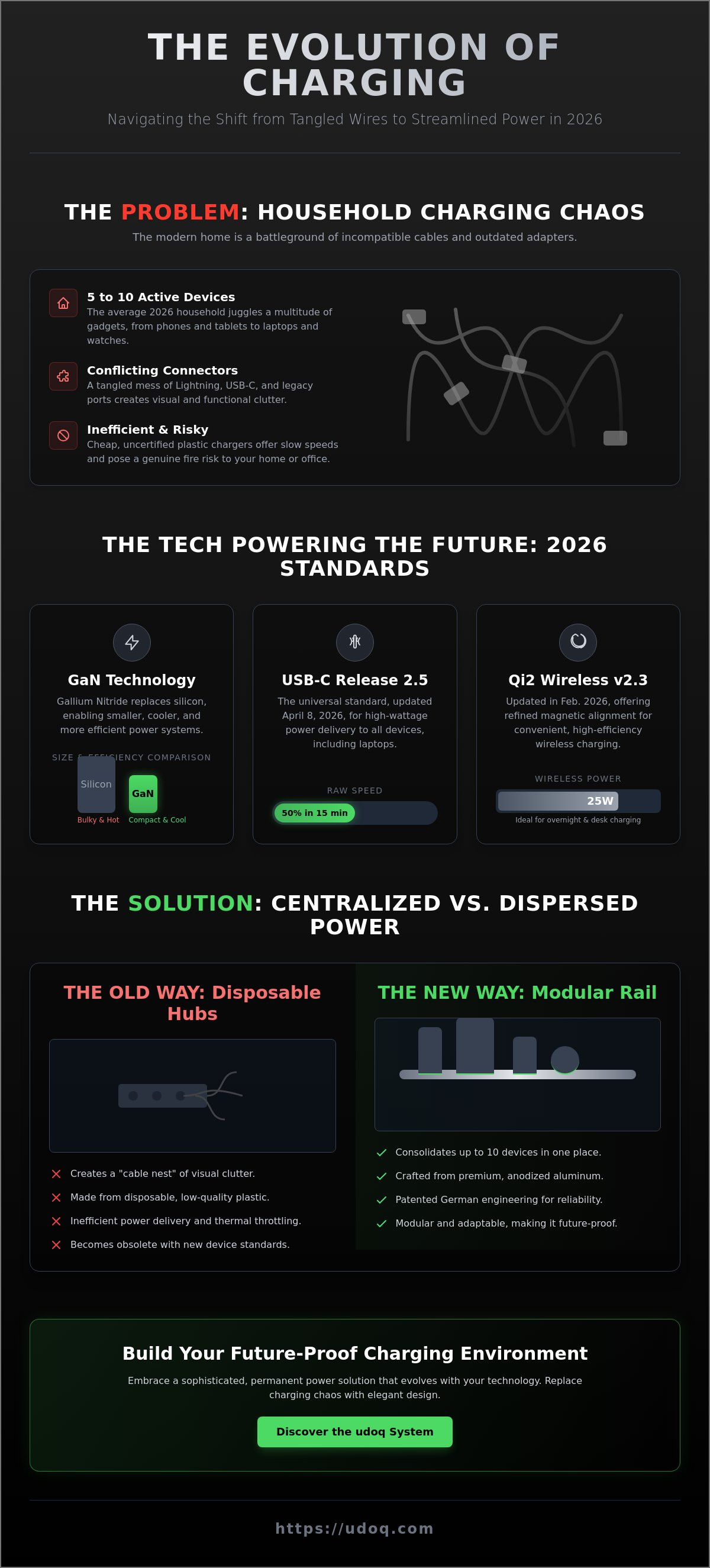
The average household in 2026 now operates at least five active mobile devices at any given time. This volume often results in a chaotic landscape of tangled cords and outdated adapters. Your workspace should reflect order and efficiency, yet finding a reliable charger that adapts to changing standards feels like a constant struggle. The EU common charger mandate, which expanded to include laptops on April 28, 2026, highlights a global shift toward standardization that many still find difficult to manage at home.
We understand the frustration of cable clutter and the relief that comes with a perfectly organized desk. You can move beyond disposable accessories toward a sophisticated, permanent power solution. This article demonstrates how to navigate the latest technological shifts, including the Qi2 v2.3 wireless update and the USB-C Release 2.5 specification published on April 8, 2026. Discover how modular, patented systems replace charging chaos with elegant German engineering. It's time to build a future-proof environment that evolves alongside your technology.
Key Takeaways
- Master the technical shift from simple cables to integrated power delivery systems using GaN and USB-C standards.
- Compare portable wall adapters against modular docking stations to find the most efficient charger for your specific workspace.
- Evaluate hardware based on material quality and power overhead to ensure your investment remains future-proof as technology evolves.
- Explore how patented German engineering and anodized aluminum provide a sustainable, clutter-free alternative to disposable plastic hubs.
- Simplify your environment by transitioning up to 10 separate devices into a single, elegant power rail.
Beyond the Wire: Understanding the Modern Charger Landscape
In 2026, the definition of a power source has fundamentally shifted. It is no longer just a simple wire tucked into a wall. It is an intelligent power delivery system. Looking back at the history of battery chargers, we see a clear progression from bulky, inefficient transformers to the sleek, high-wattage modules we use today. This evolution is necessary. Our homes are currently filled with a conflicting mix of Lightning, USB-C, and MagSafe connectors. This fragmentation creates a visual and functional mess that disrupts productivity and adds mental load to your daily routine.
Relying on a "one device, one cable" approach is an outdated habit. It forces you to hunt for specific cords every time a battery percentage drops. A centralized hub is the modern solution. It turns a cluttered desk into a streamlined, high-status workspace where power is always available and cables are invisible.
To better understand this concept, watch this helpful video:
The Anatomy of a High-Performance Charger
High-performance hardware relies on the precise harmony of voltage, amperage, and wattage. These numbers determine how fast your device recovers and how long its battery chemistry remains healthy. A premium charger uses an internal controller chip to manage this flow. This silicon brain monitors heat levels and prevents overcharging. Cheap, uncertified alternatives often skip these essential protections. They represent a genuine fire risk for your home or office. Quality is not just about charging speed; it is about protecting your long-term investments.
The Rise of Multi-Device Charging
The average household in 2026 manages between 5 and 10 mobile devices daily. Using standard power strips creates a "cable nest" that is both unsightly and inefficient. It's time to treat power as a permanent utility rather than a temporary fix. Modern charging stations serve as furniture-grade utilities. They organize your technology while providing a consistent, high-wattage flow to every connected device. This shift from plastic clutter to anodized aluminum elegance defines the udoq philosophy. Choose a charger that reflects the quality of the devices it powers.
Charging Technologies of 2026: GaN, Qi2, and USB-C
The landscape of power delivery has transformed since the early 2020s. If you're still using a charger from 2022, you're likely throttling your hardware's potential. Modern devices require sophisticated communication between the power source and the battery. Standards like USB-C and Power Delivery have matured significantly. The USB Type-C Release 2.5 specification, published on April 8, 2026, ensures that even high-demand laptops receive precise, safe energy flow. This unification means one cable can finally power everything, provided the hardware behind it is capable.
GaN Technology: Smaller, Cooler, Faster
Gallium Nitride (GaN) has replaced silicon as the gold standard for high-end power systems. The physics are simple. GaN conducts electrons more efficiently than silicon. This means less energy is lost as heat during the conversion process. Because heat is the primary enemy of electronics, GaN allows engineers to pack high-wattage components into minimalist, compact housings. It is the semiconductor revolution that ended the era of bulky power bricks. You no longer need a massive plastic block to power a workstation. Modern GaN systems provide the overhead needed for multi-device setups without the risk of overheating or thermal throttling.
Wireless vs. Wired: The Great 2026 Debate
The choice between wired and wireless is no longer about compromise. The introduction of Qi2 v2.2 in 2025 raised wireless speeds to 25W. The subsequent v2.3 update in February 2026 further refined magnetic alignment and efficiency. Wireless is the ideal choice for overnight charging or keeping your phone visible on a desk. However, USB-C remains the king of raw speed. When you need a 50% top-off in 15 minutes, a physical connection is necessary. This is where a high-quality charger proves its value by offering the best of both worlds.
Advanced modular systems bridge this gap. They allow you to slide in a high-speed USB-C connector for your tablet while your watch and phone sit on magnetic Qi2 mounts. This versatility ensures your setup remains relevant as your device collection grows. If you value a workspace that adapts to your needs, consider how a modular docking system can eliminate the need for separate, mismatched adapters. Longevity is the ultimate luxury in a world of disposable tech. By investing in standards-compliant hardware, you protect your devices and reduce electronic waste simultaneously.
Comparing Charger Form Factors: Wall Bricks vs. Modular Docks
Standard wall adapters serve a purpose for travel. They're small and portable. However, relying on them for a permanent home setup is a recipe for frustration. Each brick occupies a single outlet. In a household managing up to 10 devices, you quickly run out of wall space. Multi-port USB hubs attempt to solve this by consolidating power into one block. The problem remains aesthetic. These hubs still result in "spaghetti cables" trailing across your desk. They also frequently suffer from power drops when a second or third device is plugged in, as the internal controller reallocates wattage. This inconsistency is exactly what a high-performance charger should avoid.
The efficiency of these compact systems is grounded in advanced material science. A comprehensive review of wide and ultrawide bandgap power electronic semiconductor devices confirms that GaN technology allows for higher power density without the massive heat sinks required by older silicon designs. Modular docking stations leverage this technology to create a centralized, high-status power source. Unlike plastic hubs, these stations use industrial materials to dissipate heat while keeping your devices upright and organized. It's a shift from a temporary accessory to a permanent piece of home infrastructure.
The Hidden Cost of Cable Clutter
Visual chaos isn't just an eyesore; it affects your cognitive load. A desk covered in tangled wires creates subtle mental friction that reduces daily productivity. There's also a physical cost. Constantly plugging and unplugging cables causes wear on both the cord and your device's charging port. A centralized dock eliminates this friction. By keeping connectors in a fixed, patented sliding track, you reduce mechanical stress and extend the lifespan of your electronics. You save money by avoiding the cycle of buying cheap, disposable replacements every six months.
Scalability: The Modular Advantage
True luxury is found in adaptability. Most charging solutions are static. If you switch from an iPhone to an Android device, or add a new tablet to your collection, your old dock often becomes obsolete. The udoq rail system solves this through pure modularity. You can swap individual connectors or add magnetic mounts for smartwatches without replacing the entire unit. This "one for all" approach ensures your charging stations remain relevant for years. It's a sustainable choice that values longevity over disposable trends. Organize your devices once and let the technology evolve around your workspace.
A Buyer’s Guide: How to Evaluate a Charger for Longevity
Most consumers prioritize the lowest price per port. This approach is a mistake. A low-quality charger is a temporary fix that often degrades the battery health of your high-value electronics. Longevity requires a shift in perspective. You must evaluate hardware based on its technical overhead and physical construction. By choosing a system designed for a decade of use rather than a single device cycle, you reduce electronic waste and ensure your workspace remains functional as standards evolve.
Power overhead is the most critical technical factor. The USB Type-C Release 2.5 specification, published on April 8, 2026, supports significantly higher power delivery than previous versions. Always buy more wattage than your current smartphone requires. If your device pulls 25W, select a power source capable of at least 65W or 100W. This headroom allows the internal components to operate well below their thermal limits. It also ensures the system can power future laptops and tablets that will inevitably demand more energy.
Material choice directly impacts performance. Plastic is a thermal insulator. It traps heat inside the casing, which can lead to component failure or safety shutdowns. Anodized aluminum acts as a natural heat sink. It draws warmth away from the internal circuitry and dissipates it into the air. This superior thermal management is a hallmark of German engineering. Furthermore, ensure your hardware carries CE, FCC, and RoHS certifications. These marks are non-negotiable proof that the device meets international safety and environmental standards.
The "Future-Proof" Checklist
- Universal Standards: Does the hardware support the latest USB-PD versions to ensure compatibility with 2026 flagship devices?
- Modular Connectors: Can you swap the physical cables or connectors if a new standard emerges, or are you locked into a fixed configuration?
- Sustainable Design: Is the aesthetic timeless enough to remain a centerpiece of your desk for the next ten years?
Design and Aesthetics in the Workspace
A professional power solution should be treated as a design element, not a hidden utility. High-quality materials like anodized aluminum provide a premium feel that complements modern industrial design. Integrating your power needs into a structured system allows you to maintain a clear mind and a productive environment. Discover how to create a minimalist desk setup to maximize your daily output. If you are ready to eliminate cable chaos once and for all, explore our patented modular docking systems today.
The udoq Philosophy: German Engineering for Your Digital Life
The udoq German design multiple charging station for any mobile device represents the intersection of high-end lifestyle aesthetics and functional tech innovation. It solves the universal problem of digital chaos through refined industrial design. While earlier sections focused on the technical shifts in GaN and USB-C standards, this philosophy addresses the physical longevity of your hardware. A professional charger shouldn't be a disposable accessory. It should be a permanent piece of your environment that adapts as your device collection grows.
Precision engineering is the foundation of this system. Made in Germany, every rail is crafted from high-grade anodized aluminum to ensure durability and superior heat management. This "one for all" approach allows you to power up to 10 devices from a single wall outlet. It eliminates the need for mismatched adapters and cluttered power strips. You gain a streamlined, high-status power source that reflects the quality of the electronics it supports.
Sustainability is achieved through pure modularity. As connector standards evolve, you don't replace the entire docking station. You simply slide out the old connector and slide in a new one. This patented system protects your investment and significantly reduces electronic waste. It's a responsible, long-term solution for an ever-changing digital landscape. It turns a potential piece of e-waste into a lifetime utility.
A Tailored Charging Experience
Every workspace has different requirements. You can choose the udoq 250 for your essential devices or the massive 700mm model for a complete family hub. The patented sliding mechanism is the core of this flexibility. It allows you to adjust the spacing between your smartphones and tablets seamlessly. Whether you use thick protective cases or minimalist shells, the connectors align perfectly. Explore the udoq charging stations collection to find the rail length that fits your desk perfectly.
The Last Charger You Will Ever Need
It's time to clear the clutter and empty the "drawer of dead cables." Transitioning to the udoq German design multiple charging station for any mobile device provides an immediate sense of relief. You'll no longer deal with frayed wires or slow, outdated power bricks. You gain a future-proof station that looks as good as the technology it holds. Discover the modularity of our system and organize your tech today. Experience the lasting benefits of German engineering in your home or office.
Reclaim Your Workspace with Permanent Power
The era of disposable plastic adapters and tangled cords has officially ended. You've seen how advancements like GaN technology and the April 2026 USB-C standards have unified the technical landscape. Moving forward, your power solution should be as sophisticated as the devices it supports. A high-quality charger is no longer just a utility; it's a long-term investment in your productivity and environment. By choosing modularity, you ensure your setup remains relevant as technology continues to evolve over the next decade.
Experience the relief of a clutter-free desk and a clear mind. Our systems utilize patented German engineering and a sleek anodized aluminum design to provide a seamless charging experience. You can power up to 10 devices from 1 outlet without the visual chaos or power drops of traditional multi-port hubs. It's time to transition from cable mess to industrial elegance. Discover the udoq Modular Charging System and build a future-proof workspace that reflects your professional standards. Your devices deserve a permanent, sophisticated home.
Frequently Asked Questions
Is it better to use a high-wattage charger for all my devices?
Using a high-wattage charger is safe and often more efficient for your electronics. Modern devices use Power Delivery protocols to communicate exactly how much energy they can handle. This means a 100W source won't overpower a device that only requires 20W. It provides the overhead necessary for faster charging speeds and cooler operation during peak demand.
What is the difference between a charger and a docking station?
A standard unit is a simple power source, while a docking station is a permanent organizational hub. Most adapters leave your devices scattered across a surface with loose wires. A docking station secures your devices in a fixed position. It transforms a functional necessity into a piece of industrial design that enhances your workspace and reduces mental clutter.
Can a cheap charger actually damage my smartphone battery?
Low-quality, uncertified hardware represents a genuine risk to your device's long-term health. These units often lack the controller chips required to manage voltage fluctuations and prevent overheating. According to industry safety reports, uncertified power sources are a primary cause of lithium-ion battery degradation. Invest in certified quality to protect your hardware and ensure safety.
How do I know if my charger is compatible with the new Qi2 standard?
Check for the official Qi2 logo on the packaging or the device's technical specifications. The Qi2 v2.3 update released in February 2026 requires strict adherence to magnetic alignment standards. If your hardware lacks the internal magnets or the specific certification mark, it'll likely default to slower, less efficient legacy speeds rather than the modern 25W standard.
What is GaN technology and why is it in modern chargers?
Gallium Nitride (GaN) is a high-performance semiconductor that replaces traditional silicon in power conversion. It handles higher voltages with significantly less energy lost as heat. This efficiency allows engineers to build smaller, more powerful systems. GaN hardware provides higher power density while maintaining a cool, safe operating temperature for your home or professional office environment.
Can I charge multiple brands on one station?
The udoq German design multiple charging station for any mobile device allows you to charge any major manufacturer's products simultaneously. Modular rails allow you to mix different connectors and wireless modules in a single row. This "one for all" approach eliminates the need for brand-specific adapters. It ensures that various smartphones and tablets coexist in one organized, high-status power environment.
Why do some chargers get hot while others stay cool?
Heat is the result of energy loss during the power conversion process. Plastic housings trap this heat, causing the internal temperature to rise and potentially throttling performance. Premium systems use anodized aluminum to dissipate warmth quickly. When combined with GaN technology, these materials ensure the system remains cool to the touch even when powering multiple high-demand devices simultaneously.
How many devices can I safely charge from a single wall outlet?
You can safely charge up to 10 mobile devices from a single outlet using a properly engineered station. A standard household outlet handles approximately 1800W. Since 10 mobile devices rarely exceed 500W combined, the outlet is never overstressed. The key is using a high-quality rail that manages the distribution of power through a single, secure, and permanent connection.