The most expensive iphone charger you'll ever buy is the one you have to replace every twelve months. While the global mobile phone charger market is valued at $24.9 billion in 2026, a significant portion of that spend is wasted on disposable, frayed cables that fail long before your hardware does. You deserve a power solution that matches the industrial elegance and technical precision of your Apple devices.
It's frustrating to manage a desk cluttered with tangled cords and slow adapters that can't keep pace with the 27W wired potential of an iPhone 16 Pro. We believe your workspace should be a sanctuary of order, not a nest of chaos. This article reveals how to transition to a high-performance modular system that adapts as your technology evolves. You'll discover the technical superiority of Gallium Nitride (GaN) technology, the speed of 15W Qi2 wireless standards, and why a patented sliding track system is the last charging investment you'll ever need to make.
Key Takeaways
- Shift your perspective from buying disposable cables to investing in a permanent, high-performance charging architecture.
- Understand the technical nuances of USB-C and Qi2 to select an iphone charger that achieves peak efficiency.
- Eliminate desk clutter by replacing a tangle of individual wall bricks with a single, sophisticated modular station.
- Future-proof your environment with a system designed to adapt to changing connector standards through interchangeable components.
- Experience the relief of an organized workspace where every device has a dedicated, premium home.
The Evolution of the iPhone Charger: From Cables to Systems
The way we power our devices has fundamentally shifted. In 2026, a standard iphone charger is no longer just a white cable bundled in a box. It's a choice between three distinct architectures: high-wattage Gallium Nitride (GaN) wall bricks, the magnetic convenience of Qi2 wireless pads, and the sophisticated efficiency of modular docking stations. While individual cables were once the default, they've become the bottleneck in a high-performance digital lifestyle.
To better understand how charging technology has advanced to meet modern demands, watch this analysis of the current market:
The "standard cable" model is failing because it treats power as a temporary fix rather than a permanent utility. With global smartphone charger shipments reaching 2.1 billion units in 2025, the environmental toll of disposable, frayed plastic cords is staggering. Modern users are moving toward a "Charging Ecosystem" that prioritizes longevity and order. This shift is supported by universal 2026 Charging Standards: USB-C, which allow one high-quality interface to power everything from an iPhone 17 to a MacBook Pro. An optimized iphone charger setup should be built to last years, not months.
The Problem with Cable Chaos
A "cable nest" is more than an eyesore; it's a drain on your cognitive clarity and professional focus. When your desk is a tangle of overlapping wires, you lose time searching for the right connector. Frayed cables aren't just ugly. They cause inconsistent power delivery and can lead to expensive port damage over time. You can explore the full history of this transition in our guide to The Evolution of the Charger. Eliminating this chaos is the first step toward a minimalist, productive workspace.
The Rise of the Permanent Docking Station
We are witnessing a movement toward "charging with intention." Instead of hunting for a spare outlet in every room, sophisticated users are establishing fixed charging hubs. A docking station is a functional piece of industrial design that anchors your digital life in a single, elegant location. By choosing a permanent location, you ensure your devices are always organized, visible, and ready for use. This approach replaces the disposable mindset with one of craftsmanship and permanence. It turns a daily chore into a seamless, automated ritual.
Understanding 2026 Charging Standards: USB-C, MagSafe, and Qi2
Achieving peak performance requires technical precision. Your iphone charger is no longer just a simple power source; it's a bridge between your device's battery and a complex power grid. Since the transition to USB-C with the iPhone 15 series, the charging landscape has matured. To maximize efficiency for an iPhone 16 Pro, you need a system that supports Power Delivery (PD) and can handle a maximum wired input of approximately 27W. Anything less is a compromise in speed.
Efficiency isn't just about wattage; it's about regulation. In 2025, global smartphone charger shipments reached 2.1 billion units. This massive volume has flooded the market with non-certified, low-quality adapters that lack proper thermal management. Using these "bargain" options risks permanent battery degradation. High-quality hardware ensures that your device receives a steady, optimized current that preserves longevity. Investing in a professional power setup is an investment in the life of your phone.
USB-C vs. Lightning: Managing the Transition
Most modern workspaces are currently in a state of flux. You likely own a mix of newer USB-C hardware and legacy Lightning devices like older iPads or AirPods. Managing this transition requires a versatile setup that doesn't rely on a mess of dongles. High-quality connectors are vital to prevent physical port wear, which is a common failure point for mobile devices. For a deep dive into the technical specifications of modern connectivity, see The Ultimate Guide to USB-C. A modular approach allows you to support both standards simultaneously without sacrificing aesthetics.
MagSafe and Qi2: The Future of Magnetic Power
Wireless charging has evolved from a slow convenience into a high-speed standard. Understanding MagSafe is the first step in appreciating the new Qi2 standard. Qi2 is now the universal benchmark for magnetic power, offering 15W charging for third-party accessories. This magnetic alignment is critical. It eliminates "dead phone" syndrome caused by misaligned coils on traditional pads. Proper alignment also reduces heat, which is the primary enemy of battery health. While Apple's proprietary chargers now reach 25W for the latest models, a Qi2-certified iphone charger provides a reliable, open-standard alternative for any sophisticated home office. To see how these standards integrate into a clean workspace, explore our modular charging stations.
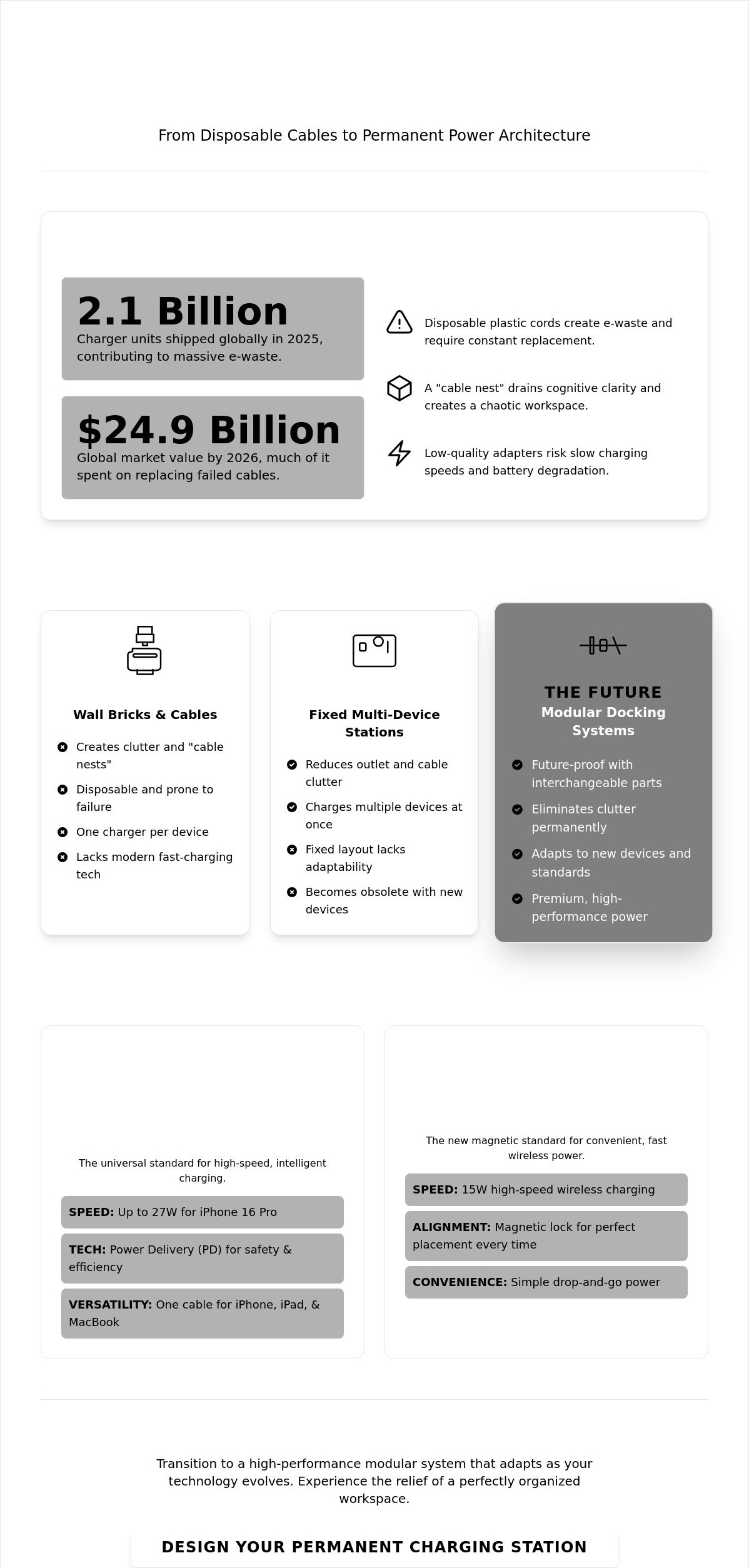
Wall Bricks vs. Multi-Device Stations vs. Modular Docks
Choosing an iphone charger infrastructure is a choice between temporary utility and permanent order. Wall bricks are the most common solution, yet they create an "outlet shortage" in modern homes. A single wall outlet should be able to power your entire ecosystem. When you rely on individual adapters, you're forced to manage a growing collection of plastic blocks. This fragmented approach is the enemy of a clean, minimalist workspace. It turns your power strip into a chaotic hub of heat and tangled wires.
Consider the "hidden cost" of the disposable model. Every time a new device generation launches with updated power requirements, users often find their existing bricks are underpowered or incompatible. This leads to a cycle of constant purchasing and waste. One high-quality station eliminates this cycle. Material choice further defines this longevity. Most standard chargers and multi-device stands rely on molded plastic. Over time, plastic degrades, discolors, and cracks. In contrast, high-grade anodized aluminum offers industrial durability. It provides the structural integrity needed for a system that lasts through years of daily use. This isn't just about aesthetics; it's about engineering a product that refuses to become e-waste.
Wall Bricks: The Disposable Standard
Gallium Nitride (GaN) technology has made wall bricks smaller and more efficient. They deliver high wattage in a compact form. However, they fail to solve the core issue of cable clutter. Each brick requires a dedicated cord, leading to the "cable nest" mentioned earlier. There's also a financial downside. As device requirements change, you're forced to buy new bricks to match new speeds. You can compare this fragmented strategy with more integrated options in our analysis of Power Bank vs. Docking Station. Bricks are tools for travel, but they aren't the foundation of a sophisticated home office.
Modular Docks: The Sustainable Investment
Modularity is the antidote to planned obsolescence. A modular dock uses a patented sliding track system to house interchangeable connectors. This allows you to adjust the setup as you upgrade your hardware. If Apple changes a connector standard, you simply replace a single cable, not the entire station. This is the hallmark of German engineering: a "one for all" narrative that values longevity over disposable trends. When you invest in udoq charging stations, you're choosing a future-proof system. It's designed to support 10+ generations of devices. This is the ultimate iphone charger solution for those who appreciate fine craftsmanship and environmental responsibility.
Choosing Your Setup: A Lifestyle-Based Guide
Your environment defines your power requirements. A single iphone charger might suffice for a commute, but your home and office demand a tailored strategy. Whether you're managing a high-output workspace or a busy household, the goal is the same: effortless access to power without the visual noise of loose wires. Sophisticated organization isn't just about hiding cables; it's about creating a system that anticipates your needs.
Optimizing for the Home Office
Efficiency in a professional setting relies on visibility and ergonomics. A flat charging pad forces you to pick up your phone to check every notification or FaceTime call. A vertical docking system keeps your screen at the ideal viewing angle. This integration allows you to monitor your workflow while maintaining a full battery. For a comprehensive look at refining your workspace, see our guide on How to Create a Minimalist Desk Setup. For those who track health metrics or time with precision, the udoq 400 Premium Watch offers a dedicated space for your Apple Watch alongside your phone. It turns your mobile device into a functional desk clock and notification hub.
The Family Charging Command Center
Multi-device households face a unique challenge: the "outlet war." When five or more devices need power, a standard power strip becomes a fire hazard and an eyesore. Centralizing your charging into a single "Command Center" solves this. By using a single rail, ranging from 250mm to 700mm in length, you can simultaneously power iPhones, Androids, and Kindles without needing five different wall outlets. This also improves sleep hygiene. By establishing a centralized hub in the kitchen or hallway, you encourage family members to leave their devices out of the bedroom at night. It's a practical way to reclaim your evening focus.
Space is often a premium in shared areas. Utilizing wall mounts allows you to lift your charging station off the counter entirely. This preserves your workspace while keeping devices safe from spills. In hospitality or business settings, this modularity is essential. Guests arrive with a variety of hardware; a system with interchangeable connectors ensures everyone stays connected. It's a professional touch that reflects a high standard of care and German engineering precision. To find the perfect fit for your lifestyle, browse our modular docking solutions.
The Minimalist Nightstand
A minimalist nightstand should be a place of rest, not a nest of tangled cords. Traditional iphone charger options often feature bright status LEDs that disrupt sleep. A refined docking solution hides the cable and the clutter, allowing for a dark, calm environment. By choosing a fixed dock, you eliminate the frustration of cables falling behind the bed. You gain the relief of a clean space that supports better rest and a more organized morning routine.
The udoq Advantage: Why Modular German Engineering Wins
A premium device deserves a premium power source. While most manufacturers treat an iphone charger as a disposable commodity, udoq approaches power as a permanent architectural element. Our system is built from high-grade anodized aluminum, a material chosen to mirror the industrial design language of your Apple hardware. This isn't just about matching colors; it's about structural integrity and a refined aesthetic that complements a professional environment.
True efficiency comes from centralized power management. A single udoq station can deliver consistent juice to up to 10 devices from a single wall outlet. This eliminates the need for multiple adapters and cluttered power strips. It transforms a chaotic charging area into a streamlined power hub. By consolidating your tech into one elegant rail, you regain control over your space and your time. It is the ultimate expression of the "less is more" philosophy.
Patented Innovation: The Sliding Connector
Precision is the hallmark of German engineering. Our patented sliding track system allows for millimeter-perfect alignment of every device. Traditional docks often force you to wiggle your phone onto a fixed plug, which puts unnecessary stress on the sensitive internal charging port. The udoq mechanism allows the connector to slide and tilt, ensuring a seamless fit every time. This "one for all" approach means your iphone charger setup remains consistent, regardless of which case or model you use. It protects your hardware investment by preventing physical wear and tear.
Future-Proofing Your Tech Investment
Technology moves fast, but your infrastructure shouldn't have to. The udoq system has successfully adapted through every major industry shift, including the transition from the legacy 30-pin connector to Lightning and now to USB-C. When you choose a modular system, you're opting for sustainability. You replace a single cable, not the entire docking station, when standards change. Over a five-year period, this modularity offers a significant cost-benefit advantage compared to buying new proprietary stands or individual wall bricks every time you upgrade your phone. It is a long-term commitment to quality and environmental responsibility. Explore the udoq collection to find the perfect fit for your home or office.
Elevate Your Workspace with Future-Proof Power
The landscape of 2026 demands more than just a functional iphone charger. It requires a system that respects your time and your desk space. You've seen how the shift toward universal USB-C and Qi2 standards makes modularity the only logical choice for a long-term investment. By choosing a permanent, high-performance hub, you eliminate the cycle of frayed cables and cluttered outlets. This transition isn't just about power; it's about reclaiming the order and efficiency your professional life requires.
Our patented German engineering provides the relief of a perfectly organized environment. Power up to 10 devices from a single outlet without sacrificing aesthetics or speed. This sustainable, future-proof modular design ensures that as your technology changes, your docking station remains a constant, reliable foundation. It's a commitment to quality that transcends disposable trends. You deserve a setup that's as refined as the devices it powers.
Organize your devices with a premium udoq docking station. Experience the clarity of a workspace designed for absolute excellence. Your journey toward a clutter-free sanctuary begins here.
Frequently Asked Questions
Will an iPhone charger dock work with my protective case?
Yes, our patented connectors are height-adjustable to accommodate protective cases up to 8mm thick. This ensures a secure connection without the need to remove your device from its shell. It is a practical design choice that maintains the sleek aesthetic of your setup while providing a stable, reliable power connection for daily use.
Is it better to charge an iPhone with a cable or a wireless dock?
Choosing between a cable and a wireless dock depends on your priority for speed or convenience. A wired iphone charger via USB-C remains the fastest method, supporting up to 27W for the iPhone 16 Pro. Wireless Qi2 docks offer a convenient 15W output and a minimalist, clutter-free aesthetic. Both options are seamlessly integrated into our modular rails.
Can I charge an iPhone and an Apple Watch on the same station?
You can absolutely charge an iPhone and an Apple Watch on a single station. Our udoq 400 and larger models are designed to host multiple devices simultaneously using dedicated adapters. This consolidation reduces cable mess and ensures all your essential tech is powered from a single wall outlet. It turns your desk into an organized hub.
How much wattage do I really need for a 2026 iPhone?
For optimal performance in 2026, you need a 30W Power Delivery (PD) adapter. While an iPhone can function with lower wattage, a 30W source allows the iPhone 16 Pro to reach its maximum 27W charging ceiling. This ensures you spend less time tethered to a station. High-wattage adapters provide the head room needed for peak efficiency.
What is the difference between a cheap charging station and a modular dock?
The difference lies in material quality and long-term sustainability. Cheap stations are typically molded plastic and become obsolete when device sizes or connectors change. A modular dock uses anodized aluminum and interchangeable components. This design allows you to replace a single $20 cable instead of a $100 station when you upgrade your phone hardware.
Does fast charging damage the iPhone battery over time?
Fast charging does not damage your battery when managed by high-quality hardware. Modern iPhones use sophisticated thermal regulation to slow down power delivery once the battery reaches 80% capacity. Our systems prioritize efficient heat management to minimize the primary factor in long-term degradation. It is a safe, engineered approach to rapid power delivery.
Can I mix USB-C and Lightning connectors on a single udoq rail?
You can mix USB-C and Lightning connectors on any udoq rail without restriction. This "one for all" philosophy is central to our modular design. It allows you to charge an iPhone 17 alongside an older iPad or legacy AirPods. Simply slide the connectors into your preferred order along the track to match your workflow.
Why is German engineering important for a simple phone charger?
German engineering ensures that every component is built for precision and industrial durability. A charger should be a reliable utility, not a disposable accessory. By focusing on high-grade materials and a patented sliding system, we create a product that lasts for decades. It is a commitment to quality that plastic alternatives simply cannot match.