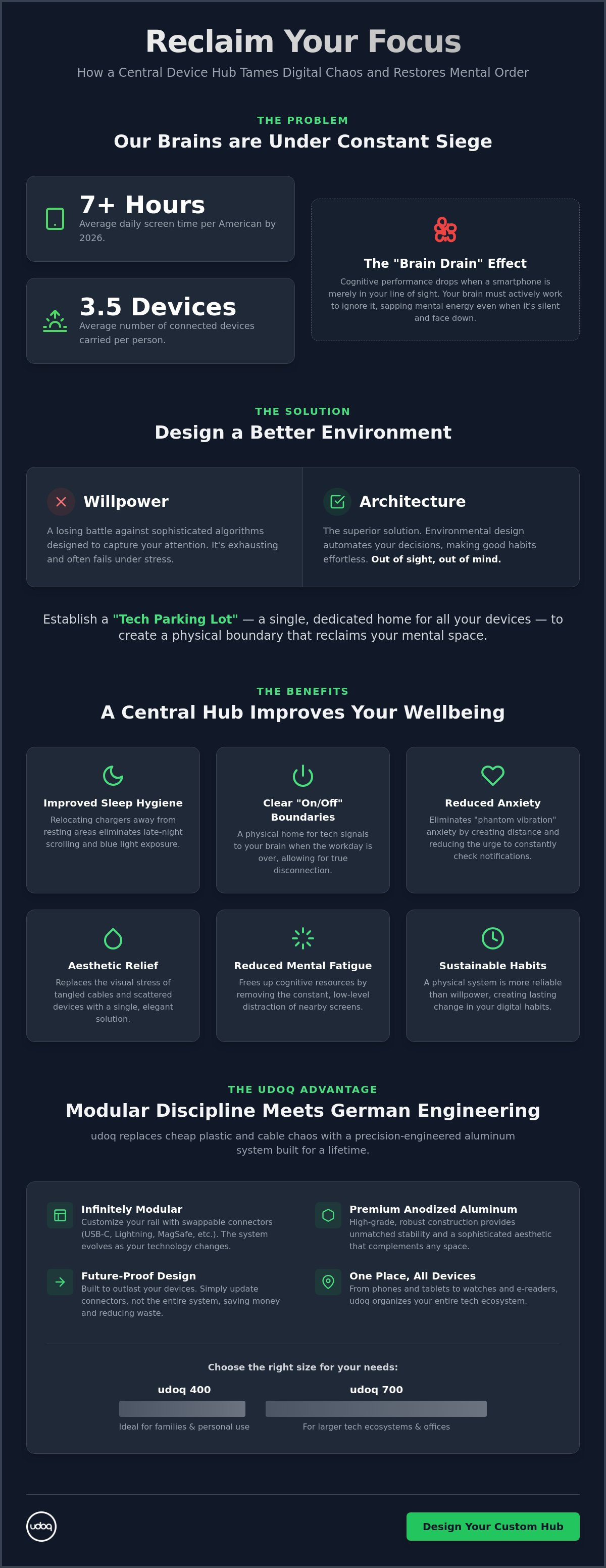
By 2026, the average American spends over seven hours every day tethered to a screen. This isn't just a statistic. It's a source of daily friction. You feel the weight of notifications interrupting dinner and the anxiety of a midnight scroll. It's easy to blame a lack of willpower, but the real culprit is your environment. Reducing screen time with a central device hub shifts the focus from discipline to design. When your technology has a designated home, your mind can finally find one too.
A physical boundary transforms digital habits from a struggle into a seamless household standard. This guide explains how a modular, industrial-grade system eliminates cable clutter and restores order. You'll discover how to improve sleep quality and reclaim your evenings through intentional organization. It's time to replace the chaos of tangled wires with a sophisticated solution that respects your space. Learn how a minimalist approach to tech can foster a more peaceful, focused home.
Key Takeaways
- Understand the "Brain Drain" phenomenon and why physical distance is essential for reclaiming cognitive energy.
- Implement a permanent digital boundary by reducing screen time with a central device hub positioned in a neutral zone.
- Improve sleep hygiene and eliminate "phantom vibration" anxiety by relocating all charging rituals away from resting areas.
- Audit your household hardware to design a custom, modular docking system that evolves with changing industry standards.
- Leverage precision engineering to replace cable clutter with a single, high-status organizational solution.
The Psychology of the Tech Parking Lot: Why Proximity Matters
Cognitive performance drops when a smartphone is within your line of sight. This phenomenon, known as "Brain Drain," occurs because your mind must actively work to ignore the device. Even if it's face down or silent, the mere proximity saps mental energy. By 2026, the average person carries 3.5 connected devices, compounding this cognitive load across multiple screens. Traditional "scattered charging" models, where cables clutter every room, exacerbate the problem. You're never truly offline because your technology is always within reach.
Establishing a "Tech Parking Lot" offers a biological hack for dopamine regulation. This is a dedicated physical zone for all household devices. Moving your hardware to a single location leverages the "out of sight, out of mind" principle. Screen time management becomes effortless when the temptation is physically removed from your immediate environment. This transition from chaos to a systemized hub signals to your brain that the workday is over.
To better understand how environmental shifts impact your habits, watch this helpful guide:
Breaking the Proximity Loop
Visual cues are powerful triggers. Seeing a screen often leads to mindless swiping. Reducing screen time with a central device hub creates a necessary "friction point." It forces you to make a conscious decision to engage with technology rather than reacting to a notification. This physical distance breaks the cycle of "phantom vibration" anxiety. A high-quality, aesthetically pleasing dock reinforces this habit. It transforms a basic utility into a premium design statement. Making the act of "parking" your phone feel intentional helps the habit stick.
Willpower vs. Architecture
The attention economy is designed to win. Relying on willpower alone to disconnect is a losing battle against sophisticated algorithms. Architecture is the superior solution. Environmental design automates your decisions. When you place your devices in a centralized charging station, you remove the need for constant self-discipline. This shift mirrors the logic of a minimalist desk setup. By organizing your space with precision, you reclaim your focus.
Consider the benefits of this architectural shift:
- Reduced Mental Fatigue: Your brain stops scanning for notifications.
- Clear Boundaries: Physical zones define when you are "on" or "off."
- Aesthetic Relief: Eliminating cable clutter reduces visual stress.
- Sustainable Habits: Systems outlast temporary bursts of motivation.
Precision engineering isn't just about the hardware. It's about the psychological relief of a tidy environment. Order in your home leads to order in your mind.
What is a Central Device Hub? Defining the Modern Charging Solution
A central device hub is a single, multi-device docking station. It replaces the chaotic web of individual cables with a unified, stationary system. This shift from charging in every room to charging in one place is essential for a peaceful home. Research suggests our digital lives may be making us more distracted. A physical hub acts as a spatial anchor. It isn't just a utility; it's a boundary. Reducing screen time with a central device hub starts with defining where technology belongs. When you centralize your hardware, you reclaim your mental bandwidth.
Technical necessity drives the need for a sophisticated hub. With the average traveler carrying 3.5 devices by 2026, a simple stand isn't enough. You need a system that supports USB-C, Lightning, and MagSafe simultaneously. Cheap plastic stands often fail to provide the stability or electrical safety required for multiple high-value electronics. Premium, modular aluminum rails like the udoq 400 or udoq 700 series offer a stark contrast. They're built for longevity. They don't wobble or slide. The udoq 400 rail provides enough space for a family's primary devices, while the udoq 700 accommodates a larger tech ecosystem. These systems provide a professional-grade solution for a modern problem.
Key Components of an Effective Hub
Precision matters in environmental design. A professional hub utilizes modular rails that allow for device growth and technology changes over time. Single-plug power supplies, such as the udoq 550 POWER, are critical. They eliminate "cable spaghetti" and reduce fire hazards by consolidating power draw into one source. High-grade materials like extruded aluminum signal a permanent home for your tech. This material choice isn't just about aesthetics. It provides the weight and durability needed to dock and undock devices with one hand. Explore how udoq systems can streamline your daily routine and clear your visual space.
The Evolution of the Docking Station
Charging has evolved significantly. We've moved from simple phone stands to comprehensive multi device charging stations. Modularity ensures your investment doesn't become e-waste when standards shift. As of April 2026, the EU requires all new laptops to support USB-C charging. This regulation reinforces the value of a universal, adaptable hub. Understanding USB-C standards is vital for modern hub design. A hub that evolves with you is a long-term investment. Reducing screen time with a central device hub is only possible if the hub itself is reliable and easy to use. It must be more convenient than the bad habits it replaces.
Health Benefits: How Centralised Charging Improves Wellbeing
Centralizing your technology isn't just about organizational efficiency. It's a critical investment in your long-term health. Stanford research shows adult brains are negatively impacted by excessive screen time, leading to impaired memory and heightened stress. Reducing screen time with a central device hub provides a physical solution to these neurological challenges. By moving the "Parking Lot" to a neutral space like a hallway or entryway, you eliminate the visual triggers that lead to late-night scrolling. This spatial shift forces a mental disconnect that willpower alone cannot achieve.
The Circadian Rhythm Connection
Your biological clock is sensitive to environmental cues. Blue light exposure from smartphones inhibits melatonin production, making it difficult to fall into deep, restorative sleep. Establish a "9:00 PM Docking Rule" for the entire household. This simple boundary ensures your bedroom remains a sanctuary for rest rather than a digital workspace. For effortless overnight power, use a system that integrates a WIRELESS ADAPTER. Understanding how wireless charging works allows you to dock your device with a single movement. It removes the friction of fumbling with cables in the dark. Consistency in this ritual stabilizes your circadian rhythm and improves morning alertness.
Reducing Digital Anxiety
Constant connectivity breeds a specific type of background stress. "Phantom vibration" anxiety and the cortisol spikes associated with frequent notifications degrade your mental clarity. Knowing exactly where your devices are provides immediate psychological relief. This is the "Udoq Effect." It replaces the chaos of scattered hardware with a sense of industrial-grade order. Digital minimalism is a spatial practice rather than just a mental one. When your phone is parked in a high-quality aluminum rail, it's no longer a source of distraction. It's simply a tool in its place. This reduces the morning stress of searching for a charger or a misplaced tablet.
A central hub also restores family dynamics. By docking devices in a common area, you naturally create phone-free zones in the living room and dining area. This encourages genuine interaction without the constant interruption of alerts. For those working from home, this separation is even more vital. Reducing screen time with a central device hub allows you to keep your minimalist desk setup free of digital clutter. You'll find that your productivity increases when your primary communication tools are parked outside your focus zone. Order in your environment translates directly to order in your mind.
- Stabilize Sleep: Remove blue light triggers from the bedroom.
- Lower Cortisol: Eliminate the stress of misplaced hardware.
- Foster Connection: Prioritize people over notifications in shared spaces.
- Boost Focus: Clear your workspace of non-essential screens.
Designing Your Hub: 5 Steps to a Screen-Smart Home
Willpower is a finite resource. Architecture is permanent. Reducing screen time with a central device hub requires a shift in your home's physical layout. You can't expect to disconnect if your charger is sitting on your nightstand. Environmental design automates the decision to put the phone away. Follow these five steps to transition from digital chaos to a systemized environment.
- Identify a Neutral Zone: Select a high-traffic area like an entryway, kitchen, or hallway. Never place the hub in the bedroom or "relaxation zones."
- Audit Your Hardware: Count every smartphone, tablet, and e-reader in the house. By 2026, the average person carries 3.5 connected devices. Don't forget guest devices and accessories.
- Select Your Rail: Match the length of your docking station to your device count. Ensure there's room for the family ecosystem to grow.
- Define Docking Hours: Set a strict time, such as 8:00 PM, when all devices must "return home." This ritual signals the end of the digital day.
- Purge Secondary Cables: Remove loose chargers from couches and bedside tables. If there's nowhere else to charge, the central hub habit becomes mandatory.
Selecting the Right Size
Precision starts with the right dimensions. A solo professional might choose the udoq 250 for a compact, efficient setup. Families require the expansive capacity of the udoq 550 or udoq 700. These larger rails accommodate multiple tablets and smartphones without crowding. Future-proof your investment by using interchangeable connectors like the C-CABLE and L-CABLE. This modularity ensures your hub remains relevant as technology standards evolve. It's a long-term investment in your home's structural order.
Location Strategy
Placement determines success. An "Entryway Dock" is the most effective tool for stopping work-life bleed. It allows you to "check in" your tech as you enter your sanctuary. If counter space is at a premium, use a wall mount to elevate your hardware. This creates a "Charging Command Center" that feels like high-end furniture rather than a tech accessory. The goal is a sleek, clutter-free environment that promotes psychological relief. You're not just charging batteries; you're designing a lifestyle that prioritizes human connection. Ready to reclaim your space? You can configure your custom charging rail to fit your specific household needs.
The udoq Advantage: Modular Discipline Meets German Engineering
Precision is the antidote to digital clutter. While mental strategies provide a temporary fix, the udoq system offers a permanent architectural solution. We believe in eliminating chaos through meticulous engineering. Reducing screen time with a central device hub is an exercise in environmental discipline. It requires a tool that matches the sophistication of your home. Our German manufacturing heritage ensures every rail is an investment in longevity. We don't build accessories. We build systems that restore order to your physical and mental space.
Sustainability is central to our design philosophy. Most consumer electronics are designed for obsolescence, but a udoq rail is a "one dock for life" investment. As technology standards shift, your hub evolves. You can swap connectors in seconds, ensuring your system remains compatible even as iPhone chargers and connector types change. This adaptability prevents e-waste and maintains your household's organizational standard. High-grade extruded aluminum provides a premium aesthetic that complements a minimalist home. It's time to transition to a "dock-first" lifestyle for the sake of your long-term health.
Patented Flexibility
Our sliding connector system is a legally protected mechanical innovation. It allows for any device combination on a single rail. You can move, add, or remove connectors like the C-CABLE or L-CABLE to fit your specific hardware mix. We've also solved the "case" problem. Udoq connectors adjust vertically to accommodate thick protective cases, ensuring a secure dock every time. For high-density households, the udoq POWER series represents the peak of efficiency. These units, such as the udoq 550 POWER, can charge up to 10 devices using a single wall outlet. This consolidation eliminates the fire hazards and visual stress of multiple power strips.
A Long-Term Investment in Order
By reducing screen time with a central device hub, you shift the focus from willpower to hardware. Udoq is likely the last charging station you'll ever need to buy. The psychological benefit of a permanent home for your digital life cannot be overstated. When your devices have a designated place, your mind stops scanning the room for them. This clarity is the ultimate luxury in a distracted world. Experience the relief of a tidy environment and a focused mind. Transform your home environment with a udoq modular dock today. Choose a system that respects your time, your space, and your wellbeing.
Reclaim Your Space and Your Focus
Environmental architecture is more powerful than self-discipline. Shifting from scattered cables to a systemized charging zone is the most effective way to sustain digital wellness. By centralizing your hardware, you remove the cognitive load of constant notifications and visual clutter. You replace the chaos of tangled wires with a permanent, high-status organizational solution that respects your time and your home. It's a fundamental change in how you interact with technology.
Reducing screen time with a central device hub is a long-term investment in your family's psychological relief. Our systems utilize patented German engineering and high-grade aluminum construction to ensure unmatched durability. The sustainable modular design adapts as your technology evolves, making it a permanent fixture in a well-ordered home. You aren't just buying a dock; you're designing a lifestyle that prioritizes human connection over digital noise.
Build your custom udoq dock and reclaim your family time. Order in your environment leads to clarity in your life. Start your transition to a more focused and peaceful household today.
Frequently Asked Questions
Does a central device hub really help reduce screen time?
Yes, it works by shifting the burden from willpower to environment. Reducing screen time with a central device hub is effective because it removes the visual trigger of the device from your immediate surroundings. When your phone is parked in an udoq 400, it's no longer a distraction in your pocket. This physical distance allows your brain to disengage from digital notifications and focus on the present moment.
Where is the best place in the house to put a charging station?
Neutral zones are the most effective locations for a hub. Place your station in the entryway, kitchen, or a central hallway to stop work-life bleed. Never place a hub in the bedroom. This ensures your resting space remains free of blue light triggers. If counter space is limited, use a WALL MOUNT to keep your technology organized and off valuable surfaces.
Will a central hub work with both Apple and Android devices?
Udoq is designed for universal compatibility. The modular rail system supports Apple and Android devices simultaneously. You can mix and match the L-CABLE for iPhones with the C-CABLE for modern Android hardware. This flexibility ensures your investment remains useful even if your family uses different operating systems or switches brands in the future. It's a long-term solution for a multi-platform household.
How do I stop my kids from just taking their phones back from the dock?
Clear boundaries are essential for success. Establish "Docking Hours" where all devices must return home for the night. The hub acts as a visual accountability tool for the entire family. It's easier to enforce rules when everyone can see which devices are parked. Consistency in this ritual transforms the hub into a respected household boundary rather than a temporary storage spot.
Can a central hub charge tablets and smartwatches at the same time?
Yes, udoq rails are built to accommodate a diverse tech ecosystem. You can dock smartphones, tablets, and e-readers side-by-side on a single rail. Use the APPLE WATCH CHARGER accessory to integrate your wearable tech into the same sleek station. This centralization eliminates the need for scattered chargers across multiple rooms. It creates a unified command center for all your household hardware.
Is it safe to charge multiple devices from a single wall outlet?
Safety is a core component of our engineering. Using a system like the udoq 550 POWER allows you to charge multiple high-value electronics from a single outlet safely. It consolidates power draw into a professional-grade unit. This eliminates the fire hazards associated with daisy-chained power strips and cheap adapters. It provides a stable, efficient energy source for your entire household ecosystem.
What is the best way to introduce screen time rules to a family?
Start by leading from the front. Reducing screen time with a central device hub is most successful when parents model the behavior first. Introduce the "Tech Parking Lot" concept as a shared commitment to family wellbeing. Focus on the benefits of a clutter-free home and improved sleep quality. Making the hub the "home" for tech ensures the rules are tied to a physical location.
Does udoq support the latest fast-charging standards?
Udoq supports the latest industry requirements. Our FAST CHARGING CABLE USB-C and FAST CHARGING CABLE Lightning are designed for modern power needs. As of 2026, many devices require the USB Power Delivery standard for optimal speed. Our cables and adapters ensure your devices are ready for use when you need them. You get precision performance without compromising your organizational standards.