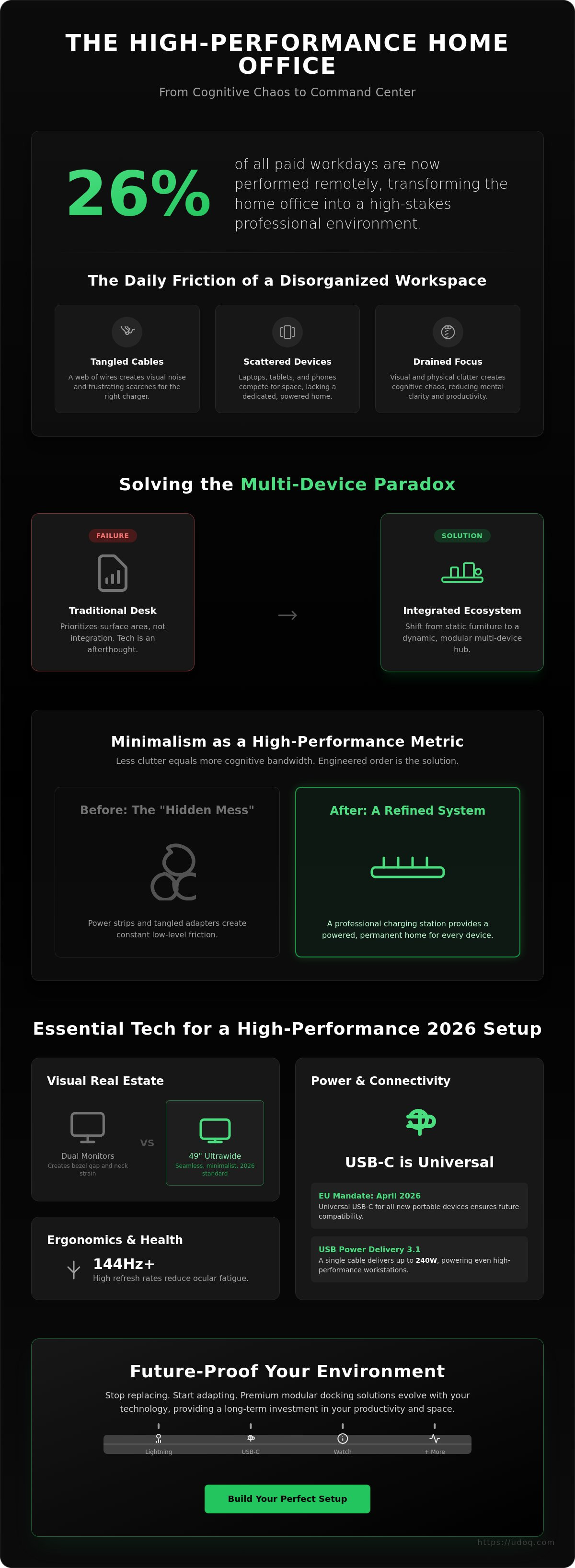
26% of all paid workdays are now performed remotely. This shift has transformed the home office from a temporary corner into a high-stakes command center. You likely feel the daily friction of a cluttered desk. Tangled cables and scattered devices don't just look messy; they drain your focus. A professional home office charging station eliminates this chaos, replacing a web of wires with a refined, functional system.
Transform your workspace into a high-performance, minimalist environment. Achieve a clean aesthetic while ensuring every device stays powered and accessible. The goal is total order. Eliminate the frustration of mismatched chargers and reclaim your mental clarity through superior design. It's time to invest in a setup that respects your time and your space.
Discover how modular organization and 2026 tech standards, like the April 28 EU mandate for universal USB-C charging, allow you to build a desk that evolves. We'll explore the GaN innovations and modular setups that turn your workspace into a professional, "Instagram-ready" ecosystem built for long-term productivity.
Key Takeaways
- Resolve the 2026 multi-device paradox by moving beyond traditional desks toward modular ecosystems that eliminate cognitive chaos.
- Balance performance with aesthetics by selecting the right display standards and high-spec computing hubs for your hybrid workflow.
- Transition from hiding cables to organizing them with a streamlined home office charging station designed for immediate accessibility.
- Define functional workspace zones to separate high-intensity focus from restorative breaks while optimizing task lighting.
- Future-proof your environment with premium modular docking solutions that adapt to evolving technology rather than requiring replacement.
The Evolution of the 2026 Home Office: Beyond Just a Desk
The 2026 professional manages a fleet of devices. Smartphones, tablets, and wearable tech are now standard work tools. This creates the "Multi-Device Paradox." While our tools are more powerful, they often create a fragmented mental state. More gadgets lead to more cognitive chaos. Traditional desks fail because they prioritize surface area over systemic integration. The Evolution of the Home Office reveals a shift from static furniture to dynamic, multi-device hubs.
Traditional desk setups fail to support modern hybrid workflows because they treat tech as an afterthought. Most furniture is designed for a single monitor and a keyboard. In 2026, your workflow is fluid. You move between devices constantly. A standard desk doesn't account for the specialized power needs of high-performance laptops or the constant accessibility required for mobile tools. A professional home office charging station replaces the "hidden mess" of power strips with a refined, industrial solution. It's about engineering a workspace where every device has a powered, permanent home.
To better understand how to power a modern ecosystem, watch this breakdown:
The Rise of the Professional Mobile Tier
Phones and tablets are no longer secondary devices. They are professional displays. They handle security keys, video calls, and real-time dashboards. This shift demands a sophisticated home office charging station. Visibility is key. Ergonomic viewing angles are a 2026 requirement. Don't reach for your device; look at it. Professional systems like the udoq collection utilize high-grade materials and technical precision to ensure your mobile tier is always active and aligned with your primary display. These are long-term investments in your digital environment.
Minimalism as a High-Performance Metric
Minimalism is a performance tool. Visual noise reduces focus. It's a simple equation; less clutter equals more cognitive bandwidth. Engineered order is the solution. It reflects a meticulous approach to detail and fine craftsmanship. It eliminates the friction of tangled wires and missing connectors. When you sit down at a desk that is perfectly organized, your brain enters a state of readiness. You don't waste time swapping cables or moving hardware to make space. True minimalist productivity ensures every tool is charged and accessible. This isn't a trend. It's a commitment to longevity and mental clarity.
Essential Tech Components for a High-Performance 2026 Setup
High performance in 2026 requires a shift from individual gadgets to a cohesive hardware ecosystem. Your desk is no longer a collection of parts; it's a professional platform. The display is your primary interface. While dual monitors provide clear application segregation, the 2026 standard favors the 49-inch Ultrawide for its seamless visual continuity. It reduces the neck strain caused by the bezel gap and aligns with a minimalist aesthetic. This setup maximizes your field of view without the physical clutter of multiple stands.
Laptops drive the modern workflow. With the EU mandate requiring USB-C for all new portables as of April 2026, universal compatibility is finally a reality. These machines now leverage USB Power Delivery 3.1, allowing a single cable to provide up to 240W of power. It's enough for high-performance workstations that previously required proprietary bricks. Your power source is no longer a peripheral. It is the foundation. A high-quality home office charging station ensures this power is distributed with technical precision, protecting your hardware investment while keeping the desk surface clear.
Visual Real Estate and Ergonomics
Refresh rates are a critical health metric. High refresh rates, such as 144Hz or 240Hz, are now standard for reducing ocular fatigue during ten-hour shifts. Combine this with gas-spring monitor arms to lift displays off the desk surface. This creates space for modular tools and essential hardware. Adhering to ergonomic workspace design prevents chronic strain. It turns your office into a sustainable environment for long-term productivity. Integrate adjustable task lighting to maintain visual clarity regardless of the time of day.
The Connectivity Hub: Thunderbolt and USB-C
Single-cable solutions are non-negotiable. One connection must handle 80Gbps data transfer, 8K video, and high-wattage power. This is the baseline for USB4 2.0. Understanding these standards is vital for future-proofing your setup. Read The Ultimate Guide to USB-C to master these technical protocols. Moving away from cheap plastic dongles is the first step toward engineered order. Transitioning to integrated home office charging stations allows you to dock your laptop and mobile devices in one fluid movement. It's the pinnacle of workspace efficiency.
Tactile Professional Essentials
Peripherals are the physical touchpoints of your work. Mechanical keyboards offer tactile feedback that reduces typing errors and finger fatigue. Pair this with a precision mouse featuring high DPI for pixel-perfect adjustments. These tools should reflect the same build quality as your charging infrastructure. Avoid disposable trends. Choose hardware that offers longevity and material durability. When your tools feel reliable, your focus remains on the task rather than the equipment.
Solving the Cable Chaos: Advanced Organization Strategies
Hiding cables is a flawed strategy. Most office guides suggest under-desk trays or boxes to conceal the mess. This approach fails for the modern mobile tier. If a cable is buried in a tray, it is inaccessible. You cannot easily move a tablet or swap a connector when the hardware is hidden. True effective cable management is about accessibility, not just invisibility. It requires a system where connectors are ready for use without the physical tangle.
The "One-Device-One-Outlet" problem is a primary source of desk chaos. Every new gadget traditionally demands its own power brick and wall socket. In 2026, this is inefficient. A professional home office charging station streamlines your electrical footprint. It consolidates multiple power requirements into a single, high-output source. This eliminates the need for bulky power strips on the floor. It brings order to the desk surface by ensuring that power is delivered exactly where the device sits. This is systemic order in action.
Modular vs. Fixed Charging Solutions
Fixed charging stands are static. They are designed for specific device sizes and connector types. When you upgrade your phone or switch to a different tablet brand, a fixed stand becomes obsolete. Modular rail systems offer a superior alternative. They allow you to slide, swap, and add connectors as your hardware evolves. This adaptability is a hallmark of premium engineering. It ensures your setup remains functional for years. To understand which system fits your workflow, consult The Ultimate Guide to Choosing a Charging Station. Modularity is the only way to future-proof a professional workspace.
Materiality and Design Language
Plastic accessories degrade the aesthetic of a high-end office. They feel temporary. High-performance environments require materials that match the industrial design of professional hardware. Aircraft-grade aluminum is the standard. It provides exceptional durability and natural heat dissipation. This is critical when fast-charging multiple high-capacity devices simultaneously. Aluminum doesn't just look better; it performs better. It reflects a commitment to quality and longevity. Your organization tools should be a long-term investment. Choose materials that mirror the sleek, minimalist finish of your primary workstation. A professional home office charging station built from solid metal provides the psychological relief of a permanent, stable environment.
Eliminate physical friction. Every cable should have a dedicated path. Every connector should be precisely positioned. This level of detail separates a temporary WFH corner from a professional command center. When your cables are managed with technical precision, your focus remains entirely on your work. Chaos is replaced by clarity.
Designing Your Aesthetic and Functional Workspace Zones
Productivity requires spatial discipline. A professional desk is not a flat surface for storage; it is a series of active zones. Dividing your workspace into a Focus Zone, a Power Zone, and a Break Zone prevents the mental fatigue of context switching. The Focus Zone remains clear of clutter, reserved for your primary display and input devices. The Break Zone is an intentional area away from the screen. Finally, the Power Zone centralizes your hardware, ensuring your home office charging station is accessible but never intrusive. This structural approach mirrors high-end industrial design by prioritizing flow and utility.
Negative space is a functional requirement. An overcrowded desk increases cortisol and reduces cognitive bandwidth. Resist the urge to fill every square inch. Instead, leave open areas to allow for physical movement and mental breathing room. Lighting serves as a critical productivity tool. Combine natural light to maintain your circadian rhythm with adjustable task lighting for high-intensity work. This balance reduces eye strain and signals to your brain when it is time to perform. Personalization should add character without compromising order. Choose one or two high-quality items that reflect your personality rather than a collection of distracting trinkets.
The Power Zone: Centralizing Your Devices
Position your charging hub to the side of your primary monitor. This keeps your mobile tier within your peripheral vision for notifications while clearing the foreground for deep work. To achieve a truly professional environment, apply a minimalist desk setup philosophy. This removes unnecessary cables from your line of sight. For those seeking to reclaim 100% of their desk surface area, consider a wall-mounted charging rail. Utilizing the udoq WALL MOUNT allows you to elevate your devices entirely, turning your hardware into a clean, vertical display that remains fully functional and powered.
Acoustics and Sensory Focus
Sensory optimization is the final frontier of performance. In a 2026 home office, active noise-canceling technology is essential for maintaining a deep-focus state. Pair this with premium desk mats. A heavy, felt or leather mat improves mouse glide and dampens the acoustic "clack" of mechanical keyboards. These small details contribute to a sense of premium calm. Air quality and scent also play a role. A clean, well-ventilated space with a neutral or subtle scent profile prevents the midday slump. When every sense is accounted for, your workspace becomes a high-performance ecosystem rather than just a place to sit.
Engineered order provides psychological relief. Eliminate the chaos of scattered hardware and reclaim your mental clarity. Explore modular charging systems to build your ideal Power Zone today.
Future-Proofing Your Setup with Modular Docking Solutions
Disposable tech accessories are a hidden cost of the modern workspace. Most chargers are designed for a single device generation. When the connector changes, the accessory becomes waste. This cycle is both financially inefficient and environmentally damaging. German engineering offers a different path. It prioritizes build quality and mechanical innovation. A premium home office charging station should be a one-time investment. It must evolve with your hardware rather than requiring replacement every few years. This approach values your time and your physical environment.
Adaptability is the udoq signature. As the industry transitions fully to USB-C following the April 2026 EU mandate, older Lightning or Micro-USB devices still require support. A modular system handles these shifts effortlessly. You don't buy a new dock; you simply swap a cable. This is systemic longevity. It positions your workspace as a stable environment in a constantly changing tech landscape. By choosing hardware that respects industry standards while remaining flexible, you eliminate the friction of technical obsolescence.
The udoq Advantage: Patented Modularity
The udoq rail system is a mechanical breakthrough. It allows for instant device and connector swapping. Slide in a new C-CABLE or L-CABLE in seconds. This patented design ensures your setup is never obsolete. You can charge up to 10 devices from a single outlet safely and efficiently. This level of power consolidation is unmatched by traditional power strips or cheap plastic hubs. For those who prioritize health and connectivity, the udoq 400 premium watch integration keeps your wearable tech powered and visible. It ensures every professional tool has a dedicated, powered home.
Sustainability Through Longevity
True sustainability comes from products that stay out of landfills. Choosing a system that lasts a decade is a professional and ethical choice. It's a move away from the "hidden mess" of disposable tech. Invest in an aluminum foundation that grows with your needs. This is the definition of a "forever dock." It anchors your 2026 setup with a sense of permanence and prestige. You aren't just buying a tool; you're investing in a long-term system for your environment. Explore the udoq collection to anchor your 2026 setup with engineered order and superior build quality.
A tidy environment provides the psychological relief necessary for deep work. By centralizing your mobile tier and future-proofing your power source, you reclaim your focus. The transition from chaos to clarity is immediate. Your workspace becomes a reflection of your professional standards. Choose quality. Choose longevity. Build a setup that lasts as long as your career.
Master Your Professional Environment
Your workspace is a direct reflection of your professional standards. Transitioning from a cluttered desk to an engineered ecosystem is the ultimate productivity upgrade. You've seen how modularity solves the 2026 multi-device paradox. By centralizing your mobile tier and embracing universal standards, you reclaim both physical space and mental bandwidth. A premium home office charging station is the final piece of this high-performance puzzle. It turns a chaotic surface into a streamlined command center where every tool has a purpose and a place.
Order is a long-term investment. udoq relies on patented German engineering and sustainable aluminum construction to ensure your setup evolves with you. These systems remain compatible with all mobile brands; they provide a permanent solution for a shifting tech landscape. Eliminate the friction of disposable accessories and mismatched cables. Choose a foundation that values longevity, technical precision, and meticulous craftsmanship. It's a commitment to your professional environment that pays dividends in focus every single day. Don't settle for temporary fixes when you can have a permanent system.
It's time to transform your environment into a sanctuary of clarity. Build your custom 2026 docking station today and experience the psychological relief of total organization. Your best work begins at a desk designed for excellence. Step into the future of productivity with confidence and style.
Frequently Asked Questions
What are the best tech setup ideas for a small home office in 2026?
Verticality and modularity are essential for small spaces. Reclaim your desk surface area by using wall-mounted rails or gas-spring monitor arms. A vertical home office charging station allows you to dock multiple devices in a minimal footprint. This approach prevents the visual clutter that often overwhelms smaller rooms. Focus on multi-functional tools that serve several purposes to minimize the number of physical objects on your desk.
How do I hide cables on my desk without making them hard to reach?
Use a rail-based system rather than traditional under-desk trays. Trays hide cables but make them inaccessible for daily use. A modular charging rail keeps connectors at the desk level, perfectly aligned and ready for immediate connection. This method eliminates tangles while ensuring you don't have to crawl under furniture to swap a cable. It creates a clean aesthetic where wires are organized and always available for your mobile tier.
Is a modular docking station worth the investment compared to cheap hubs?
Modularity offers longevity that disposable hubs cannot match. Cheap plastic hubs often fail or become obsolete when connector standards change. A premium modular system allows you to swap individual cables or adapters as your hardware evolves. This prevents the financial and environmental cost of replacing the entire unit. It's a long-term investment in your workspace stability and technical precision that respects both your time and your budget.
How can I integrate both Apple and Android devices into one workspace?
A universal rail system is the most efficient solution for mixed-brand environments. You can slide in a C-CABLE for Android devices and an L-CABLE or MAGNETIC ADAPTER for Apple hardware on the same track. This eliminates the need for separate chargers and keeps all devices powered in one central location. It provides a cohesive look for your home office charging station regardless of the manufacturer of your smartphone or tablet.
What is the most important ergonomic accessory for WFH productivity?
An adjustable monitor arm is the most critical ergonomic tool. It allows you to position your primary display at eye level to prevent chronic neck strain. Lifting the monitor also creates negative space on the desk surface for your input devices and organization tools. Combine this with a high-quality desk mat to dampen sound and improve tactile feedback. These adjustments turn a standard desk into a sustainable professional environment for long-term health.
How do I future-proof my desk setup for new charging standards like Qi2 or USB4?
Choose a system that uses interchangeable connectors rather than fixed ports. As standards like USB4 2.0 or Qi2 become the baseline, a modular rail allows you to upgrade specific adapters without rebuilding your entire setup. This adaptability is the core of future-proofing. It ensures your workspace remains compatible with high-speed data and 240W power delivery as new hardware enters the market. Invest in a system that evolves with technology.