A cluttered workspace is more than an eyesore; it's a cognitive drain that can reduce your deep-work efficiency by 21 percent. You likely appreciate the intent behind your magsafe charger, yet the reality often involves devices sliding off weak magnets and heat-induced throttling that significantly extends your downtime. High-end technology deserves a mounting solution that reflects its caliber rather than a tangle of plastic cables.
This guide provides the technical clarity you need to choose a setup that balances 15W performance with the minimalist elegance of anodized aluminum. You'll learn how to eliminate desk chaos while ensuring your hardware receives the fastest, most stable power delivery possible. We will examine the evolution from basic magnetic pucks to patented modular docking tracks, giving you a blueprint for a professional environment that remains future-proof through 2026 and beyond.
Key Takeaways
- Master the mechanics of magnetic alignment and thermal management to ensure peak charging efficiency for your devices.
- Contrast the flexibility of standalone pucks with the professional stability of integrated, modular docking stations.
- Select a magsafe charger setup that accommodates your full device inventory and preferred viewing orientation.
- Discover how patented German engineering transforms cable chaos into a future-proof, organized workspace.
Understanding MagSafe Technology: More Than Just a Magnet
MagSafe represents the refined evolution of the MagSafe wireless charging standard, utilizing a ring of Neodymium magnets to perfect the connection between device and power source. Traditional Qi charging often suffers from misalignment. A shift of just a few millimeters can increase heat and slash energy efficiency by 50 percent. MagSafe eliminates this variable. It ensures the induction coils are perfectly centered every time you set your phone down. This snap-to-align functionality provides the relief of a guaranteed charge, removing the frustration of waking up to a dead battery.
Explore the practical application of magnetic accessories and alignment in this detailed field test:
Official "Made for MagSafe" hardware includes an integrated NFC chip. This silicon component authenticates the charger, unlocking speeds up to 25W on the latest iPhone 17 models. In contrast, "MagSafe Compatible" alternatives are essentially standard Qi chargers with magnets attached. These are usually limited to 7.5W. Choosing certified hardware ensures your magsafe charger operates at peak performance without thermal throttling. German engineering standards prioritize this efficiency, as heat is the primary enemy of long-term battery health.
The 2026 Standard: MagSafe vs. Qi2
The industry has finally embraced magnetic unity. Qi2 is the open standard based on Apple's Magnetic Power Profile. It brings magnetic alignment to the broader smartphone market, offering 15W speeds to both Android and iOS users. For owners of the iPhone 12 through the iPhone 17, this means a wider array of high-quality peripherals. Precision alignment remains the primary defense against energy loss. It ensures that 100 percent of the power intended for your device actually reaches the battery.
Why Your Choice of Adapter Matters
Your magsafe charger is only as capable as the wall plug feeding it. To achieve the maximum 25W output, a 30W or higher USB-C Power Delivery (PD) adapter is mandatory. The iPhone and charger perform a digital handshake to negotiate the safest maximum current. Avoid uncertified, low-quality magnets found in bargain accessories. Poorly shielded magnets can interfere with internal Hall effect sensors and digital compasses. For a professional, clutter-free environment, integrate these components into charging stations that maintain order and aesthetic harmony. Invest in quality to ensure your ecosystem remains future-proof and functional.
Performance & Speed: Comparing MagSafe Charger Capabilities
Speed is a variable, not a constant. Your magsafe charger doesn't deliver a flat rate of power from zero to 100%. Power delivery follows a specific curve. It peaks during the first 50% and tapers off significantly once the battery reaches 80% to preserve cell longevity. By 2026 standards, the final 20% of a charge takes nearly as long as the initial half of the session because the device prioritizes chemical stability over raw speed.
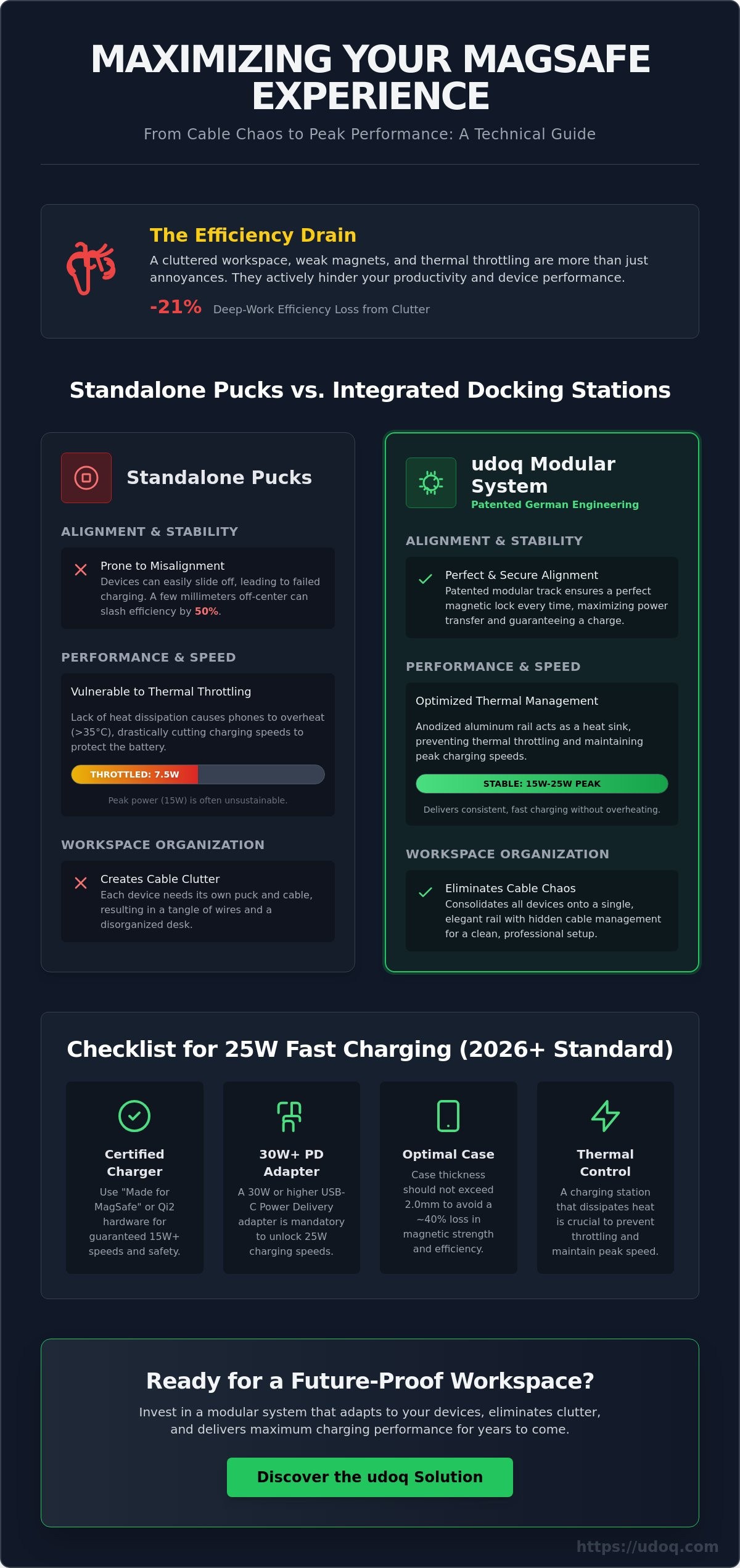
Heat is the primary enemy of efficiency. When internal temperatures exceed 35°C (95°F), the iPhone triggers thermal throttling. This safety mechanism can slash your 25W peak down to 7.5W in seconds. Cable length also dictates performance. Standard 1-meter cables offer the lowest resistance. Retail 2-meter versions require thicker internal copper to prevent voltage drop. If your case exceeds 2.0mm in thickness, you lose roughly 40% of magnetic alignment strength. This misalignment forces the induction coils to work harder, which generates more waste heat and slows the process.
25W Fast Charging Requirements
The 2026 standard for the iPhone 17 Pro requires a 25W MagSafe peak. To achieve this, your hardware must support the Power Delivery (PD) 3.1 protocol. A 20W adapter is now obsolete for professional fast wireless charging. A 30W+ adapter is the new baseline. This provides the necessary headroom for the magsafe charger to negotiate the maximum handshake without straining the power source. Using a lower-wattage brick will result in a 15W cap, regardless of the charger's theoretical capacity.
Battery Health and Magnetic Charging
Myths about magnets damaging batteries persist, but they're unfounded. Modern shielding ensures that the magnetic array has zero impact on lithium-ion chemistry. Performance concerns usually stem from heat, not magnetism. You can review the FCC guidelines on RF exposure for details on how wireless devices are regulated for safety. Smart software now manages these cycles by holding the charge at 80% during the night, only finishing the cycle before your morning alarm.
Elevation is a functional solution for thermal management. Using a vertical stand allows for passive air cooling across the device's rear surface. This configuration dissipates heat 15% more effectively than a flat puck on a desk. For a setup that prioritizes both speed and thermal health, consider a modular charging station that keeps your device upright. German engineering ensures your workspace remains clutter-free and optimized for performance.
The Comparison: Standalone Pucks vs. Integrated Docking Stations
The standard magsafe charger puck is a study in compromise. It offers magnetic alignment but forces a "loose cable" lifestyle that disrupts a professional workspace. When you lift your phone, the puck often remains attached, dragging the cable across your desk and requiring a second hand to peel it off. This friction is a minor but constant tax on your focus. A dedicated docking station eliminates this through mass and gravity. By securing the charging element within a heavy frame, you achieve true one-handed operation. Your phone detaches with a simple lift, leaving the charger exactly where it belongs.
Static 3-in-1 "tree" chargers offer a temporary solution to clutter, but they lack long-term flexibility. These fixed structures cannot adapt when Apple changes device dimensions or sensor placements. Modular rail systems represent the superior choice for long-term value. Instead of a rigid plastic arm, a modular dock utilizes a patented sliding track. You can reposition, add, or swap connectors as your device lineup evolves. This adaptability turns a simple power source into a future-proof piece of infrastructure.
Aesthetic impact goes beyond simple organization. Physical clutter competes for your cognitive resources. A 2021 study by researchers at Princeton University confirmed that a chaotic environment limits your brain's ability to process information. A single, streamlined dock replaces the "cable nest" of three or four separate wires, creating a calm environment that fosters deep work and professional productivity.
The Hidden Cost of Cheap Magnetic Chargers
Low-cost chargers often feature fixed, non-replaceable cables. When the internal copper frays at the stress point, the entire unit becomes e-waste. This "disposable tech" cycle contributes to the 50 million tons of electronic waste generated annually. Choosing German-engineered anodized aluminum over cheap plastic is a commitment to sustainability. Aluminum doesn't just look better; it dissipates heat more effectively and resists the structural fatigue that causes plastic docks to crack after 18 months of daily use.
Multi-Device Management
Powering an iPhone, Apple Watch, and AirPods simultaneously shouldn't require three separate wall outlets. A multi device charging station streamlines this process into a single-entry power source. This minimalist approach cleans up the visual noise of your desk and ensures every device is ready when you are. By consolidating your power needs, you reclaim your workspace and simplify your daily routine. Discover the efficiency of a unified system through our premium charging stations designed for the modern professional.
Designing Your Workspace: How to Choose the Right Magnetic Setup
Your workspace isn't a junk drawer. It's a cockpit. Choosing the right magnetic setup requires a cold assessment of your current hardware. If you charge a tablet alongside an iPhone, a single puck won't suffice. You need a modular system that handles multiple power profiles. Modern workflows in 2026 often involve an iPhone 18 and an iPad Pro; your dock must accommodate both without creating a footprint that consumes your entire desk.
Think about your viewing angle. iOS StandBy mode transformed the iPhone into a bedside clock and productivity dashboard. This requires a horizontal orientation. If you prioritize reading Slack notifications while typing, a vertical mount is superior. High-end docks offer the flexibility to switch between these modes instantly. This isn't just about convenience. It's about how you consume data during your 9-to-5 grind.
Material choice is a technical decision, not just an aesthetic one. Plastic chargers trap heat and degrade over time. Anodized aluminum is the industry standard for premium tech. It acts as a natural heat sink for your magsafe charger, maintaining peak 15W charging speeds without thermal throttling. It's a choice for longevity. Aluminum doesn't just look better; it protects your battery health by managing temperatures more efficiently than synthetic alternatives.
Portability is the final factor. Does your dock need to travel, or is it a fixed anchor? A 500-gram solid aluminum base provides the stability needed for one-handed device removal. If you're a digital nomad, a foldable magnetic puck is better. For the professional office, a fixed station ensures your devices always have a designated home.
Minimalist Desk Setup Essentials
A minimalist desk setup relies on the total absence of visual noise. Chaos begins with cables. Premium docking stations hide these wires within a patented track system, leaving only the clean lines of your devices. Using a magnetic adapter allows you to integrate older tech into this modern, unified station. It bridges the gap between generations, ensuring your workspace remains functional as standards evolve. You don't need five different cables; you need one intelligent system.
Wall Mounting vs. Desk Placement
Desk real estate is finite. If your surface is crowded, move your power source to the wall. The udoq WALL MOUNT clears your desk entirely. It places your magsafe charger and device at eye level, which is the optimal ergonomic position for video calls. This vertical shift is essential for small offices under 100 square feet. It prevents the "desk creep" where cables slowly take over your primary work zone. A wall-mounted system is a statement of order and German engineering precision.
Invest in a system that grows with your technology. Discover our modular charging stations
The udoq Solution: Future-Proofing with the Magnetic Adapter
The evolution of the magsafe charger has reached its peak with the udoq patented sliding track system. While standard pucks clutter your desk, our rail-based architecture provides a permanent, elegant home for every device. The MAGNETIC ADAPTER seamlessly integrates MagSafe technology into this modular ecosystem. It allows you to position your iPhone at the perfect viewing angle while it draws power. You aren't locked into a single configuration. As mobile standards shift, you simply slide out the old connector and slide in the new one. This adaptability ensures your investment remains relevant for years.
The POWER series takes this efficiency further with its "One Outlet, Ten Devices" capability. A single wall plug feeds a hidden internal hub, distributing power to multiple units simultaneously. It eliminates the need for a dozen separate bricks. Your workspace stays clean. Your workflow remains uninterrupted. It's a sophisticated solution for those who value order and technical precision.
German Engineering Meets Modular Design
Precision defines every udoq dock. We use high-grade anodized aluminum, a material chosen for its durability and superior heat management. Unlike plastic docks that trap warmth, our aluminum rails act as a heat sink to protect your battery health. This design philosophy ends cable spaghetti forever. All wires are tucked away inside the profile. The udoq 250 POWER serves as a compact foundation for essential magnetic charging. It fits perfectly on nightstands or small desks. It proves that high performance doesn't require a large footprint. You get the relief of a clear surface and the confidence of German engineering.
Sustainable Tech for the Design-Conscious
Disposable tech is a relic of the past. A modular dock is the last charging station you'll ever need to buy. When you upgrade from Lightning to USB-C, or as your magsafe charger requirements change, the dock stays. You only replace the small adapter. This system grows with your family or your business. If your team expands or your device count increases, you can scale your setup without discarding the original hardware. It's a sustainable approach to a high-tech lifestyle. Experience the relief of a clutter-free environment. Discover the udoq collection of modular charging stations and reclaim your space today.
Master Your Magnetic Desktop Ecosystem
Choosing the right magsafe charger is no longer just about buying a cable; it's an investment in your daily productivity. We've explored how 15W peak performance depends on precise thermal management and why modularity wins over disposable tech in 2026. A single, static puck often leads to desk clutter. A unified station brings order to your digital life. Your workspace should adapt as quickly as your devices do.
The udoq system utilizes Patented German Engineering to ensure your setup remains relevant through every hardware cycle. Our anodized aluminum rails provide superior heat dissipation compared to generic plastic alternatives, protecting your battery longevity across multiple device generations. This modular design supports all brands, allowing you to slide, swap, and add connectors in seconds. It's a sustainable solution designed to end the cycle of electronic waste once and for all.
Don't settle for a tangled mess of wires. Build your custom udoq charging station today and experience the relief of a perfectly organized desk. You're ready to power up with professional precision.
Frequently Asked Questions
Is a MagSafe charger faster than a standard USB-C cable?
No, a wired USB-C connection remains faster than a magsafe charger for rapid power delivery. While the 2024 MagSafe standard for iPhone 16 supports up to 25W, a standard USB-C cable paired with a 30W adapter can reach a 50% charge in approximately 30 minutes. MagSafe prioritizes the relief of a cable-free desk and perfect magnetic alignment over maximum charging speed. It's the ideal solution for maintaining a minimalist workspace while ensuring your device stays powered.
Can I use a MagSafe charger with an Android phone?
Yes, you can use magnetic chargers with Android devices that support the Qi2 interface released in 2023. Older Android models lack internal magnets, so they require a specialized magnetic ring adapter or a compatible case to snap into position. While the magnetic connection provides stability, charging speeds often default to the standard 7.5W or 15W Qi limit depending on your specific phone hardware. It's a versatile way to bring German engineered order to a multi-device household.
Do MagSafe chargers work through thick phone cases?
No, MagSafe technology generally requires a case thickness of less than 2mm to maintain a reliable connection. Thick, rugged cases or those constructed from non-conductive materials like heavy wood or leather often block the magnetic pull and hinder induction efficiency. For the best results, choose a MagSafe-compatible case with built-in magnets. This ensures your phone remains securely attached to your udoq dock even when mounted at a vertical angle for easy viewing.
Why does my MagSafe charger get warm while charging?
Heat is a standard byproduct of the electromagnetic induction process, which typically operates at 70% to 80% efficiency. The energy that isn't transferred to your battery is dissipated as heat through the charger's surface. High-quality systems include thermal sensors that throttle power if internal temperatures exceed 35 degrees Celsius. This intelligent management protects your battery's long-term health. Our anodized aluminum docks help dissipate this heat more effectively than plastic alternatives, keeping your tech cool and safe.
What is the difference between Qi2 and Apple MagSafe?
Qi2 is an open industry standard that was built using Apple's proprietary MagSafe specifications as a foundation. Announced by the Wireless Power Consortium in January 2023, Qi2 uses a Magnetic Power Profile to bring universal alignment to both iPhone and Android users. While MagSafe was originally a closed ecosystem, Qi2 allows all manufacturers to achieve 15W charging with magnetic precision. It represents a significant step toward a future-proof, one-for-all charging environment for every mobile professional.
Is it safe to leave my iPhone on a magnetic charger overnight?
It's entirely safe to leave your iPhone on a magsafe charger throughout the night. Modern devices utilize sophisticated software like Apple's Optimized Battery Charging, which was introduced in iOS 13 to manage power intake. The system often pauses charging at 80% and completes the final 20% just before you typically wake up. This prevents the battery from sitting at maximum capacity for extended periods. It reduces chemical aging and ensures your device is ready for the day ahead.
How many devices can I charge at once with a udoq docking station?
A udoq docking station can accommodate between 4 and 8 devices depending on the length of your chosen rail. For example, our 400mm rail easily fits four large smartphones or a combination of tablets and e-readers. Our patented sliding track system allows you to add or move connectors as your device collection evolves. This modular approach ensures your charging station remains a long-term investment. You can organize your entire digital life on a single, clutter-free platform.
Can a MagSafe charger damage the credit cards in my phone wallet?
Yes, the magnets in a charger can potentially demagnetize credit cards that rely on traditional magnetic strips if they're placed directly against the charging coil. You should remove your wallet or use a shielded MagSafe-branded wallet to protect your data. Most modern cards use EMV chips which are resistant to magnetic interference, but hotel keys and transit passes are still highly vulnerable. Always ensure there's no physical card between the back of your phone and the magnetic puck during power transfer.