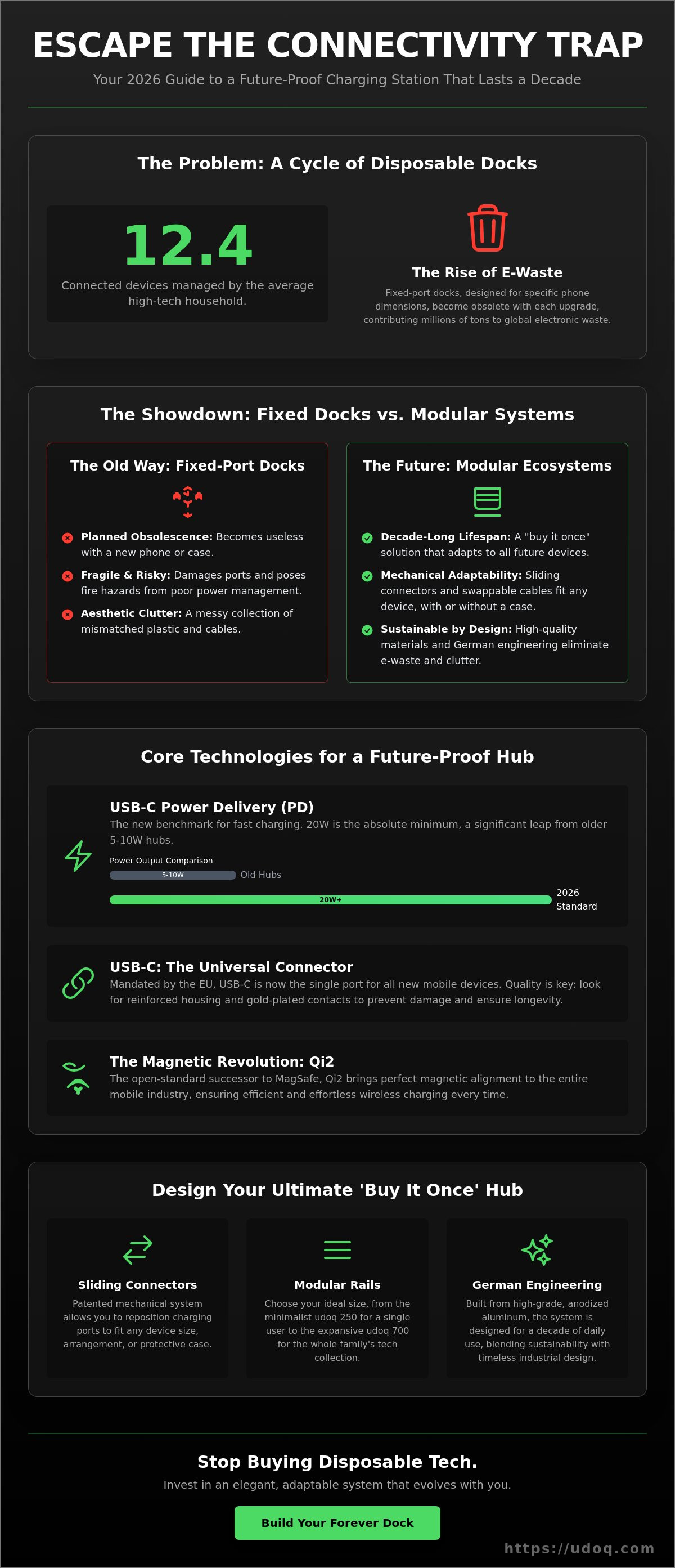
Why are you still buying a new charging dock every time you upgrade your phone? With the average high-tech household now managing 12.4 connected devices, the cycle of disposable plastic stands and mismatched cables has become an expensive burden. Finding a truly future-proof charging station for new phones shouldn't feel like a gamble against the next industry standard. You deserve a refined environment where technology serves your aesthetic, not the other way around.
We understand the frustration of the connectivity trap. It's exhausting to deal with docks that don't fit your new case or hubs that offer sluggish speeds. This 2026 guide reveals how to invest in a modular charging ecosystem that adapts to every new release, eliminating e-waste and clutter forever. We will break down the essential technical standards, from USB PD 3.1 power delivery to Qi2.2 wireless speeds, and show you how to build a "buy it once" solution that lasts a decade. Discover how a single, elegant hub can provide one-handed docking for every current and future device in your collection.
Key Takeaways
- Identify the "Connectivity Trap" where fixed-port docks fail and learn why mechanical adaptability is the only cure for planned obsolescence.
- Master the 2026 standards by integrating USB-C Power Delivery and Qi2 wireless charging into a single future-proof charging station for new phones.
- Discover the benefits of sliding connectors and modular rails that allow you to swap cables and reposition devices as your tech collection evolves.
- Calculate your ideal hub size, from the minimalist udoq 250 to the expansive udoq 700, ensuring every tablet and phone has a dedicated place.
- Explore the intersection of German industrial design and long-term sustainability through a system built for a decade of daily use.
Why Most Charging Stations Become Obsolete Within Two Years
Mobile accessory cycles are notoriously short. Most users replace their devices every two to three years. Unfortunately, the accessories they buy are often designed to fail even sooner. This is the hallmark of planned obsolescence. A standard dock is built for the phone you have today, not the one you'll own in 2027. When you search for a future-proof charging station for new phones, you're looking for a departure from this disposable culture.
Fixed-port docks are electronic dead ends. They rely on rigid, molded plastic that accommodates a specific device thickness and port location. If your next phone is slightly wider or uses a thicker protective case, that expensive stand becomes e-waste. This cycle contributes to the millions of tons of electronic waste generated globally. True sustainability requires a shift from fixed electronics to mechanical modularity.
To visualize how modern charging hubs are evolving to meet these challenges, watch this overview of contemporary charging technology:
The Problem with Fixed-Port Designs
A molded plastic dock is a ticking clock for your desk. Manufacturers often change device dimensions by mere millimeters. Even a 1mm increase in phone thickness can render a fixed dock useless. Connector alignment is equally fragile. If the internal port isn't perfectly centered, you'll find yourself wiggling the device just to initiate a charge. This stress eventually damages both the dock and your phone's charging port. It's a design flaw that prioritizes cheap manufacturing over user longevity.
The True Cost of Cheap Multi-Port Chargers
Budget hubs found on mass-market sites often hide significant risks behind low prices. Poor power distribution is common. This leads to overheating or even fire hazards in extreme cases. These stands rarely hit advertised speeds because they lack sophisticated power management. Beyond technical failures, there's an aesthetic clutter tax. A desk filled with mismatched cables and plastic stands creates mental chaos. High-end solutions prioritize the Qi wireless charging standard alongside modular physical connections to ensure long-term viability. By choosing a future-proof charging station for new phones, you invest in a tidy, high-performance environment that respects your time and your physical space. You can explore these adaptable designs in our charging station collection to see the difference that precision engineering makes.
Essential Standards for a 2026 Future-Proof Setup
Modern power requirements have evolved. A future-proof charging station for new phones must support more than just basic connectivity; it requires technical precision. USB-C Power Delivery (PD) is now the benchmark. While older hubs provided a mere 5W or 10W, 20W has become the absolute minimum for efficient smartphone charging in 2026. High-end devices often demand even more to reach full capacity quickly. Without this standard, your sleek new hardware will spend hours tethered to a slow hub, defeating the purpose of advanced battery technology.
USB-C: The Universal Connector of 2026
The transition is complete. Following the EU common charger directive, which mandated a single port for all mobile devices, USB-C is now the mandatory standard for new phones. This shift ensures long-term utility for the udoq C-Cable. High-quality connectors are essential. Look for cables with reinforced housing and gold-plated contacts to prevent the fraying and oxidation common in budget alternatives. A premium connector doesn't just transfer power; it protects the delicate internal components of your devices.
The Magnetic Revolution: Qi2 and MagSafe
Wireless charging has found its focus. Qi2 is the open-standard successor to Apple's MagSafe technology. It brings magnetic alignment to the entire mobile industry. A truly future-proof charging station for new phones must integrate a magnetic adapter to ensure perfect coil alignment every time. This precision eliminates the heat buildup and energy loss caused by "near-miss" placements. It guarantees consistent charging speeds and provides the psychological relief of a secure, tactile connection.
Legacy support remains a practical necessity. Even as we move toward a USB-C world, many users still rely on older tablets, e-readers, or legacy accessories. A sophisticated hub should offer interchangeable L-Cables or Micro-USB options alongside modern standards. It's about total environment control. You aren't just charging a phone; you're managing a suite of tools. Understanding the dual role of these connectors is vital. While power is the priority, high-speed data transfer capabilities ensure your hub remains relevant as devices become more integrated. To start building your organized workspace, consider the modular options available today. You can explore our precision-engineered systems to find the perfect fit for your evolving tech collection.
Modular vs. Fixed Docks: Evaluating Longevity
Fixed docks are static. They are designed for a single moment in time. A future-proof charging station for new phones requires a dynamic mechanical foundation. While most docks use soldered ports that break under pressure, a modular system uses independent connectors. This allows your hub to evolve as industry standards shift. You don't have to replace the entire unit when a new connector type emerges; you simply swap the cable.
The Sliding Rail Advantage
The patented udoq rail system provides a mechanical solution to a technical problem. It allows you to slide connectors horizontally to accommodate varying device widths and protective cases. This flexibility enables one-handed docking, a hallmark of precision engineering. You don't have to fight with cables or mismatched ports. The system aligns with your device, not the other way around. It turns a chaotic desk into a structured environment.
Scalability is essential for a growing tech collection. You might start with a single phone and later add a tablet or a smartwatch. A fixed hub forces a total replacement. A modular rail allows you to add a new C-CABLE or a MAGNETIC ADAPTER. This adaptability is supported by the USB Power Delivery (USB PD) Specification. This standard ensures your hardware can handle the increased power demands of future devices, up to 240W, without needing a new physical base.
Heat Dissipation and Device Health
Material choice is the silent hero of longevity. Most budget chargers use polycarbonate, which acts as a thermal insulator. Charging, especially at high speeds, generates significant heat. This thermal stress is the primary killer of lithium-ion batteries. Anodized aluminum serves as a natural heat sink. It draws warmth away from your devices, protecting their internal circuitry and extending battery life.
Metal beats plastic every time. Aluminum doesn't just offer a premium feel; it provides structural integrity that lasts a decade. It won't yellow, crack, or warp under the heat of a fast-charging cycle. This "One for All" philosophy allows you to charge an iPhone, an Android device, and a wearable like the udoq 400 simultaneously. It's an investment in order and the long-term health of your electronics. Explore our full range of modular stations to see how industrial design solves the problem of a future-proof charging station for new phones.
How to Design Your Ultimate Charging Hub for New Phones
Designing a future-proof charging station for new phones begins with a meticulous audit of your digital ecosystem. List every device you use daily. Include your primary smartphone, tablet, e-reader, and wireless earbuds. Consider the physical dimensions of each, specifically with their protective cases attached. Many users overlook the "fit" issue. A rugged case can add 3 to 5mm to a device's profile. Your hub must accommodate these variations without compromise. Planning for these physical shifts is the first step toward a permanent organizational solution.
Select a rail length that matches your current needs while allowing for growth. We offer four distinct sizes: the compact udoq 250, the versatile 400, the expansive 550, and the family-sized 700. Each model is crafted from high-grade anodized aluminum. This material choice ensures your hub remains a sophisticated fixture in your home or office for a decade or more. It is an investment in both aesthetic order and technical reliability.
Sizing Your Workspace
Precision starts with the rail. We recommend the udoq 400 for a balanced phone and smartwatch setup. It provides ample lateral space for multiple devices without overwhelming your desk. This choice facilitates a minimalist desk setup by replacing a tangle of wires with a single-cable power supply. For shared family environments or high-traffic areas, consider the udoq 700. If desk space is at a premium, a WALL MOUNT allows you to move your charging hub to a vertical surface, keeping your workspace clear and focused.
Customizing the Connector Mix
Mechanical adaptability is our signature. You can swap an L-CABLE for a C-CABLE in under 30 seconds. This speed ensures your hub evolves as quickly as your hardware. Integrating a WIRELESS ADAPTER or a MAGNETIC ADAPTER offers "drop and go" convenience for Qi2-compatible devices. The internal rail design manages all cable slack. It hides excess wire within the aluminum housing to maintain a seamless, professional look. This eliminates the visual noise of mismatched cords.
Don't build for today alone. Leave a 20% space buffer on your rail to plan for the "Next Phone." Mobile screens have historically trended larger. A 6.1-inch device might be replaced by a 6.9-inch model in your next upgrade cycle. By choosing a slightly longer rail now, you ensure your future-proof charging station for new phones remains relevant. It is a long-term commitment to a clutter-free environment. Configure your personalized charging hub today to experience the psychological relief of a truly organized workspace.
udoq: German Engineering for the Decisive Tech Owner
Designed by Marcus Kuchler, udoq represents a legacy of industrial design excellence. It isn't just a gadget; it's a mechanical system built to outlast your next five devices. When you invest in a future-proof charging station for new phones, you're choosing a solution that rejects the cycle of planned obsolescence. This is the intersection of high-end lifestyle aesthetics and functional tech innovation.
Sustainability is achieved through 10-year durability. By using high-grade aluminum rather than disposable plastic, we reduce e-waste significantly. This material choice also solves a critical technical issue often ignored by competitors: heat dissipation. While plastic docks trap heat and degrade battery health, our aluminum rails act as a passive cooling system. They protect your device's internal circuitry while charging at maximum speeds. It's a professional-grade solution for those who value both performance and longevity.
The udoq 250 to 700 Series
Our entire charging station collection is designed to scale with your ambitions. The udoq 250 offers a compact footprint for bedside tables, while the udoq 700 provides a command center for the whole family. For those with high-wattage requirements, the POWER series integrates multi-port chargers directly into the rail. This ensures that even power-hungry tablets and laptops receive the current they need without cluttering your workspace with extra bricks.
Owning an udoq means owning a patented, original innovation. Our mechanical design is legally protected, ensuring you possess a piece of authentic engineering rather than a generic imitation. This prestige is backed by national manufacturing heritage, providing a level of reliability and superior build quality that mass-produced plastic stands cannot match. It is the last charging station you will ever need to buy.
Invest in Your Environment
Your environment dictates your focus. An organized desk leads to professional productivity, while a tangle of mismatched cables creates subtle, persistent stress. udoq provides the psychological relief of a tidy workspace. It replaces chaos with a singular, elegant hub that works for all current and future devices. It's a statement of order and a commitment to quality craftsmanship.
Premium hardware deserves a premium docking solution. Don't let a $1,000 smartphone sit on a $10 plastic stand. Give your technology the foundation it deserves. Choose a system that evolves with you. It's time to transition to a modular future today and reclaim your physical and mental space.
Master Your Workspace with a Permanent Charging Solution
The cycle of disposable accessories ends with a shift toward mechanical modularity. You've discovered how adaptable design and high-grade materials transform a simple dock into a lifelong investment. By choosing a system that evolves with your hardware, you eliminate the frustration of mismatched cables and the environmental burden of plastic waste. It's the only way to stay ahead of changing industry standards while maintaining a sophisticated aesthetic.
Investing in a future-proof charging station for new phones is more than a technical upgrade; it's a commitment to an organized, high-performance environment. Our systems feature Patented German Engineering and Anodized Aluminum Construction, ensuring they withstand the demands of modern technology for a decade or more. This sustainable approach reduces e-waste by 90% over ten years. It provides the psychological relief that only a truly tidy workspace can offer.
Don't let your desk remain a landscape of clutter. Reclaim your space and protect your devices with a solution designed for the decisive owner. It's time to build a hub that stays relevant through every future upgrade cycle. Build Your Custom Future-Proof Dock Now
Frequently Asked Questions
Will a modular charging station work with my phone case?
Yes, the modular design allows you to adjust the height of the connectors to accommodate any case thickness. Most fixed docks fail when you add a rugged or battery case. Our system ensures a secure connection without requiring you to strip your phone of its protection. It is a precise mechanical solution for a common daily frustration.
How do I change connectors when I get a new phone?
You can swap connectors in under 30 seconds without using any tools. Simply remove the side cap of the rail, slide out the old cable, and insert the new C-CABLE or L-CABLE. This simplicity makes it a truly future-proof charging station for new phones. You update only the internal component, keeping the premium aluminum base for years.
Can I charge an Apple Watch and an Android phone on the same dock?
Yes, the rail system supports any combination of devices simultaneously. You can mix and match a magnetic charging adapter for your watch with a USB-C connector for an Android device. It eliminates brand silos in your home. This universal utility is perfect for households with diverse technology needs.
What is the benefit of a future-proof charging station vs. a standard hub?
The primary benefit is longevity and the elimination of e-waste. Standard hubs are static; they become obsolete the moment a device size or port standard changes. A future-proof charging station for new phones adapts physically and technically. You invest once in a high-quality base that evolves with the industry for a decade or more.
Does udoq support fast charging for the latest iPhone and Samsung models?
Yes, our POWER series and premium cables are designed to meet the latest Power Delivery standards. This ensures your devices receive the maximum wattage they require for rapid charging. We prioritize technical precision to match the high-speed capabilities of your premium hardware. You won't sacrifice performance for organization.
Is it difficult to assemble a modular docking station?
Assembly is intuitive and takes only a few minutes. You simply slide your chosen connectors into the aluminum rail and secure the end caps. It is a one-time process that establishes a permanent home for your devices. We provide clear, visual guidance to ensure your setup is effortless and professional.
How does the sliding rail system work?
The rail acts as a horizontal track that holds your charging connectors in place. You can slide each device left or right to find the optimal spacing for your desk or nightstand. This patented mechanical innovation allows for one-handed docking. It gives you total control over the layout of your charging environment.
Why is aluminum better than plastic for a charging dock?
Aluminum provides superior heat dissipation and structural integrity. Charging generates heat, which is the primary enemy of battery longevity. Our anodized aluminum rails act as a natural heat sink, drawing warmth away from your phone. Unlike plastic, it won't warp, crack, or yellow over time. It is a premium material for a premium environment.