MagSafe is not a charging cable; it is the foundation of a modular, high-performance docking system. Since its October 2020 reintroduction for iPhone, many users still ask what is magsafe while struggling with standard Qi chargers that can lose up to 50 percent of power through simple misalignment. You shouldn't have to choose between fast charging and a clean aesthetic. A cluttered desk is a cluttered mind, and tangled wires are a design failure we no longer need to tolerate.
We recognize the frustration of messy cables and the concern over long-term battery health. This guide provides the technical clarity you need to master Apple's magnetic ecosystem. You'll discover how to integrate these components into a premium, anodized aluminum workspace that prioritizes order and efficiency. We'll also show you how to bring this patented modularity to your non-Apple hardware. It's time to replace chaos with German-engineered precision and create a future-proof charging setup that actually works.
Key Takeaways
- Learn what is magsafe and how this proprietary magnetic standard evolved from a safety feature into a comprehensive device ecosystem.
- Understand the physics of neodymium magnets to eliminate the heat and power loss common in standard wireless charging.
- Identify the technical differences between official certification and magnetic compatibility to ensure peak performance for your hardware.
- Transform your workspace by integrating MagSafe into a patented, modular docking system designed for a clutter-free lifestyle.
Defining MagSafe: From MacBook Safety to iPhone Ecosystem
MagSafe is a proprietary magnetic mounting and charging standard developed by Apple. It represents a shift from simple power delivery to a sophisticated, modular interface. To truly understand what is magsafe, one must look past the magnets to the engineering intent: eliminating human error. It ensures perfect alignment every time, removing the friction of manual adjustment. This technology creates a secure connection that is both easy to attach and effortless to remove.
The technology has evolved significantly since its inception. Looking at the History of MagSafe reveals a legacy of intentional design that prioritizes hardware longevity. Originally a safety mechanism for laptops, it's now a foundational element of the modern smartphone experience. It provides the relief of a secure connection without the clutter of traditional plugs.
To better understand how this technology functions in your daily life, watch this helpful video breakdown:
The Origins: Apple’s Iconic MacBook Connector
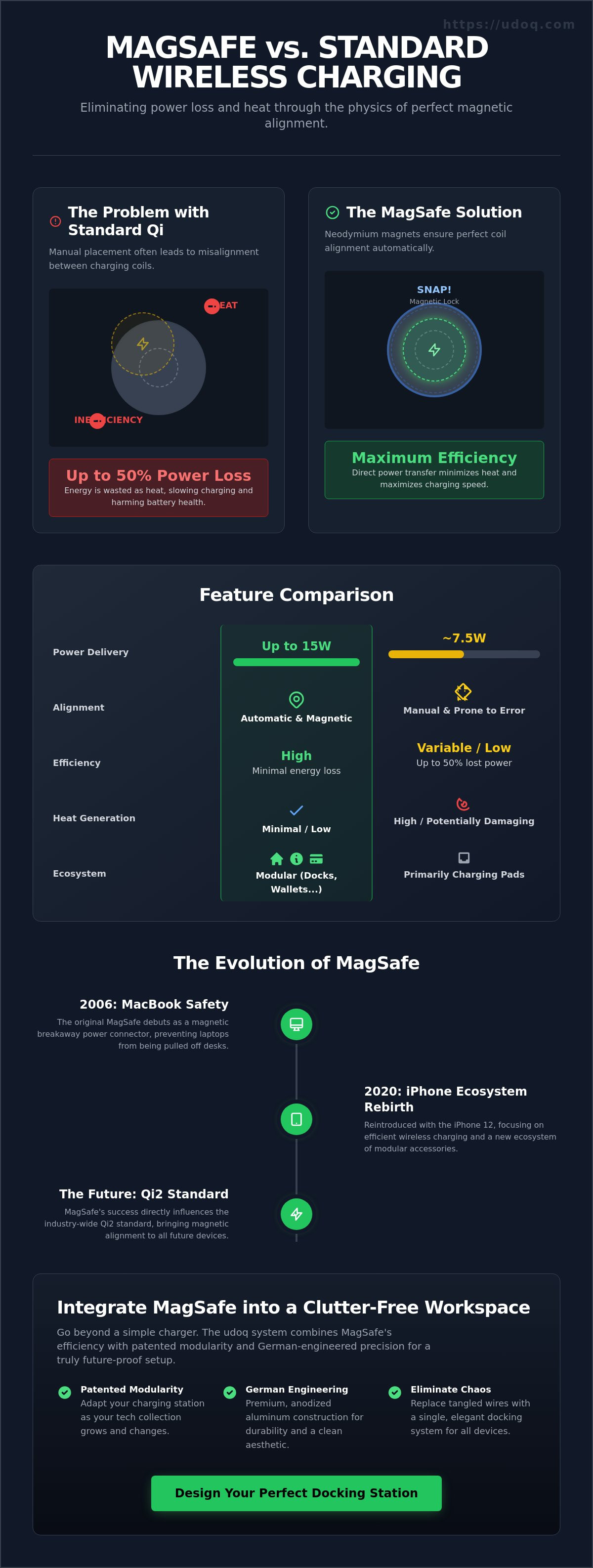
In January 2006, Apple solved a universal pain point for laptop owners. The original MagSafe connector used magnets to stay attached to the MacBook power port. If someone tripped over the cord, it simply disconnected. This prevented expensive hardware from falling to the floor. It was a triumph of mechanical safety that established Apple's reputation for premium, user-centric engineering. This early version focused on physical protection; today's version focuses on functional modularity and efficient power transfer.
The iPhone Rebirth: More Than Just a Charger
The technology returned in October 2020 with the iPhone 12. This version isn't just a breakaway cable; it's an intelligent ecosystem. Inside the phone, a circular array of neodymium magnets surrounds a charging coil. An NFC sensor allows the phone to identify specific accessories. This means your phone knows if it's attached to a 15W charger or a leather wallet. It creates a seamless interaction that transforms the device into part of a larger, organized system.
By 2026, this standard has influenced the entire industry, leading to the creation of the Qi2 standard. This evolution allows you to integrate your mobile devices into a professional environment. You can now organize your devices with a charging station built for this ecosystem. This modularity allows for a workspace that adapts to your needs. Instead of loose cables, you have a structured environment that reflects the precision of German engineering. Discover the modularity of a system that grows with your tech collection.
How MagSafe Works: The Physics of Magnetic Alignment
Precision defines the MagSafe experience. At its core, the technology utilizes a ring of neodymium magnets to guide the internal charging coil into the exact center of the power source. This isn't just about convenience. It's about maximizing inductive efficiency. When users ask what is magsafe, they are often asking about the physics of power transfer. Standard wireless charging fails when the coils are even a few millimeters off center. This misalignment creates resistance, leading to energy loss of up to 50 percent and excessive heat.
Heat is the primary enemy of lithium-ion battery longevity. By locking the device into a perfect position, MagSafe ensures that energy flows directly into the battery rather than dissipating as thermal waste. MagSafe delivers up to 15W of power, doubling the 7.5W limit found in basic Qi chargers. This 100 percent increase in speed saves valuable time during a busy workday. While these magnets are powerful, they won't damage your phone's internal storage or GPS. Modern smartphones use flash memory, which is immune to magnetic interference. However, safety remains a priority for those with specific health needs. You should review the FDA safety recommendations for MagSafe if you use a pacemaker or other implanted medical device.
The Magnetic Ring and Inductive Power
Inductive charging requires two copper coils to be in close proximity. The magnetic ring provides a tactile "snap" that confirms your device is receiving maximum power. This stable connection allows you to use the phone while it charges without breaking the circuit. It's a seamless transition from a handheld device to a fixed workstation component. To maintain this level of organization, consider a premium docking station that integrates these magnetic principles into your daily workflow. These systems aren't just stands; they're engineered interfaces that respect the physics of your hardware.
MagSafe vs. Qi2: The 2026 Wireless Charging Standard
The industry has recognized the brilliance of magnetic alignment. Qi2 is the open-standard evolution of MagSafe technology, bringing these magnetic benefits to Android and other non-Apple devices. This shift ensures that magnetic accessories are a future-proof investment. Whether you use an iPhone or a modern Android flagship, the magnetic interface is now the global benchmark for efficiency. It's the end of fumbling with cables and the beginning of a truly clutter-free lifestyle. By adopting this standard, you invest in a system that remains relevant as you upgrade your devices over the next decade.
MagSafe Certified vs. Compatible: What You Need to Know
Clarity is essential when investing in your digital infrastructure. When you ask what is magsafe in the context of retail, you'll encounter two distinct categories: "Made for MagSafe" (MFM) and "MagSafe Compatible." The difference isn't merely a label. It's a technical distinction that affects charging velocity, thermal management, and long-term hardware safety. Choosing the wrong accessory can lead to 50 percent slower charging speeds and unnecessary battery wear. Precision engineering requires a clear understanding of these standards.
Apple introduced the MFM program alongside the iPhone 12 in 2020 to ensure a consistent user experience. Official certification means the product uses Apple's proprietary MagSafe technology, including the authenticated charging module and NFC chip. These components communicate with your iPhone to negotiate the fastest possible power delivery. Without this handshake, your device may default to a lower power state to protect its internal circuits.
The "Made for MagSafe" (MFM) Seal of Approval
Certified modules are the only way to achieve 15W wireless charging speeds on most iPhone models. This hardware undergoes rigorous testing to meet strict standards for electromagnetic interference and heat dissipation. It's an investment in reliability. For example, the udoq 400 Premium Watch incorporates high-end integration to maintain this level of professional performance. Using certified hardware ensures your device remains cool during the power cycle, which preserves the health of your battery over hundreds of charge cycles.
Magnetic Compatibility: When Grip Matters Most
MagSafe Compatible accessories use a standard ring of magnets without the internal Apple electronics. These are often sufficient for non-charging applications like car mounts, wallets, or simple desk stands. However, magnet quality varies wildly in this category. Low-quality magnets often fail to secure heavier devices like the 240-gram iPhone 15 Pro Max. A weak connection leads to accidental drops and a chaotic workspace. When evaluating third-party hardware, look for these indicators of quality:
- Magnet Grade: High-quality N52 neodymium magnets provide the strongest pull.
- Surface Material: Look for silicone or micro-suction finishes that prevent the phone from sliding.
- Alignment: Ensure the accessory features the vertical "orientation magnet" to prevent the phone from rotating.
- Build Quality: Favor materials like anodized aluminum over cheap plastics for better durability.
For a truly professional setup, prioritize MFM certification for any device that delivers power. Reserve "compatible" labels for static mounts where the magnetic grip is the only requirement. By selecting the right hardware, you build a charging station that is as reliable as it is elegant. Don't settle for inferior connections that compromise your hardware's potential.
Building Your MagSafe Ecosystem for Maximum Productivity
A single charger is just a starting point. To truly leverage what is magsafe, you must view it as a modular architecture for your digital life. The ecosystem consists of four essential categories: protective cases, magnetic wallets, portable battery packs, and stationary desk docks. These components work in harmony, allowing you to layer accessories without compromising performance. You can snap a magnetic wallet onto a MagSafe-ready case, then transition the entire setup onto a vertical dock at your desk. This modularity eliminates the friction of switching gear throughout the day.
The aesthetic benefit of this system is undeniable. A magnetic connection allows for a "floating" phone display, lifting your device off the desk surface. This creates a minimalist, clutter-free environment that promotes deep focus. By removing the visual noise of horizontal cables and bulky cradles, you reclaim your workspace. It is a professional solution for those who value both form and function. This transition from loose parts to a structured system is the core of the udoq philosophy.
Beyond the Puck: The Rise of Magnetic Desk Docks
Traditional charging involves a floppy cable that eventually slips behind the desk. A stationary docking solution replaces this chaos with a fixed point of power. Vertical magnetic mounts improve ergonomics by positioning the screen at eye level. This is ideal for monitoring notifications or participating in video calls without hunching over. For a broader perspective on optimizing your workspace, consult our Ultimate Guide to Choosing a Charging Station. A well-placed dock ensures your device is always visible, charged, and ready for action.
The Role of the MagSafe Case
Standard protective cases often weaken the magnetic pull, leading to unstable connections and slow charging. A dedicated case is required to "pass through" the magnetic field effectively. These cases contain an internal ring of magnets that aligns perfectly with the phone's hardware. Whether you prefer the elegance of leather or the industrial feel of anodized aluminum, the internal magnets are the non-negotiable component. You can learn more about these technical requirements in our guide on What Is a MagSafe Case?. Choosing the right materials ensures your ecosystem remains durable and future-proof.
Stop managing cables and start managing your time. Explore our collection of modular charging stations to build an ecosystem that reflects your commitment to quality and order. Invest in a workspace that works as hard as you do.
Integrating MagSafe into a Modular udoq Docking Station
MagSafe technology reaches its full potential when integrated into a structured, professional environment. While many users view it as a mobile-only solution, udoq elevates the concept through German-engineered modularity. Our philosophy centers on a clutter-free life where your tools adapt to your needs. When you grasp what is magsafe as a modular interface rather than a simple cable, the logic of the udoq system becomes clear. It's a long-term investment in your environment that prioritizes order, quality, and technical precision.
Sustainable design is at the heart of our industrial approach. Unlike disposable plastic stands, a udoq rail is a future-proof foundation made from high-grade anodized aluminum. As your hardware collection grows or connector standards change, you simply swap or add modules. This "one for all" narrative ensures that your docking station remains relevant for years. It's time to Explore udoq Charging Stations and discover how modularity solves the chaos of modern device management.
The udoq Magnetic Adapter: Seamless Power
The udoq Magnetic Adapter brings the convenience of magnetic alignment to our patented sliding track system. This mechanism allows for perfect positioning along the rail, accommodating everything from an iPhone 12 to the latest flagship models. You can charge your iPhone, AirPods, and Apple Watch on a single, elegant aluminum rail without a single visible wire. This setup provides the tactile "snap" of a secure connection while maintaining a clean, professional aesthetic. For a detailed technical setup, refer to The Magnetic Adapter Guide 2026. Instead of asking what is magsafe in isolation, you can now see it as one vital component of a unified power hub.
Transitioning from Cables to a Professional Dock
Visualize the immediate relief of removing five separate cables from your desk. A single udoq rail replaces that tangle with a sophisticated, minimalist interface. Our system is engineered to power up to ten devices from a single outlet, hidden neatly behind the anodized aluminum frame. This isn't just about charging; it's about reclaiming your mental space. Organize your devices with a system that reflects the precision of your work. By choosing a professional dock, you move away from the "floppy cable" experience toward a permanent, reliable workstation. Power up in style and experience the efficiency of a workspace designed for the high-end lifestyle. The transition to a modular system is the final step in mastering your digital ecosystem.
Master Your Workspace with Magnetic Precision
Understanding what is magsafe transforms your perspective on power management. It's more than a magnetic click; it's a technical standard that ensures peak efficiency through perfect alignment. You've discovered how to distinguish certified hardware from simple accessories and how to layer components for maximum productivity. The transition from chaotic cables to a structured ecosystem is the final step in creating a professional environment that respects your time and your hardware.
Your workspace should reflect the precision of your work. Don't settle for disposable plastic stands or a mess of separate wires. Our patented German engineering provides a sustainable, anodized aluminum foundation that adapts to your needs as they change. This modular system can power up to 10 devices simultaneously, keeping your desk organized and your mind focused. It's a long-term investment in a future-proof lifestyle that values longevity and superior craftsmanship.
Ready to reclaim your desk? Build your custom modular docking station with udoq and experience the relief of a truly clutter-free office. Power up in style and let your setup evolve with you.
Frequently Asked Questions
Is MagSafe the same as wireless charging?
MagSafe is a proprietary enhancement of the Qi wireless charging standard. While both use inductive coils, MagSafe adds a magnetic array to ensure 100 percent alignment. This precision eliminates the power loss found in traditional wireless chargers, where even a 3mm misalignment can stop the charging process. To understand what is magsafe, you must see it as a more efficient and reliable evolution of standard induction.
Does MagSafe work with Android phones?
MagSafe chargers provide basic Qi charging to Android devices, but they won't magnetically snap without a specialized adapter. However, the Qi2 standard introduced in 2023 brings this magnetic alignment to the Android ecosystem. Modern flagships can now utilize these magnets to achieve higher efficiency. This allows Android users to integrate their devices into a professional, modular docking system alongside their other hardware.
Will MagSafe magnets damage my credit cards or battery?
The magnets won't damage your phone's battery or flash storage, but they can affect the magnetic stripes on older credit cards. Apple's official leather wallets are shielded to prevent this interference. If you use a third-party magnetic mount, ensure your cards are stored in a protected sleeve. Modern chip-and-pin or contactless cards are generally immune to these specific magnetic fields.
Can I use a MagSafe charger with a regular non-MagSafe case?
You shouldn't use a standard case with a magnetic charger. A 2mm layer of plastic or leather can reduce the magnetic pull by over 70 percent, making the connection unstable. To maintain a secure grip and 15W charging speeds, use a case with an integrated magnetic ring. This ensures the power passes through the material without generating excessive heat or losing efficiency.
What is the difference between Qi and Qi2?
Qi2 is the open-standard successor to Qi, officially incorporating the Magnetic Power Profile first seen in Apple's hardware. While the original Qi standard relied on guesswork for placement, Qi2 ensures perfect alignment for all compatible devices. This global standard, finalized in late 2023, allows Android and iPhone users to share the same high-performance magnetic accessories. It's the new benchmark for what is magsafe technology in the wider industry.
Does MagSafe charge faster than a standard Lightning or USB-C cable?
Wired charging remains the fastest method for power delivery. A 20W USB-C power adapter can charge an iPhone to 50 percent in approximately 30 minutes. MagSafe is currently capped at 15W for most models, providing a balance between speed and the convenience of a cable-free desk. It's a lifestyle choice that prioritizes a clutter-free environment over raw charging velocity.
Why is my MagSafe charger getting warm during use?
Heat is a natural byproduct of inductive power transfer. If your device reaches a certain temperature, the software may limit charging above 80 percent to protect the battery's longevity. Using a premium, anodized aluminum dock helps dissipate this heat more effectively than plastic alternatives. Proper thermal management is critical for maintaining your phone's battery health over hundreds of charge cycles.
Is it safe to leave my phone on a MagSafe dock overnight?
It's perfectly safe to dock your phone overnight. Modern smartphones use optimized battery charging to manage power intake once the battery reaches 80 percent. A stable, vertical dock is the ideal solution for overnight charging, as it keeps the device secure and easy to find. This routine helps you organize your devices and start every day with a full charge and a clear mind.