What if your charging setup evolved with your technology instead of becoming obsolete every two years? The average high-tech household now manages over 12 connected devices, yet many surfaces remain cluttered with a chaotic mess of tangled cables. You've likely dealt with the frustration of slow charging for tablets or the constant search for the right connector. Finding a premium charging solution for mixed android and apple devices shouldn't require a compromise between high-end aesthetics and functional power.
It's time to reclaim your space. You can eliminate cable clutter and unify your entire device ecosystem with a modular, high-performance charging station. This article details how the udoq system, from the compact udoq 250 to the expansive udoq 700 POWER, provides a permanent home for every piece of hardware. We'll examine how universal USB-C standards and proprietary mechanical innovations allow for effortless, one-handed docking. Discover a sophisticated approach to organization that values both your time and your environment.
Key Takeaways
- Identify the psychological impact of visual chaos and learn to manage the complex overlap of Lightning, USB-C, and Micro-USB connectors.
- Evaluate the total cost of ownership between disposable accessories and a long-term, modular charging infrastructure.
- Discover how a modular rail system provides the ultimate charging solution for mixed android and apple devices through adaptable, sliding technology.
- Execute a five-step hardware audit to determine the optimal rail length and power requirements for your specific workspace.
- Understand the engineering behind patented sliding connectors that allow for one-handed docking and a perfectly organized environment.
The Challenge of the Mixed-Device Household
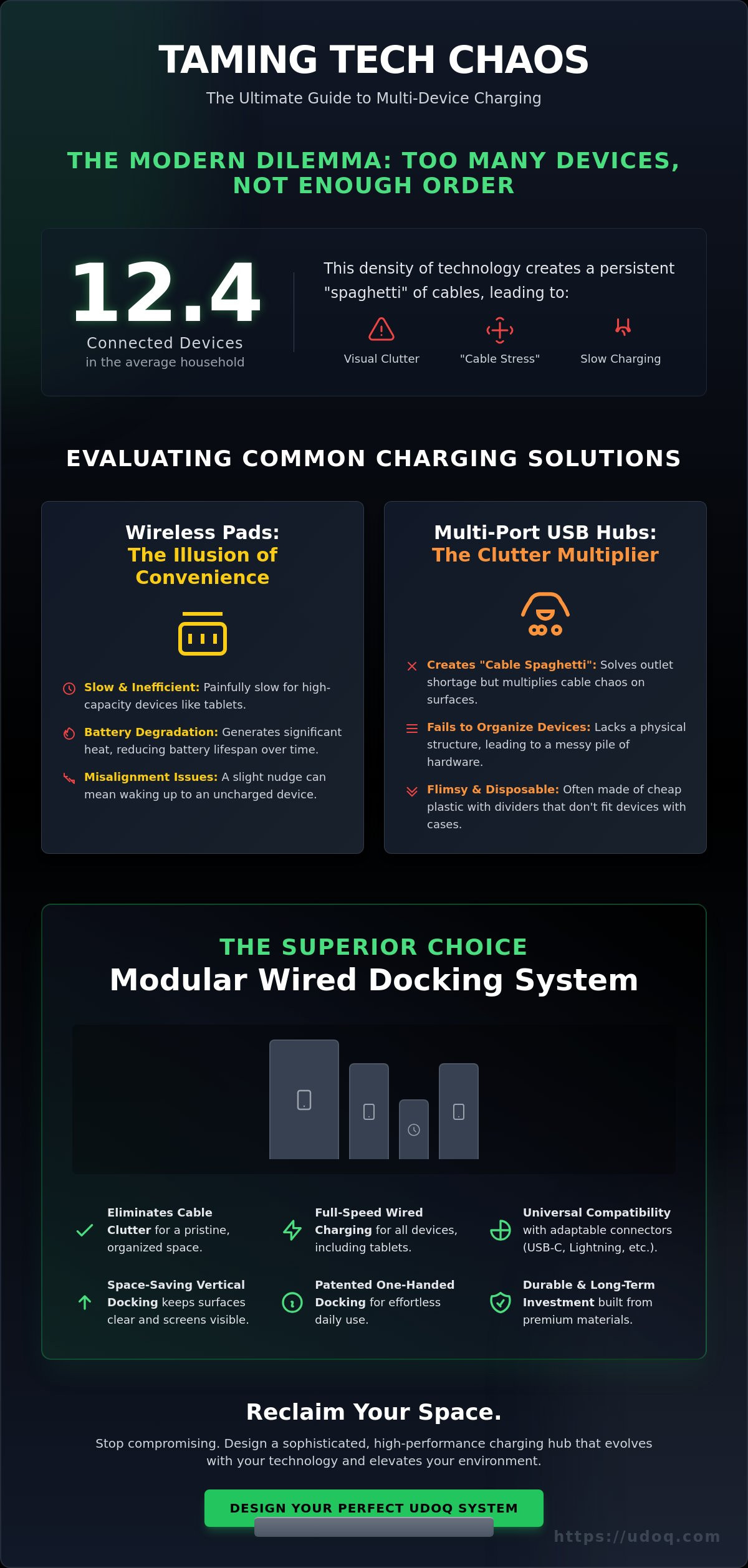
Modern living spaces are increasingly defined by a hidden form of chaos. While your home interior might appear minimalist, your counters and desks often tell a different story. The average high-tech household now manages 12.4 connected devices. This density creates a persistent "spaghetti" of cables that disrupts both your aesthetic and your daily routine. Finding a unified charging solution for mixed android and apple devices is no longer just a luxury. It is a fundamental requirement for maintaining an organized, high-functioning environment.
Traditional USB hubs often fail because they only solve the power distribution problem, not the physical organization. Cables still sprawl across surfaces, creating visual noise that conflicts with sophisticated home design. This clutter carries a genuine psychological cost. It creates "cable stress" in shared living areas where family members frequently argue over charger priority. The industry is slowly moving toward a universal charger standard to reduce electronic waste, but the current transition period remains messy and frustrating.
To better understand the current landscape of multi-device power and organization, watch this helpful video:
The Connector Chaos: USB-C vs. Lightning
Apple's transition to USB-C with the iPhone 15 series was a significant step toward industry unity. However, the Lightning legacy persists in millions of devices, from older iPhones to AirPods and various accessories. Managing this overlap with loose cables is highly inefficient. You're often left with a drawer full of unverified, low-quality "all-in-one" cables. These pose serious risks to your expensive hardware and rarely deliver the fast charging speeds your devices require. A professional charging station eliminates this risk by using high-quality, dedicated connectors for each specific device type.
The Tablet Dilemma: Why Wireless Isn’t Enough
Wireless charging is often marketed as the ultimate clutter-killer, but it falls short for high-capacity hardware. Charging a large iPad Pro or a Galaxy Tab via Qi wireless is painfully slow and inefficient. These larger devices also consume significant counter space when laid flat on a charging pad. Vertical docking offers a superior spatial solution. It secures your tablets in a minimal footprint while ensuring they receive high-wattage power through a direct connection. This keeps screens visible and surfaces clear, transforming a chaotic pile of tech into a curated display of productivity tools.
Evaluating Multi-Device Charging Solutions
Selecting a permanent charging solution for mixed android and apple devices requires looking past immediate convenience. You must consider long-term viability, device safety, and spatial harmony. Most consumers default to inexpensive accessories that often need replacement within a year. A true system is an investment in your environment. It should function like a piece of high-end furniture rather than a temporary plastic add-on. This "Total Cost of Ownership" approach prioritizes durability over the cycle of disposable tech.
Wireless Charging Pads: Pros and Cons
Wireless technology offers a "drop and go" appeal. It's aesthetically clean but technically limited. Misalignment remains a persistent issue, often leading to a device that hasn't charged by morning. Energy loss is another factor. Non-magnetic systems generate significant heat, which accelerates battery degradation over time. Using your phone while it's flat on a pad is nearly impossible. For a household with diverse hardware, wireless often creates more friction than it solves.
Multi-Port USB Hubs: The "Cable Spaghetti" Problem
Standard multi-port hubs solve the outlet shortage but ignore the clutter. Without a structured frame, cables eventually fray and connectors get lost. Generic stands with thin plastic dividers often fail to accommodate devices in protective cases. This creates a messy "spaghetti" effect on your desk or nightstand. For a deeper dive into these categories, The Ultimate Guide to Choosing a Charging Station provides a comprehensive breakdown of why basic hubs fall short.
The Superiority of Wired Docking
Wired connections remain the gold standard for efficiency. They provide stable power delivery without the thermal stress of induction. This is especially critical as the USB-C standard becomes the universal baseline for modern electronics. A wired dock ensures your high-capacity tablets and smartphones reach full power quickly and safely. It's a reliable foundation for any tech-heavy home. It eliminates the guesswork of charging while preserving the health of your battery.
Refined organization isn't just about hiding cables. It's about accessibility and precision. A well-engineered station allows for one-handed docking, keeping your workspace ready for action. If you're ready to upgrade your environment, explore the minimalist designs at udoq to find a permanent solution for your device ecosystem.
Why Modular Wired Systems Win for Mixed Ecosystems
Static charging stations are a gamble. If you switch from an iPhone to a Samsung, or if industry standards shift again, a fixed-port dock becomes electronic waste. This is the primary weakness of most "all-in-one" accessories found on retail shelves. A truly sophisticated charging solution for mixed android and apple devices must be modular. It should adapt to your current hardware while remaining ready for whatever you purchase next year. Chaos demands a systemic response, not a plastic compromise.
The udoq system utilizes a patented sliding mechanism that allows you to rearrange connectors in seconds. You aren't locked into a specific layout. If you need to transition from a legacy Lightning setup to the modern C-CABLE standard, you simply swap the component. This future-proofing ensures your investment lasts for years, regardless of changing industry standards. Every device receives its maximum safe wattage through Power Delivery (PD) standards. This protects your battery while optimizing speed for high-capacity hardware.
The Anatomy of a Modular Dock
The foundation of this system is a high-grade aluminum rail. It serves as both a structural base and a natural heat sink, dissipating warmth during intensive charging sessions. Unlike plastic alternatives, this material offers long-term durability and a premium feel that complements modern interiors. You can choose from various lengths, such as the udoq 250 or the udoq 700, to fit your specific device count. A single power source can support up to ten devices simultaneously. This eliminates the need for multiple wall outlets and keeps your desk pristine.
Interchangeable connectors, including the L-CABLE and C-CABLE, slide along the rail to accommodate different sizes and brands. You can even adjust the depth of the connector. This ensures a perfect fit for a slim smartphone or a tablet housed in a ruggedized protective case. It's a level of technical precision that generic plastic dividers simply cannot match.
Universal Compatibility: Android, Apple, and Beyond
A modular system isn't limited to smartphones and tablets. You can integrate e-readers, power banks, and gaming controllers onto the same rail. This creates a centralized hub for all your portable tech. Smartwatches require specific attention because their charging needs differ from mobile phones. Rather than using a generic stand that might tip over, a dedicated adapter provides stability and style. Check out the udoq 400 Premium Watch for a specialized mixed setup that handles your wearable tech with the same precision as your primary devices.
Designing Your Universal Charging Hub: A 5-Step Guide
Creating a permanent charging solution for mixed android and apple devices requires a shift in mindset. You're no longer just buying a cord. You're designing a system. Most households react to new tech by adding another loose cable to a power strip. This creates the visual chaos that disrupts a refined workspace. A structured hub eliminates this friction by treating your devices as a unified ecosystem rather than a collection of separate problems.
Step 1 & 2: Device Audit and Rail Sizing
Start with a hardware audit. Count your specific port requirements: Lightning for legacy Apple gear, USB-C for modern iPhones and Androids, and Micro-USB for older accessories. This data determines your rail length. The udoq 250 is an ideal minimalist choice for essentials. Families or power users with multiple tablets should look toward the udoq 700 to ensure every screen has a home. Modular rail length is the horizontal measurement that defines your station's device capacity and organizational potential.
Aluminum is the superior material for a minimalist desk setup. It offers industrial-grade durability and a high-status finish that plastic alternatives can't replicate. It also acts as a structural anchor for your tech, providing the weight necessary for stable docking.
Step 3 & 4: Connector Selection and Power Management
Precision matters when selecting your internal components. The udoq C-CABLE is engineered for a perfect fit and high-speed power delivery. For those who prefer a "snap" connection, integrating a magnetic adapter allows iPhone users to enjoy their preferred docking style alongside Android hardware. This mix-and-match capability is the hallmark of a truly modular charging solution for mixed android and apple devices.
Identify your "Power Users." If you manage high-capacity tablets or laptops, choose the POWER versions of the udoq rails. These include specialized power blocks that deliver the high wattage required for fast charging. This setup allows you to hide the internal power supply within the rail's profile for a cord-free aesthetic that emphasizes order.
Step 5: Mounting and Future-Proofing
Finalize your layout by choosing between a desktop placement or a WALL MOUNT. Mounting your station to the wall maximizes desk space and creates a floating tech gallery effect. Always leave a few centimeters of "open rail" space. This foresight allows you to add a new MAGNETIC ADAPTER or an additional C-CABLE when you upgrade your hardware next year. It's an investment that evolves with you.
Ready to reclaim your workspace from cable chaos? Build your custom udoq station today and experience the psychological relief of a perfectly organized environment.
The udoq System: German Engineering for Every Ecosystem
German engineering is synonymous with technical precision and longevity. The udoq system embodies this heritage by moving beyond the concept of a simple accessory. It's a permanent architectural response to the chaos of modern technology. While generic brands rely on mass-produced plastic and fixed configurations, udoq utilizes patented sliding technology. This mechanical innovation allows you to reposition connectors with fluid ease. It's a charging solution for mixed android and apple devices that respects both your hardware and your interior design.
Sustainability in the tech world is often overlooked. Most chargers are designed for a two-year lifecycle, destined for a landfill the moment a new connector debuts. udoq reverses this trend. By offering a modular rail that accommodates interchangeable C-CABLE, L-CABLE, and wireless components, the system stays relevant for decades. You don't replace the station; you simply evolve the internal components. It's the last charging hub you'll ever need to purchase.
Built to Last: The Aluminum Advantage
High-grade aluminum is the core of the udoq experience. This material outperforms plastic in every measurable category, from structural integrity to heat dissipation. It ensures your devices remain cool during high-wattage power delivery, protecting sensitive battery chemistry. This "buy once, buy right" mentality is a hallmark of premium manufacturing. Explore the full range of udoq Charging Stations to find the modular foundation that fits your specific needs.
A Solution for Home and Office
The system scales effortlessly to meet the demands of any environment. A udoq 250 provides a minimalist anchor for a bedside nightstand, while a udoq 700 POWER transforms a corporate conference room into a high-utility hub. This adaptability solves the primary objection of changing tech standards. Whether you're managing a suite of iPads or a mix of Android smartphones, the rail remains the constant.
Organization provides a profound sense of psychological relief. An "always ready" hub eliminates the friction of searching for cables or clearing counter space. It's time to transition from environmental chaos to a curated system of order. Choose a solution designed for the next ten years of your digital life. Upgrade your space with udoq and experience the intersection of high-end aesthetics and functional innovation.
Reclaim Your Space with Modular Precision
The era of cable clutter is over. By choosing a modular system, you move away from disposable accessories and toward a permanent architectural asset. You've learned how high-grade aluminum and patented German engineering create a foundation that evolves with your technology. This refined approach ensures that your charging solution for mixed android and apple devices remains functional for the next decade. It's a commitment to order that values your time as much as your physical environment.
The udoq system is designed to fit 100% of mobile devices, providing a seamless experience backed by 5-star customer reviews. It's an investment in quality that eliminates the daily friction of cable stress. Stop settling for plastic stands that fail to meet the demands of your growing ecosystem. Choose a system that reflects your appreciation for fine craftsmanship and industrial durability.
Ready to transform your home or office? Build Your Custom Mixed-Device Charging Station Now and experience the clarity of a perfectly organized environment. Your technology deserves a home that is as sophisticated as the devices themselves.
Common Questions about Unified Charging
Can I charge an iPhone and a Samsung tablet on the same udoq dock?
Yes, you can charge both simultaneously by using different connector modules on the same rail. Simply slide an L-CABLE for your legacy Apple device next to a C-CABLE for your Samsung tablet. This versatility makes it the premier charging solution for mixed android and apple devices in a shared household or workspace.
Will udoq work with thick protective cases like OtterBox?
Yes, the system features adjustable connectors that move vertically to accommodate various case thicknesses. You can customize the connector height to ensure a secure fit for ruggedized cases like OtterBox or slim designer shells. This mechanical flexibility prevents the need to remove your protection before docking your hardware.
What happens when Apple or Android change their connector types again?
The udoq system is future-proof because only the internal cable modules need to be replaced. If a new industry standard emerges, you simply swap your current C-CABLE or L-CABLE for the updated version. Your high-grade aluminum rail remains a permanent, sustainable fixture in your home for years to come.
Is wired charging faster than wireless charging for multiple devices?
Wired charging is significantly faster and more energy-efficient than wireless induction. It delivers direct power without the thermal stress and heat generation that can degrade your battery over time. For high-capacity tablets and modern smartphones, a wired connection ensures you reach full power in the shortest possible window.
Can I mount the udoq charging station to a wall?
Yes, you can use the specialized WALL MOUNT accessory to secure your station to any vertical surface. This is an excellent option for kitchens or entryways where counter space is at a premium. It creates a floating tech gallery that keeps your devices organized, visible, and always ready for use.
Does udoq support fast charging for the latest 2026 smartphone models?
Yes, the POWER versions of our rails are designed to meet the highest Power Delivery (PD) standards for 2026 hardware. Choosing a udoq 400 POWER or udoq 700 POWER ensures your high-performance devices receive the maximum safe wattage. It provides a reliable charging solution for mixed android and apple devices with varying power requirements.
How many devices can I power from a single wall outlet with udoq?
You can power up to ten devices from a single outlet depending on your chosen rail length and power block configuration. The udoq 700 is designed for large families or offices needing to centralize multiple pieces of hardware. This consolidated approach eliminates the need for bulky power strips and multiple unsightly wall adapters.
Is it difficult to install the connectors into the udoq rail?
Installation is straightforward and requires no technical expertise or specialized tools. The connectors slide into the aluminum rail and lock into place with a simple manual adjustment. You can rearrange your layout in seconds as your device collection grows or your organizational needs change.