Why are you still settling for a desk buried in tangled cables and the daily frustration of misaligned charging pads? The Wireless Power Consortium launched the Qi2 standard in January 2023, effectively ending the era of guessing if your device is actually drawing power. By integrating a magnetic ring based on Apple's MagSafe technology, the qi2 wireless charger ensures perfect alignment and peak efficiency every time you set your phone down.
You deserve a workspace that reflects order and technical precision. It's frustrating when a slight bump stops your charging progress or when you're forced to juggle different pads for different brands. This guide provides the roadmap to mastering the Qi2 transition, allowing you to achieve 15W fast charging across both Android and iOS platforms without the clutter. We'll examine the modular benefits of this new magnetic standard and show you how to build a future-proof, elegant charging station that honors the principles of German engineering and minimalist design. Discover how to transform your desk into a streamlined hub of productivity.
Key Takeaways
- Understand how the new Magnetic Power Profile optimizes thermal management for faster, more efficient power delivery.
- Compare the universal qi2 wireless charger standard against proprietary MagSafe to ensure total interoperability across your mobile ecosystem.
- Evaluate the long-term sustainability of modular rail systems versus fixed stands to protect your investment as hardware standards evolve.
- Discover how udoq’s patented German engineering integrates Qi2 technology into a seamless, clutter-free charging experience.
The Evolution of Wireless Power: What is a Qi2 Wireless Charger?
Wireless power is finally shedding its historical inefficiencies. The qi2 wireless charger represents a fundamental shift in how we power our daily devices. Based on Apple's MagSafe technology, this new standard, announced by the Wireless Power Consortium (WPC) in early 2023, brings magnetic alignment to the entire mobile industry. It moves beyond the limitations of the original Qi wireless charging standard to provide a more reliable, efficient experience for both Android and iOS users.
This transition marks the end of the "alignment anxiety" that defined early wireless pads. By standardizing the interface, the industry has created a universal language for power. Whether you use a high-end iPhone or a flagship Samsung, the connection remains the same. It's a sophisticated solution for a modern, multi-device lifestyle that values both form and function.
To better understand this concept, watch this helpful video:
The core of this evolution is the Magnetic Power Profile (MPP). It replaces the guesswork of positioning your phone on a pad. By using a ring of magnets, Qi2 ensures the charging coils align perfectly every time. This precision eliminates the heat buildup and energy waste common in older inductive systems. The Magnetic Power Profile is the technological foundation that enables Qi2 to deliver consistent, high-speed power across different brands and ecosystems.
Why the Wireless Power Consortium (WPC) Created Qi2
Inductive charging used to be a game of chance. If your device sat a few millimeters off-center, charging speeds plummeted or charging stopped entirely. The WPC developed Qi2 to solve this frustration once and for all. Magnets lock the device into the "sweet spot," ensuring peak efficiency and reducing energy loss by up to 25% compared to misaligned pads. This design mirrors the udoq commitment to German engineering; it's about removing friction from your environment. The Magnetic Power Profile is the core technology that guarantees perfect coil alignment for every charge.
The 2026 Device Landscape: Who Supports Qi2?
The market has shifted rapidly toward this magnetic future. While iPhone 13 through iPhone 17 models already support the standard, the latest Samsung Galaxy models and high-end Android flagships have adopted the tech to stay competitive. The qi2 wireless charger ecosystem now extends to tablet accessories and specialized wearables, creating a unified charging environment. This "one for all" approach simplifies your desk and reduces cable clutter.
- Apple: iPhone 13, 14, 15, 16, and 17 series.
- Samsung: Latest Galaxy S-series and Z-Fold models released after 2024.
- Accessories: New Qi2-enabled earbuds and modular tablet docks.
Full 15W speeds are now the industry minimum for fast wireless power. While Qi2 hardware is backward compatible with older Qi devices, you need a Qi2-certified charger and a compatible device to unlock these maximum speeds. It's a future-proof investment for anyone who values order, technical precision, and a seamless power experience.
The Magnetic Power Profile: Why Precision Matters
Precision is the core of the qi2 wireless charger standard. The Magnetic Power Profile (MPP) uses a sophisticated ring of magnets to lock the transmitter and receiver coils into perfect alignment. It isn't just about convenience; it's about physics. In legacy wireless charging, a deviation of just three millimeters can drop efficiency by 20% or more. This lost energy doesn't just vanish. It converts into waste heat that cooks your device from the inside. By centering the coils every time, Qi2 eliminates the "searching" phase where the charger struggles to establish a stable connection. This physical locking mechanism is a global standard established by the Wireless Power Consortium (WPC) to ensure cross-brand compatibility and peak performance.
The software layer is as vital as the hardware magnets. Every charging session begins with a digital handshake. The device identifies its power needs, and the charger confirms its output capacity. This protocol prevents overcharging and manages the thermal envelope in real time. Safety features like Foreign Object Detection (FOD) add another layer of security. If the system detects a coin, paperclip, or credit card between the coils, it halts power immediately. This prevents metal objects from reaching dangerous temperatures, protecting both your phone and your desk surface.
15W Fast Charging: Breaking the Speed Barrier
The shift to 15W represents a 100% increase over the 7.5W cap found on older chargers. This speed boost provides a meaningful mid-day charge that finally rivals wired connections. To achieve these rates, the role of the power supply unit (PSU) is critical. A high-quality PSU ensures the voltage remains stable, which prevents the "ghost touches" often associated with cheap chargers. For a deeper look at how modern power delivery works across your workspace, consult this Ultimate Guide to USB-C. Consistency is the hallmark of German engineering, and Qi2 delivers it through standardized power profiles.
Thermal Efficiency and Battery Longevity
Heat is the primary enemy of lithium-ion batteries. Sustained temperatures above 30°C (86°F) accelerate chemical degradation, leading to shorter battery life over time. Because the qi2 wireless charger maintains perfect alignment, it operates significantly cooler than its predecessors. Less resistance means less thermal stress. We utilize premium materials like anodized aluminum in our charging stations to further this goal. Aluminum acts as a superior heat sink, drawing warmth away from your smartphone. This combination of magnetic precision and high-grade materials ensures your device stays healthy for years. Experience the relief of a cooler, faster charge with a premium charging dock designed for the modern professional.
Qi2 vs. MagSafe vs. Original Qi: The 2026 Comparison
The 2026 technology landscape has moved beyond proprietary limitations. While Apple MagSafe introduced the world to magnetic alignment, the qi2 wireless charger has perfected the concept as a global standard. MagSafe remains a closed ecosystem. It requires specific "Made for MagSafe" (MFM) licensing that inflates costs for both manufacturers and consumers. Qi2 is different. It's an open standard developed by the Wireless Power Consortium, utilizing the same Magnetic Power Profile (MPP) technology to provide a universal solution.
Device interoperability is the strongest argument for the new standard. There's a common misconception that Qi2 is just an iPhone feature. That isn't true in 2026. Major Android manufacturers have adopted the standard, making it the primary charging method for flagship devices across all brands. A single high-quality dock can now power an iPhone 17 and a Samsung Galaxy S26 with the same efficiency. This modular approach reduces clutter and simplifies the modern workspace.
- Charging Speed: Both MagSafe and Qi2 deliver a consistent 15W of power.
- Magnetic Strength: Both standards use high-grade magnets to ensure a secure, slip-free connection.
- Compatibility: MagSafe is Apple-centric; Qi2 is a "one for all" solution for modern electronics.
Is Qi2 Better Than Apple MagSafe?
Performance parity is the reality. Both standards offer 15W charging speeds, but Qi2 offers a superior cost-to-performance ratio. MFM certification adds a significant "tax" to accessories, often increasing prices without adding functional value. Qi2 streamlines the certification process. It allows for premium, anodized aluminum chargers that meet strict safety standards at a more accessible price point. For a multi-device household, choosing Qi2 is the logical move. It's an investment in a future-proof ecosystem that isn't tied to a single manufacturer's roadmap.
The Death of the "Dumb" Wireless Pad
Standard inductive charging pads are now relics of the past. These "dumb" pads rely on manual placement. If your phone is off by just 3mm, charging efficiency plummets or stops entirely. This misalignment creates excess heat, which degrades your battery's health over time. 2026 marks the end of this frustration for flagship users.
The magnetic snap of a qi2 wireless charger guarantees perfect coil alignment every time. It eliminates the "dead zone" guesswork. Efficiency is maximized. Heat is minimized. This shift represents a transition from "hit-or-miss" gadgets to precision German engineering. To see how these standards integrate into a professional environment, explore the Ultimate Guide to Choosing a Charging Station. Reliability is no longer an option; it's a requirement for the organized professional.
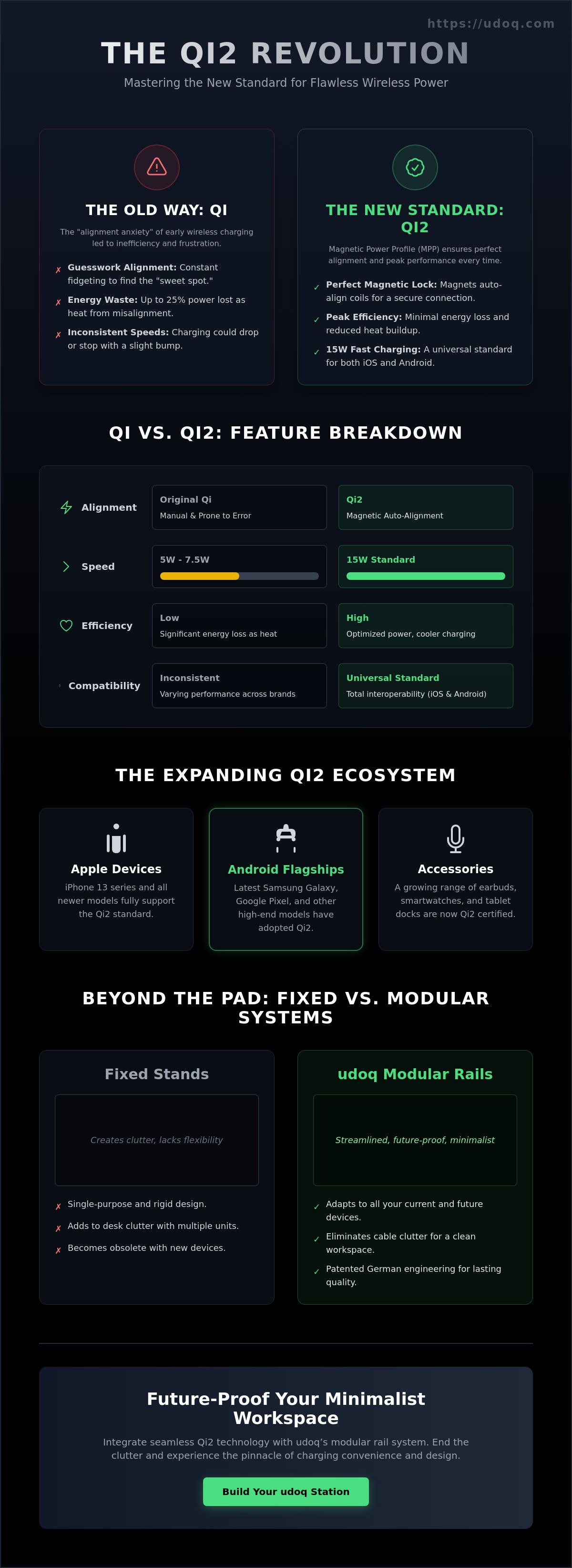
Beyond the Pad: Evaluating Fixed vs. Modular Qi2 Solutions
The most common objection to new technology is the fear of obsolescence. Users often ask why they should invest in a high end dock when standards change every few years. They don't want to buy a new charger every time they upgrade their phone. This cycle of disposable tech creates unnecessary waste and constant frustration. The arrival of the qi2 wireless charger standard highlights the divide between temporary fixes and long term investments.
The Problem with Fixed Charging Stands
Fixed charging stands are static solutions for a dynamic problem. Brands like Anker and Belkin offer sleek designs, yet their utility is locked into a single configuration. You are restricted to charging one specific device at one predetermined angle. If your next smartphone features a larger camera housing or a different physical footprint, the alignment often fails. This rigidity leads to tech clutter. Research suggests the average household accumulates 5 to 7 redundant charging cables and bricks every three years. Most of these devices consist of non recyclable plastic shells that eventually end up in landfills. They are products designed for the moment, not for the future.
The Case for Modular German Engineering
Modularity is the antidote to the "buy and discard" culture. udoq approaches power through a patented charging rail system. This isn't just a stand; it is a foundation. Built from high grade anodized aluminum, the rail provides a premium, durable base that outlasts multiple phone generations. It allows you to slide, swap, and reposition adapters as your needs change. By using a wireless adapter, you can seamlessly integrate the qi2 wireless charger standard into your existing setup. This future proof approach ensures that your hardware evolves alongside your devices.
- Sustainable Impact: Upgrading a single component is 80 percent more resource efficient than replacing an entire docking station.
- Aesthetic Relief: A single rail eliminates the "cable nest" common in home offices, replacing chaos with industrial elegance.
- Precision: The sliding track allows for exact alignment, ensuring maximum charging efficiency for every device size.
Choosing a modular system is a declaration of order. It moves your workspace away from messy tangles and toward a sophisticated, minimalist environment. You gain the freedom to adapt without the guilt of electronic waste. Experience the relief of a workspace that remains perfectly organized, regardless of how many devices you own.
udoq and Qi2: Future-Proofing Your Minimalist Workspace
The arrival of the qi2 wireless charger standard marks a significant shift in how we power our daily essentials. For the udoq system, this evolution is a natural fit. Our patented rail system was designed for this exact moment of technological transition. It transforms a chaotic desk into a sophisticated environment where technology serves your aesthetic, not the other way around. You deserve the relief that comes with a clutter-free workspace.
The core of the udoq experience is our "Slide and Swap" mechanism. You aren't locked into a single, static configuration. If you upgrade your smartphone or switch between different ecosystems, your hardware adapts. On a single udoq 400 Premium Watch or a larger 700mm rail, you can charge up to 10 devices simultaneously. This setup handles a diverse range of electronics:
- Latest Qi2-enabled smartphones
- Legacy iPhones and Android devices
- Tablets and e-readers
- Smartwatches and wireless earbuds
All cables stay hidden within the sleek, anodized aluminum profile. It's functional art for the modern professional who values precision and order.
Customizing Your udoq for the Qi2 Era
Integrating a qi2 wireless charger into your current setup is effortless. You simply slide the new magnetic adapter into your existing rail. This creates a visually harmonious row where MagSafe and Qi2 devices align perfectly. There's no staggered height or mismatched cables to disrupt your focus. For users with high-wattage requirements, the udoq POWER series provides the necessary amperage to keep every device at peak performance. It's a modular solution that respects your space and your time.
Sustainable Tech: Buy Once, Upgrade Often
We believe in longevity. Our German engineering philosophy rejects the cycle of disposable electronics. Many udoq users who purchased their rails in 2016 are still using them with 100% compatibility today. They've simply swapped their older connectors for USB-C and Qi2 adapters. This ensures your investment remains relevant through 2026 and beyond. It’s a commitment to sustainability that saves money and reduces e-waste.
Don't settle for temporary plastic docks that end up in landfills. Choose a system that grows with your needs and maintains its premium feel for a decade. Transition your office into a center of productivity and style. We invite you to explore the charging station collection and discover the power of modular organization.
Master Your Minimalist Workspace
The arrival of the Magnetic Power Profile marks a definitive end to charging guesswork. By 2026, the qi2 wireless charger will be the global benchmark for 15W efficiency; bridging the gap between Android and Apple ecosystems. Superior tech deserves a superior foundation. udoq provides this through patented German engineering and a sophisticated anodized aluminum finish that complements any professional environment. Our modular system is uniquely sustainable. It has adapted to every major device connector since 2016, ensuring your investment never becomes obsolete. The patented sliding track allows you to rearrange your setup in seconds, proving that high-end design and functional utility can coexist perfectly. Stop chasing cables and start curating your environment. It's time to replace clutter with precision and style.
Build your own future-proof udoq charging station today
Your desk deserves the gold standard of organization.
Frequently Asked Questions
Is Qi2 compatible with my old iPhone or Android phone?
Qi2 works with iPhone 15, 14, and 13 models running iOS 17.2 or later. Older Android devices generally lack the internal magnetic array required for this new standard. While a qi2 wireless charger remains backward compatible with older Qi-enabled phones, these devices won't snap into place and will charge at slower speeds of 5W or 7.5W.
Does a Qi2 charger come with a power brick?
Most premium Qi2 chargers don't include a wall adapter to reduce electronic waste and maintain a minimalist footprint. You'll need a USB-C Power Delivery 3.0 adapter with a minimum 20W output to reach full charging speeds. This modular approach ensures you only use high-quality power sources that match your specific desk setup.
Can I use a Qi2 wireless charger with a non-magnetic case?
You cannot use a qi2 wireless charger effectively with a standard non-magnetic case. The Magnetic Power Profile requires precise alignment to deliver 15W of power safely. Cases thicker than 2mm or those made of non-conductive materials without magnets will block the connection. Always choose a Qi2-certified or MagSafe-compatible case for a secure, efficient attachment.
Is Qi2 faster than a standard USB-C cable?
Qi2 isn't faster than a direct USB-C wired connection. A standard USB-C cable typically delivers 20W to 30W for smartphones, while Qi2 is capped at a 15W peak. Wireless charging focuses on convenience and the relief of a clutter-free environment rather than maximum raw speed. It's a sophisticated solution for maintaining battery health throughout your workday.
What is the difference between Qi2 and "MagSafe Compatible" chargers?
Qi2 is a universal industry standard based on Apple's magnetic technology, while "MagSafe Compatible" often describes uncertified third-party hardware. Certified Qi2 chargers guarantee 15W charging for both iPhones and future Android handsets. Uncertified magnetic chargers frequently limit output to 7.5W. Qi2 represents a future-proof investment that works across different mobile ecosystems.
Does Qi2 charging make the phone hotter than wired charging?
Wireless charging generates more heat than wired charging because induction isn't 100% efficient. Qi2 minimizes this issue by using magnets to ensure perfect coil alignment every time. This precision reduces energy waste and prevents the excessive heat common with misaligned pads. It's a more disciplined, engineered approach to power delivery.
Will Qi2 work with Apple Watch or other smartwatches?
Qi2 doesn't support the Apple Watch or most other smartwatches due to their proprietary charging requirements. These smaller devices use different inductive frequencies and coil sizes that aren't compatible with the Magnetic Power Profile. You'll still need a dedicated dock or module for your wearables. udoq solves this by organizing all these different standards into one cohesive system.
Do I need a special cable to use a Qi2 charging pad?
You need a high-quality USB-C cable that supports at least 20W of power delivery. Using a thin or outdated cable will prevent the pad from receiving enough energy to hit the 15W wireless limit. Ensure your cable is rated for 3A to maintain a stable, high-speed connection. Quality cables are essential for the longevity of your charging hardware.