Why settle for a disposable plastic hub that becomes obsolete every time you upgrade your smartphone? You've likely felt the persistent frustration of untangling a bird's nest of cables on your nightstand or realizing a new device won't fit your current charger. It's a cycle of clutter and planned obsolescence that drains your productivity and disrupts your focus. Most charging solutions are merely temporary fixes for a permanent problem.
The solution lies in a modular docking station system designed for longevity and aesthetic precision. This 2026 guide shows you how to eliminate cable chaos once and for all while creating a workspace that reflects your professional standards. We'll explore how patented German engineering and high-grade aluminum rails allow your charging hub to evolve alongside changing industry standards like USB PD 3.2. You'll learn to build a future-proof system that delivers high-speed power to all your devices simultaneously, replacing cheap plastic with a permanent investment in order and efficiency.
Key Takeaways
- Transition from disposable accessories to a sustainable modular docking station system built from high-grade aluminum.
- Master the mechanics of sliding connectors to achieve perfect device alignment and effortless hardware upgrades.
- Balance the high-speed performance of C-Cables with the minimalist convenience of integrated wireless adapters.
- Implement strategic placement techniques to consolidate your tech at a single power source and eliminate visible cable clutter.
- Leverage patented German engineering to create a customized charging hub that adapts to every new device in your ecosystem.
Beyond Cables: Why a Modular Docking Station System is Essential in 2026
Modern life demands multiple devices, yet our workspaces often resemble a tangled graveyard of cords. A modular docking station system serves as a permanent architectural foundation for your mobile hardware. It's a scalable framework that organizes, charges, and displays your technology with surgical precision. By consolidating power into a single, elegant rail, you reclaim your environment and your focus. There's a profound psychological relief in knowing your devices are charging in a dedicated space. It eliminates the "low battery" anxiety that comes from hunting for a spare cable at the last minute.
We must move past the "disposable gadget" mindset that dominates the tech accessory market. Traditional docks are fixed, rigid, and destined for the landfill when your next phone changes dimensions or port locations. A modular infrastructure prioritizes longevity over temporary convenience. It's a long-term investment in your environment. It's the difference between a cluttered desk and a refined "tech home" where every tablet, phone, and watch has a dedicated, secure position.
Visualize the impact of a streamlined setup in this demonstration:
The Evolution of the Charging Hub
The journey from a single wall plug to the modern workspace has been notoriously messy. We progressed from wall warts to bulky power strips, eventually settling for cheap, fixed-position multi-device docks. These plastic units often failed because they were top-heavy or couldn't accommodate devices with protective cases. A professional Docking station in 2026 must be dynamic. The modular rail design represents the pinnacle of this evolution. It allows for perfect device alignment and easy cable management. It hides the "last mile" of cabling within a sleek aluminum profile, ensuring your desk remains a sanctuary of productivity.
Solving the Tech Obsolescence Trap
Tech standards shift rapidly, as seen with the recent EU common charger regulations pushing everything toward USB-C. We've managed the transition from Micro-USB and the lingering presence of Lightning connectors, yet new standards like USB PD 3.2 are already here. Most people replace their entire charging setup every two years to keep up. A modular docking station system breaks this cycle. If a manufacturer changes a port or a device grows larger, you simply swap an individual component or move a slider. It's a sustainable approach that honors both the environment and your financial investment. By choosing high-grade aluminum over brittle plastic, you ensure your hardware remains a permanent fixture. Explore the full range of charging stations to find the configuration that fits your current and future needs.
Engineering Modularity: How a Rail-Based System Outperforms Fixed Chargers
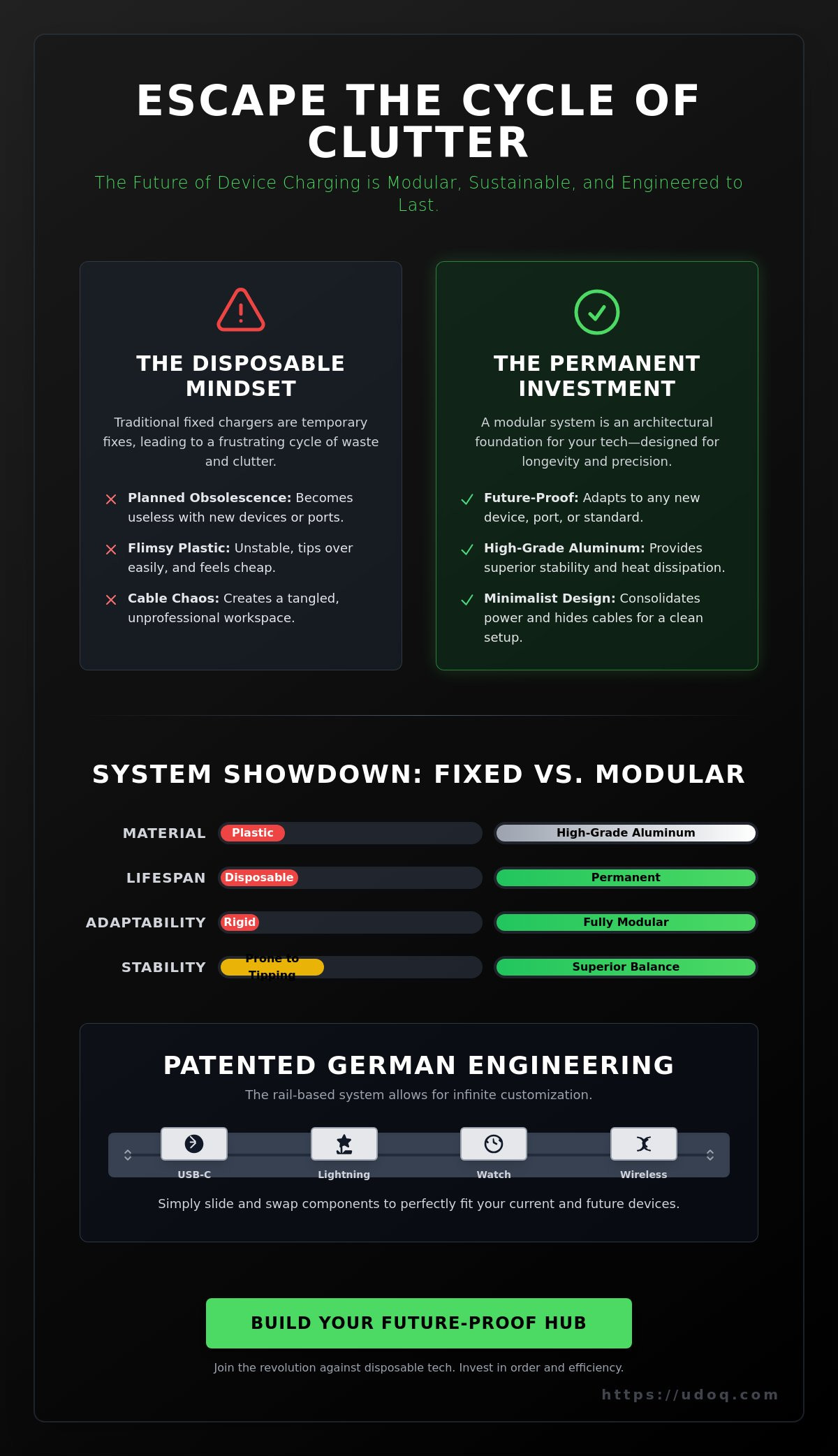
Fixed chargers are static. They assume your hardware ecosystem never changes. A modular docking station system rejects this rigidity. By utilizing a rail-based architecture, it provides the structural integrity needed for multiple devices while maintaining the flexibility to reorganize them on a whim. This isn't just a gadget; it's precision engineering for your desktop. Traditional docks often fail because they lack the weight to remain stable when you remove a device. A rail system solves this through superior balance and friction. It creates a permanent home for your tech.
The Strength of Aluminum Construction
High-grade aluminum is the cornerstone of a premium charging hub. Unlike lightweight plastic docks that tip over under the weight of a large tablet, aluminum provides necessary ballast. It stays where you put it. Beyond stability, metal acts as a natural heat sink. As devices draw high wattage during fast charging, heat dissipation becomes critical for preserving battery health. This material choice also defines the visual language of a minimalist desk setup. It offers a refined, industrial aesthetic that complements modern smartphones and laptops. It feels substantial and professional. It's built to last for decades, not months.
Patented Sliding Technology
The true innovation lies in the mechanical rail. This system allows connectors to slide laterally, accommodating various device widths and orientations. It solves the "case problem" through adjustable height settings. Whether you use a thin skin or a rugged protective shell, the connector reaches the port every time. This adherence to modular design principles ensures that the system is repairable and adaptable. You can swap an L-CABLE for a C-CABLE in seconds without replacing the entire rail. It's a hardware framework that empowers the user to configure their space according to their specific needs. It's a dynamic solution for a dynamic tech life.
Charging ten devices simultaneously requires sophisticated power management. A single power cable feeds the entire rail, eliminating the need for multiple wall outlets and messy power strips. High-output chargers, often utilizing Gallium Nitride (GaN) technology, provide the necessary current to each sliding module. This ensures that every smartphone, tablet, and wearable receives a consistent, high-speed charge without overheating the system. You get the speed of a direct wall connection with the organization of a centralized hub. It's the most efficient way to manage a high-device household.
If you're ready to upgrade your environment, consider starting with a customized rail system that grows with your tech collection.
Customization vs. Convenience: Evaluating Modular Charging Components
Building a modular docking station system is an exercise in intentional design. It's the process of transforming a chaotic pile of tech into a streamlined command center. You aren't just buying a charger; you're architecting a workflow. This requires a calculated evaluation of how you interact with your devices daily. Do you prioritize the raw, uncompromised speed of a wired connection, or do you value the friction-free experience of a magnetic mount? A professional setup often utilizes both, placing high-drain devices like tablets on dedicated cables while keeping smartphones accessible on adapters.
The choice between wired and wireless is often a choice between performance and aesthetics. A WIRELESS ADAPTER provides a clean, cable-free look that appeals to the minimalist. It's perfect for a quick top-off between meetings. Conversely, a direct C-CABLE connection is essential for devices that require rapid power delivery to sustain heavy use. By integrating specialized mounts like the APPLE WATCH CHARGER directly into the rail, you eliminate the need for separate, unsightly charging pucks. Everything has a place. Nothing is left to chance.
Choosing Your Connector Ecosystem
The modern workspace revolves around the udoq C-CABLE. It's the universal standard for 2026, yet many users still maintain a mixed ecosystem. A modular rail allows you to bridge the gap between generations. You can run an L-CABLE for an older tablet alongside the latest USB-C smartphone without creating a visual mess. For those who prefer the snapping precision of magnetic alignment, the udoq MAGNETIC ADAPTER offers a superior docking experience. It provides the convenience of a "drop and go" system while maintaining the secure connection of a physical port. It's the ultimate compromise for the high-status user.
Sizing Your System
Spatial planning is the final step in your organizational journey. The udoq 250 is a compact powerhouse, perfect for personal essentials on a bedside table. If you're managing a family's worth of hardware, the udoq 700 offers the expansive rail space needed to dock up to ten devices simultaneously. Don't just plan for what you own today. Consider the "POWER" series variants, which feature built-in high-output chargers. These units simplify your cable management by funneling all power through a single cord. A udoq 550 POWER might seem like more than you need for three devices, but that extra rail space is a buffer against future tech obsolescence. It's better to have the capacity and not need it than to outgrow your system in six months. Measure twice, buy once, and enjoy the psychological relief of a tidy environment.
Designing Your Workspace: Implementation of a Modular Charging Hub
Strategic placement transforms a modular docking station system from a simple accessory into a functional anchor for your environment. It's about more than just power. It's about defining where technology lives in your home or office. By consolidating your devices into a single, high-grade aluminum rail, you eliminate the visual noise of multiple chargers. This system hides the "last mile" of cabling within its own profile. You only need one wall outlet to power an entire ecosystem. This creates a clean, intentional look that matches the precision of your hardware.
The versatility of a rail-based hub extends to commercial environments. Modern hotel lobbies and conference rooms benefit from a universal charging solution that accommodates every guest's device. It signals a commitment to detail and professional standards. Whether you choose a desktop placement for accessibility or a vertical installation for space efficiency, the goal remains the same. You are creating a sanctuary of order in a world of digital chaos.
The Entryway Command Center
Morning friction often stems from misplaced tech. Establishing a "drop zone" in your entryway solves this. Use a udoq 550 or a udoq 700 to create a centralized hub for the entire family. It ensures every smartphone and tablet is visible, secure, and fully charged before you leave the house. This high-traffic area becomes a point of organization rather than a source of clutter. It simplifies your routine. It saves time. It looks sophisticated.
Professional Office Integration
Desk real estate is a premium resource. To achieve a true minimalist desk setup, you must clear the surface of unnecessary cords. Utilizing a wall mount allows you to lift your devices into a clean vertical array. This is particularly effective for professional tablets and secondary phones that you need to monitor throughout the day. It keeps your primary workspace open for deep work while keeping your communication tools within sight. A modular docking station system mounted at eye level is both a space-saver and a productivity booster. It reflects a meticulous approach to your professional environment.
Ready to reclaim your workspace? Explore our collection to configure your own docking station today.
The udoq System: Patented German Engineering for Your Device Ecosystem
The udoq advantage is rooted in a refusal to accept the mediocre. Most charging solutions are temporary accessories; the udoq modular docking station system is a permanent hardware framework. It's the result of meticulous patented design and the use of premium materials like milled aluminum. This system doesn't just hold your devices; it organizes your life. It's built for those who value longevity over disposable trends. When charging standards evolve, you simply swap a cable, not the entire unit. It's a sustainable investment in your environment that eliminates electronic waste.
The versatility of the system is best demonstrated by the udoq 400. This rail length is the ideal choice for personal setups, offering enough space for a smartphone, tablet, and a premium watch. It maintains a compact footprint while providing high-speed power to every device. Reconfiguration is effortless. You can slide, swap, or add connectors in under five minutes. It's an intuitive process that requires no technical expertise, only a desire for order. You aren't locked into a single configuration. Your dock evolves as quickly as your tech collection does.
A Legacy of Design
The udoq vision originated with Marcus Kuchler and the team at Marwin Product Design. They aimed to solve the "cable chaos" problem through functional elegance rather than marketing hype. "Engineered in Germany" isn't just a label; it's a benchmark for technical precision and material durability. This heritage ensures that every rail and connector meets a standard of reliability that plastic competitors cannot match. It's a focus on the psychological relief of a tidy space. It's design that respects your time and your aesthetic standards. Every component is legally protected, reinforcing our position as the original innovators in the modular space.
Ready to Organize Your Tech?
Starting your journey toward a clutter-free workspace is a simple, decisive action. You can begin with a pre-configured starter set or architect a fully custom array from the ground up. The peace of mind that comes with a single-plug solution for up to ten devices is transformative. You reclaim your desk, your nightstand, and your focus. Don't let your technology dictate the state of your environment. Take control with a system that adapts to you. Build your custom udoq docking station today and experience the difference of true modularity. It's time to invest in a permanent solution for your digital life.
Invest in Permanent Order
Reclaiming your environment starts with a shift in perspective. You've seen how a modular docking station system replaces the cycle of disposable plastic with a permanent, rail-based foundation. It's a commitment to precision and long-term utility. By centralizing power for up to 10 devices through a single wall outlet, you eliminate the mental and physical clutter of tangled cords. You move from managing chaos to mastering your workspace.
This is the standard of 2026. Patented German engineering meets sustainable aluminum construction to create a hub that grows with your tech collection. Don't let changing port standards dictate your organization. Choose a system that adapts. It's time to elevate your home or office with a solution that values your time and your aesthetic. You deserve a workspace that reflects your professional standards.
Build your custom udoq modular docking station and experience the psychological relief of a truly organized workspace.
Frequently Asked Questions
What is a modular docking station system?
A modular docking station system is a scalable hardware framework designed to organize and charge multiple mobile devices using a patented rail-based architecture. Unlike fixed chargers that quickly become obsolete, this system allows you to slide, swap, and add connectors as your device collection changes. It represents a long-term investment in your workspace, prioritizing high-grade aluminum durability and functional elegance over disposable plastic accessories.
Can I charge devices with different connectors on the same dock?
Yes, you can mix and match various connector types on a single aluminum rail. You can install a C-CABLE alongside an L-CABLE or a MAGNETIC ADAPTER to accommodate a diverse ecosystem of smartphones, tablets, and wearables. This versatility ensures that every device in your household has a dedicated charging position, regardless of its manufacturer or specific charging port standard. It solves the problem of shifting industry standards with a single, elegant solution.
Will a modular dock work if I have a thick protective case on my phone?
Our system is engineered to accommodate almost any protective shell through adjustable connector heights. You can manually set the height of each individual charging module to ensure a secure connection, whether you use a minimalist skin or a rugged industrial case. This mechanical precision eliminates the need to remove your case every time you want to dock your device. It provides a seamless user experience while maintaining the structural integrity of your hardware.
How many devices can a single udoq system power?
A single modular docking station system can power up to 10 mobile devices simultaneously depending on the rail length and power configuration you choose. For instance, the udoq 700 provides ample space for a large family hub or a professional command center. By using a single high-output power cord to feed the entire rail, you eliminate the need for multiple wall outlets and the clutter of secondary power strips.
Is it possible to wall-mount a modular docking station?
Yes, you can utilize a dedicated WALL MOUNT to lift your devices off your desk and onto any vertical surface. This installation method is ideal for clearing desk real estate in professional offices or creating a centralized "drop zone" in a high-traffic entryway. It maintains the same modular flexibility while providing a clean, architectural look that enhances your interior design. It is a sophisticated way to manage tech in limited spaces.
What happens to the dock when I upgrade to a new phone with a different charger?
You simply swap the individual connector module rather than replacing the entire station when you upgrade your hardware. If your new device requires a USB-C connection instead of a legacy port, you can install a new C-CABLE in seconds. This future-proof design protects your initial investment and significantly reduces electronic waste. It ensures your docking infrastructure remains relevant as technology standards and device dimensions continue to evolve.
Is the power supply included with the modular rail?
Power configurations vary based on the specific model you choose for your setup. The "POWER" series, such as the udoq 400 POWER, includes an integrated high-output charger to streamline your power management. For standard rail models, you can select from various multi-port chargers and cable boxes to customize the power delivery to your specific device requirements. This allows you to scale your power needs alongside your growing device ecosystem.
How does a modular dock help with cable management?
The system helps by hiding the "last mile" of cabling within the sleek aluminum profile of the rail. All individual device cables are tucked away inside the unit, leaving only one main power cord visible as it connects to the wall outlet. This design eliminates the visual noise of tangled wires and creates a serene, organized environment. It reflects a meticulous approach to tech organization and the psychological relief of a tidy space.