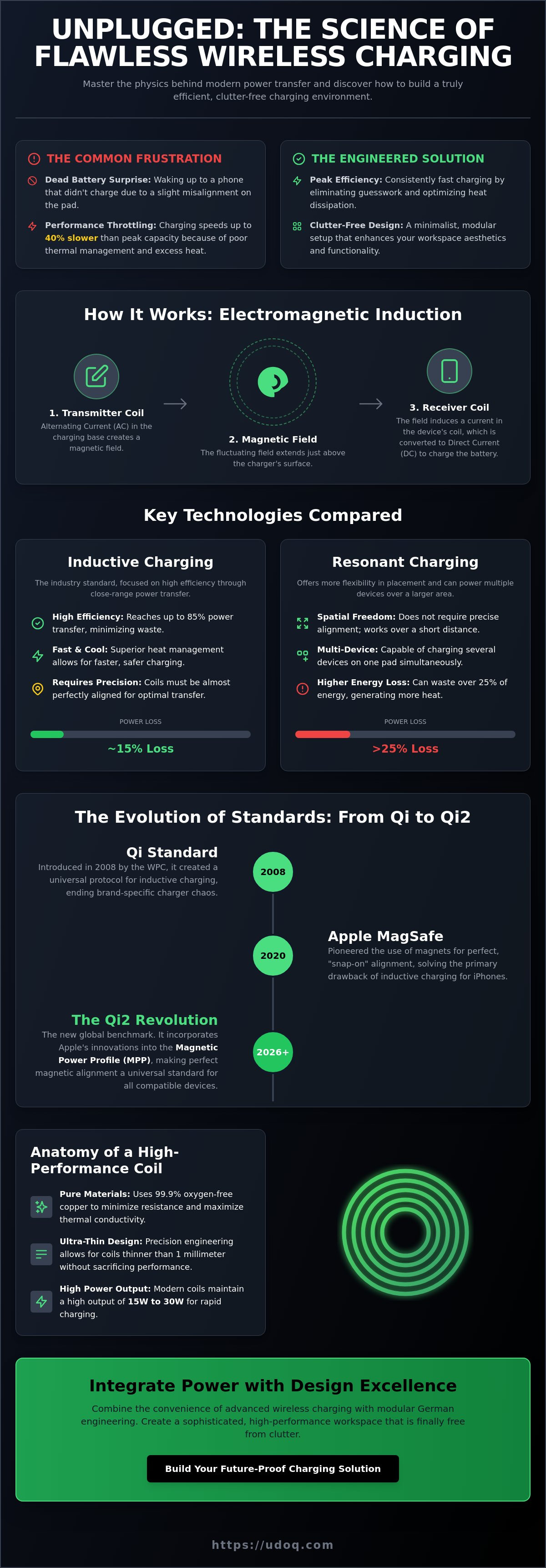
Why does a technology designed for ultimate convenience still require a millimeter-perfect alignment dance to actually function? We've all experienced the frustration of waking up to a dead battery because a phone shifted slightly on its pad. Understanding exactly how does wireless charging work is the first step toward reclaiming your desk from the chaos of cables and heat. You deserve a setup that's as efficient as it is elegant, yet many users still struggle with charging speeds that are 40% slower than peak capacity due to poor thermal management.
You'll master the critical differences between induction and resonance to optimize your 2026 tech environment. This guide explores the latest Qi2 and MagSafe standards, providing the technical clarity needed to eliminate overheating and inconsistent power delivery. Discover how to align sophisticated physics with minimalist design. We're moving beyond the clutter to create a functional, high-performance workspace that honors the principles of German engineering. Let's build a future-proof charging solution that works every time.
Key Takeaways
- Master the physics of electromagnetic induction and the two-coil system that defines modern power transfer.
- Navigate the evolution of charging standards from early Qi to the magnetic alignment of the Qi2 revolution.
- Demystify energy loss and thermal management to understand exactly how does wireless charging work in a high-performance setup.
- Identify the material barriers and safety protocols essential for maintaining peak induction efficiency and device security.
- Discover how to integrate wireless convenience with modular German engineering to create a truly clutter-free environment.
The Physics of Power: Understanding Electromagnetic Induction
Wireless charging is a sophisticated form of wireless power transfer (WPT). It eliminates the friction of physical connectors and the chaos of tangled cables. At its core, the system relies on a two-coil system: a transmitter located in the charging base and a receiver embedded in your smartphone. You've likely wondered how does wireless charging work while setting your device down at the end of the day. The answer lies in inductive charging, which is the primary mechanism driving this technology. It transforms electricity into a magnetic field and back again with surgical precision.
The process begins when alternating current (AC) flows through the transmitter coil. This creates a fluctuating magnetic field that radiates locally. When you place a compatible device on the pad, this field intercepts the receiver coil. This interaction induces a current in the second coil. The device then converts this into direct current (DC) to replenish the battery. It's a seamless exchange of energy across a physical gap. German engineering focuses on optimizing this flux to ensure minimal energy waste. By 2026, the efficiency of these systems has reached 85%, a significant jump from early prototypes.
To better understand how does wireless charging work, watch this helpful video:
Inductive vs. Resonant Charging
Inductive charging remains the industry standard for 2026 consumer electronics. It offers high efficiency but requires precise alignment between coils. This is why many high-end systems use magnets to snap the device into the sweet spot. Resonant charging offers more spatial freedom and can power multiple devices at once. However, it suffers from higher energy loss, often exceeding 25% waste. Most premium charging stations utilize refined inductive coupling to prioritize heat management and speed. This ensures your hardware stays cool and your desk remains clutter-free.
The Role of the Induction Coil
Precision engineering dictates the performance of these components. High-end coils use 99.9% pure oxygen-free copper to minimize resistance and maximize thermal conductivity. The power capacity depends on the coil's diameter and the specific number of windings. Thinner coils might save space but often sacrifice charging speed. Inductive coupling acts as the bridge between two separate circuits. By 2026, manufacturers have refined these coils to be thinner than 1 millimeter while maintaining 15W to 30W output. This allows for the sleek, minimalist designs that define modern tech aesthetics.
The Evolution of Standards: Qi, MagSafe, and the Qi2 Revolution
The history of cable-free power started with fragmentation and chaos. In 2008, the Wireless Power Consortium (WPC) introduced the Qi standard. It established a universal protocol for induction. This move eliminated the need for brand-specific chargers. It paved the way for the industry to adopt a single, reliable language for power. By 2026, this standard has evolved into a sophisticated ecosystem where safety and interoperability are the foundations. Understanding how does wireless charging work in this modern era requires a look at how these standards prevent "rogue" chargers from damaging expensive internal components.
Standards matter because they regulate the wireless transfer of energy through strict communication between the transmitter and receiver. Without these protocols, devices could overheat or receive inefficient power loads. The underlying physics of how does wireless charging work remains rooted in induction, but the delivery has become much smarter. Modern systems now use digital handshakes to verify compatibility before a single watt is transferred.
Qi vs. Qi2: What Changed?
Qi2 is the new global benchmark. It incorporates the Magnetic Power Profile (MPP), a technology based on Apple’s original magnetic innovations. This shift ensures that magnets now handle the alignment for every device, not just iPhones. Efficiency is the primary goal here. For a deeper analysis of these technical shifts, consult our Qi2 Wireless Charger guide. It details how the WPC unified the industry to reduce energy waste.
- Charging Speeds: Qi2 has pushed standard speeds from 7.5W to a consistent 15W across all certified devices.
- Thermal Management: Better alignment means less heat. This protects your battery's long-term health.
- Universal Logic: In 2026, the divide between Android and iOS hardware has effectively vanished at the charging pad.
MagSafe and the Magnetic Advantage
Apple introduced MagSafe in 2020. It solved the frustrating "sweet spot" problem. Traditional charging pads often failed if a phone shifted a few millimeters during the night. Magnets eliminate this energy waste. They ensure perfect coil-to-coil alignment every time. This precision is vital for high-end docking stations made from anodized aluminum. If you own older hardware, you can use a magnetic adapter to gain this functionality. It bridges the gap between legacy tech and modern efficiency.
The 2026 reality is simple. Magnetic attachment is no longer a luxury feature; it's the key to a clutter-free environment. It allows for vertical docking and multi-device stations that stay organized. You can explore our charging stations to see how these sophisticated standards integrate into a premium, professional workspace. Our German engineering ensures that your path to a cable-free life is both elegant and permanent.
The Efficiency Debate: Heat, Power Loss, and Performance
Wired charging via USB-C remains the gold standard for raw efficiency. It delivers nearly 100% of the power directly to your battery. Wireless charging operates differently. To understand how does wireless charging work, you must accept the 80% Rule. Most inductive systems lose 20% to 30% of energy during the transfer between the charging base and the device. This energy doesn't simply disappear; it converts into thermal energy.
Is wireless charging wasteful compared to a cable? Technically, yes. However, the trade-off is about more than just electricity. It's about the relief of a clutter-free environment and the elimination of wear on physical ports. Modern 2026 power management chips mitigate this waste. They use precise algorithms to monitor the coupling efficiency. If the connection is poor, they reduce the draw to prevent damage and optimize the flow.
Induction creates heat as a natural byproduct. Modern 2026 silicon manages this better than previous generations. These chips use real-time thermal throttling to adjust power intake. They protect your battery health by preventing the internal temperature from exceeding 45 degrees Celsius. It's a sophisticated balance between speed and safety. This future-proof technology ensures that your hardware remains functional for years rather than months.
Why Your Phone Gets Hot While Charging
Your device warms up because of the Eddy Current effect. These are loops of electrical current induced within conductors by a changing magnetic field. Misalignment exacerbates this. If the coils don't line up perfectly, the magnetic field works harder and creates more wasted heat. Premium materials matter here. udoq uses anodized aluminum because it dissipates heat significantly faster than cheap plastic. Efficient cooling ensures your device stays within safe operating parameters; it's a hallmark of superior German engineering.
Fast Wireless Charging: Marketing vs. Reality
High-wattage wireless charging often hits a wall of diminishing returns. Pushing 50W into a small smartphone chassis creates extreme heat. Steady, organized charging is often better for battery longevity than rapid bursts. Heat is the primary enemy of lithium-ion battery lifespan. Choosing a stable, well-engineered dock prevents the thermal spikes that degrade your capacity over time. Our charging stations prioritize consistent power delivery over volatile speed. This protects your investment for the long term. Understanding how does wireless charging work helps you make better choices for your tech ecosystem.
Practical Implementation: Cases, Safety, and Placement
Understanding how does wireless charging work requires looking at the physical environment between the transmitter and the receiver. Efficiency isn't just about the coil; it's about the obstacles. By 2026, the industry has shifted away from horizontal pads that clutter desk surfaces. Vertical docks now dominate professional environments. They provide fixed alignment and visual access. This transition solves the "alignment dance" that plagued early adopters. It creates a seamless workflow where the device is always visible and always drawing power.
Can You Charge Through a Case?
Materials matter. Induction relies on a tight magnetic coupling. Most plastic or silicone cases under 3mm thick allow power to flow without significant loss. Once a case exceeds 5mm, the magnetic field weakens exponentially. Metal is the primary enemy. An aluminum back or a steel plate for a magnetic car mount will reflect the energy. This creates heat instead of power. Modern users now opt for cases with integrated magnetic rings. These ensure the coils are centered every time. It's a simple rule: keep it thin, keep it non-metallic, and keep it centered.
Safety and Foreign Object Detection
Safety is a core pillar of German engineering. Foreign Object Detection (FOD) is the critical protocol here. If a coin, paperclip, or credit card sits between the charger and the phone, the system detects an interference. It stops the power flow immediately. Without FOD, metal objects can reach temperatures exceeding 100 degrees Celsius in under two minutes. This presents a clear fire risk. To ensure safety while learning how does wireless charging work, always look for the digital handshake protocol. The device and charger communicate via small data bursts to confirm compatibility before the main power transfer begins. Cheap, uncertified hardware often skips these protocols. This risks your $1,200 smartphone to save a few dollars on a charger.
Precision is the key to longevity. A 2mm misalignment can result in a 20% drop in charging speed. This inefficiency generates wasted heat, which degrades your battery over time. Vertical stations eliminate this guesswork through gravity-fed positioning. Your device sits exactly where it needs to be. It's about order, performance, and the relief of a clutter-free desk. Our modular systems are designed to adapt to these technical requirements while maintaining a minimalist aesthetic.
Discover a more organized way to power your devices with our premium charging stations.
The udoq Approach: Modular Power and Design Excellence
Wireless charging solves the physical connection problem, yet it often fails to solve the cable clutter problem. Most charging pads are loose gadgets that slide across desks, adding to the visual chaos of a workspace. udoq shifts the focus from temporary gadgets to permanent infrastructure. By combining the convenience of induction with the stability of a fixed dock, we create an environment where power is always accessible and never messy.
The philosophy is simple: order brings relief. Our system uses a patented sliding track that allows you to move, swap, and add charging components as your device collection grows. You don't need a new dock every time a manufacturer changes a connector or a battery standard. You simply adjust the rail. It's a sophisticated solution for those who value both high-end aesthetics and functional precision.
Adding Wireless Power to Your Modular Rail
The udoq wireless adapter integrates directly into our aluminum track. It utilizes the same principles of electromagnetic induction discussed earlier, but it optimizes the delivery. While standard pads require you to hunt for the "sweet spot," our adapter holds your phone in a fixed, vertical position. This ensures the copper coils are always aligned for maximum efficiency.
Vertical charging offers distinct advantages for the modern professional. It facilitates instant facial recognition and allows you to monitor notifications at a glance without breaking your workflow. For users managing a diverse ecosystem, the udoq 400 provides ample space to house a smartphone, a tablet, and a smartwatch in one unified hub. It's the ultimate answer to the question of how does wireless charging work in a multi-device household: it works best when it's organized.
German Engineering: Future-Proofing Your Workspace
Sustainability in tech is often overlooked. Most charging stations are discarded within 24 to 36 months because they can't adapt to new device dimensions. udoq breaks this cycle. Our rails are crafted from high-grade anodized aluminum. This material isn't just for looks; it acts as a superior heat sink. Since heat is the primary enemy of charging efficiency, our aluminum construction helps maintain cooler battery temperatures during long power sessions.
- Modularity: Slide, add, or remove adapters as your tech evolves.
- Durability: Industrial-grade materials designed to last a decade, not a season.
- Efficiency: Optimized coil alignment reduces energy waste.
When you understand how does wireless charging work at a technical level, you realize that stability and heat management are vital. We've engineered every millimeter of the udoq system to address these variables. It's an investment in your environment that pays dividends in clarity and longevity. To begin building your custom power hub, explore our full collection of charging stations and experience the relief of a clutter-free desk.
Master Your Workspace Power
Wireless technology has evolved into a high-performance necessity. By 2026, the Qi2 standard has resolved the alignment frustrations of the past, utilizing magnetic arrays to optimize energy transfer. Understanding how does wireless charging work reveals that while induction is complex, the result should be effortless. Modern systems now successfully manage the 20% to 30% power loss seen in earlier iterations, turning efficiency into a standard feature. High-end lifestyle aesthetics finally meet functional tech innovation.
True organization requires hardware that matches the precision of your devices. udoq provides a solution built on patented German engineering and a sustainable modular design. It's a long-term investment that powers up to 10 devices from one outlet, replacing chaos with a refined, premium feel. You don't have to settle for a desk buried in plastic cords. Invest in a system that respects your time and your environment. It's time to transition from cluttered utility to sophisticated order.
Discover the udoq modular charging system and eliminate cable clutter forever. Experience the relief of a perfectly organized home or office today.
Frequently Asked Questions
Is wireless charging bad for my phone's battery health?
No, wireless charging doesn't inherently damage your battery. Heat causes degradation, but modern Qi2 standards introduced in 2023 include sophisticated thermal management to keep temperatures low. Keeping your phone between 20% and 80% charge is the gold standard for longevity. High-quality German-engineered chargers dissipate heat through anodized aluminum surfaces. This prevents the battery from exceeding the 35°C threshold where lithium-ion cells begin to degrade faster.
Can I charge my phone wirelessly if it has a pop-socket or ring holder?
Most pop-sockets and ring holders block the induction coils and prevent a successful connection. Wireless power transfer requires a distance of less than 5mm between the charger and the phone's internal coil. Plastic or metal attachments create a gap that stops the magnetic field. Use a MagSafe-compatible pop-socket that you can remove. This ensures a seamless connection and maintains the minimalist aesthetic of your workspace.
How much slower is wireless charging compared to a USB-C fast charger?
Wireless charging is typically 30% to 50% slower than high-speed wired connections. While a standard USB-C PD charger can deliver 30W or more, most wireless pads are capped at 15W. Efficiency losses of roughly 20% occur during the induction process. Understanding how does wireless charging work helps you choose the right tool; use a cable for a 30-minute boost and a sleek dock for consistent, organized power.
What happens if I leave my phone on a wireless charger overnight?
Your phone won't overcharge if left on a pad overnight. Modern smartphones use integrated circuits to terminate power intake once the battery reaches 100%. The charger then enters a standby mode with minimal draw. This automated process provides the relief of a fully charged device every morning. It's a reliable way to maintain order in your daily routine without the need to monitor your battery levels constantly.
Does wireless charging use electricity even when no phone is on the pad?
Wireless chargers consume a small amount of "vampire" power when idle. Most Energy Star certified chargers draw less than 0.5 watts while waiting for a device to be placed. This is a negligible impact on your monthly utility bill. A modular system that organizes all your cables into one high-quality hub reduces overall clutter and ensures your power usage is as efficient and sustainable as possible.
Can wireless charging work through thick leather or metal phone cases?
Wireless charging works through leather cases under 5mm thick but fails entirely with metal. Metal is conductive and interferes with the magnetic field, often triggering Foreign Object Detection sensors to shut the charger down. If your case contains aluminum or steel, you'll need to remove it. Choose a slim, premium case to maintain the functional elegance of your cable-free setup and ensure the patented technology works correctly.
Is it safe to use wireless charging if my phone is wet or damp?
It's safer to use a wireless pad than a USB-C port if your phone is damp. Wireless systems don't have exposed electrical contacts, which eliminates the risk of short-circuiting a wet port. Always wipe your device dry before placement to prevent moisture from trapping against the charger's surface. This professional approach protects your high-end hardware from long-term corrosion and ensures your charging environment stays clean and functional.
Can I use a wireless charger with an older phone that doesn't have it built-in?
You can upgrade an older device using a Qi receiver patch. These thin adapters plug into your charging port and stick to the back of your phone, enabling induction. It's a practical way to extend the life of your current tech. Learning how does wireless charging work allows you to adapt older hardware to a modern, clutter-free environment without needing to purchase a new smartphone or replace your entire setup.