Why does your premium workspace still look like a tangled nest of plastic and copper? While 90 percent of flagship smartphones released since 2023 support inductive power, most desks remain cluttered with legacy cables. You already know that qi wireless charging is the key to a cleaner environment, but the reality often falls short. You’ve likely dealt with pads that require surgical precision for alignment or cheap chargers that turn your smartphone into a pocket heater.
It’s time to demand more from your hardware. This guide will help you master the technical and practical essentials of wireless power to create a sophisticated, clutter-free desk. You’ll learn the critical differences between the original standard and the new Qi2 magnetic alignment, ensuring your setup remains relevant through 2026. We will explore how to eliminate heat-related battery degradation and choose modular, German-engineered solutions that adapt to your evolving device collection.
Key Takeaways
- Understand the global standard and the technical "handshake" that ensures safe, efficient power transfer.
- Compare Qi, Qi2, and MagSafe to identify the most significant upgrades for your 2026 tech ecosystem.
- Master the practical application of qi wireless charging to replace cable clutter with a sophisticated, minimalist environment.
- Learn to combine wireless convenience with German-engineered modularity for a truly sustainable and organized workspace.
Understanding Qi Wireless Charging: The Universal Standard
Qi is the global benchmark for cable-free power. Managed by the Wireless Power Consortium (WPC), it ensures your devices receive energy without a physical plug. The name "Qi" originates from the Chinese word for energy flow, pronounced "chee." It represents a seamless, invisible stream of power. The core mission is universal interoperability. You should be able to use one charger for every device, regardless of the brand on the box. By 2026, this vision is a reality. Qi technology now powers 95% of mobile devices, from flagship smartphones to high-end wearables.
To better understand how this technology functions in your daily life, watch this helpful breakdown:
The Origins and Evolution of the Qi Standard
The journey of cable-free power began in 2010 with basic 5W charging speeds. Since those early days, the Qi wireless charging standard has undergone radical improvements. The 2023 introduction of Qi2 brought magnetic alignment, solving the problem of inefficient placement. By 2026, we have reached speeds exceeding 50W, rivaling traditional wired connections. Certification is the pillar of this evolution. It guarantees that every charger passes 45 unique safety tests. This prevents overheating and protects your battery's long-term health. We've moved from simple pads to sophisticated, communication-based systems. Modern chargers talk to your device to deliver the exact wattage required.
Inductive Charging: The Science Behind the Magic
Wireless power relies on electromagnetic fields to bridge the gap between surfaces. The process involves two main components: a transmitter and a receiver. The transmitter is the charging base. It contains a copper coil that creates an oscillating magnetic field. Your device contains a matching receiver coil. When these two coils align, the magnetic field generates an electric current in the receiver. Inductive charging is the transfer of energy between two coils without physical contact. This method eliminates the wear and tear associated with traditional ports. It creates a cleaner, more organized environment. Professional charging stations utilize this science to provide a stable, efficient power source. This is German engineering at its most functional. It turns a technical necessity into a minimalist design statement.
How Qi Charging Works: From Coils to Current
Qi wireless charging relies on a sophisticated internal architecture. It isn't magic; it's physics. Inside every transmitter, you'll find high-quality copper coils, ferrite shields to direct magnetic flux, and control circuits that manage power flow. These components work in harmony to move energy without physical contact. This design emphasizes technical precision over messy cables.
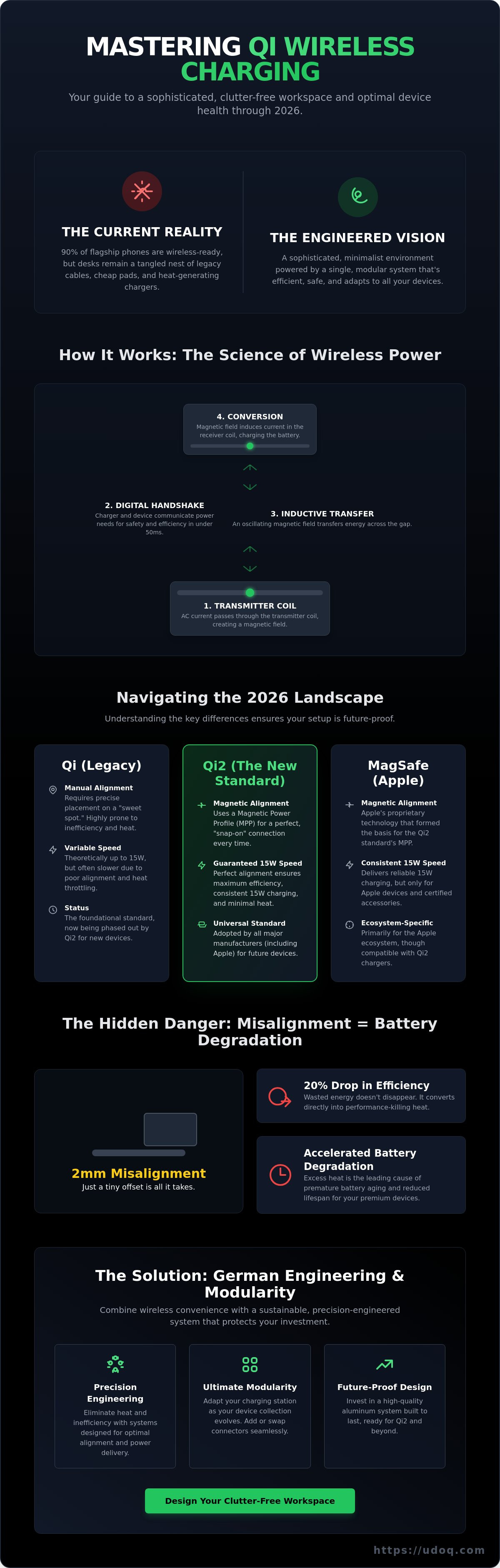
Before a single watt moves, a digital "handshake" occurs. The charger sends a signal to identify the device. The device responds with its specific power requirements. This communication prevents the charger from heating up foreign objects like keys or coins. This safety protocol happens in less than 50 milliseconds, ensuring power only flows when a compatible device is present.
Efficiency depends on resonance and frequency. Most qi wireless charging systems operate within the 110 to 205 kHz frequency range. Distance remains the primary enemy of speed. Energy transfer efficiency peaks when coils are within 3 to 5 millimeters of each other. Once that gap exceeds 10 millimeters, the magnetic field weakens and the connection typically fails.
The Role of Electromagnetic Induction
An alternating current passes through the transmitter coil to create a fluctuating magnetic field. When your smartphone enters this field, its internal receiver coil captures the energy. It converts the magnetic field back into electrical current to fill the battery. This process is seamless and silent. If you use a modular system, the wireless adapter acts as a bridge. It converts traditional docks into Qi-ready stations, maintaining a clean aesthetic while upgrading your tech.
Alignment and Efficiency: Why Placement Matters
Precision is paramount for effective power delivery. Traditional chargers often have a narrow "sweet spot." Misalignment by just 2 millimeters can cause a 20% drop in charging efficiency. This lost energy doesn't just disappear; it turns into heat. Excess heat is the leading cause of battery degradation in mobile devices. Advanced engineering solutions often utilize multi-coil arrays to solve this. These overlapping coils create a larger active area, removing the frustration of precise positioning. This ensures a cooler, faster charge every time you set your device down. It's the difference between a simple gadget and a high-performance qi wireless charging solution.
Discover how udoq engineering eliminates desk chaos with modular charging solutions designed for the modern professional.
Qi vs. Qi2 vs. MagSafe: Navigating the 2026 Landscape
Wireless power evolved rapidly between 2020 and 2026. The original Qi standard relied on basic inductive coupling, which often failed if a device shifted a few millimeters. Qi2 changed that. It's the most significant architectural leap in the history of qi wireless charging because it standardizes magnetic alignment across the entire industry. While Apple's MagSafe once felt like a proprietary walled garden, Qi2 brings that same precision to the Android ecosystem and beyond.
Charging speeds have also seen a massive shift. In 2026, we categorize performance into three distinct tiers:
- Legacy Qi (5W - 7.5W): Found in older accessories; slow and prone to high heat loss.
- Qi2 / Standard MagSafe (15W): The current baseline for flagship smartphones, providing a balance of speed and battery health.
- 2026 High-Speed Profiles (25W): The newest standard for premium devices, utilizing advanced thermal management to rival wired connections.
Qi2 and the Magnetic Power Profile (MPP)
The Magnetic Power Profile (MPP) is the core innovation of Qi2. It uses a precision-engineered ring of magnets to lock the charger and device into a perfect state of alignment. This isn't just a matter of convenience; it's about physics. Perfect alignment ensures that the induction coils are centered, which drastically reduces energy waste and heat buildup. By 2026, this technology has become standard in non-Apple devices, allowing Android users to enjoy the same snap-on functionality that iPhone users have utilized for years. It turns wireless charging into a reliable, high-efficiency utility rather than a finicky luxury.
MagSafe Compatibility: Is it Qi or Something Else?
MagSafe is often misunderstood as a completely different technology. In reality, MagSafe is built directly on the foundation of qi wireless charging but includes proprietary layers for NFC device identification and specific power handshakes. Every MagSafe-enabled iPhone is essentially a Qi device with a magnetic ring. For users who value a structured, clutter-free environment, the udoq magnetic adapter provides a bridge. It allows you to integrate these magnetic devices into a professional docking system without the chaos of loose cables.
Qi2 chargers maintain full backwards compatibility. They'll still power your older 5W or 7.5W Qi-only devices, though you won't get the benefit of the magnetic lock. This interoperability is a hallmark of clever engineering. It ensures that your charging infrastructure remains future-proof as you transition between different generations of hardware. Whether you're using an iPhone 15 or a 2026 Android flagship, the underlying logic remains the same: efficient power through intelligent design.
The Pros and Cons of Going Wireless in Your Workspace
Transitioning to a wireless workspace is a strategic decision that balances raw performance with environmental order. While a USB-C cable offers faster peak speeds, the psychological benefits of a minimalist desk are measurable and significant. A 2024 study by the Princeton University Neuroscience Institute confirmed that physical clutter limits the brain's ability to focus and process information. By removing the "cable nest," you create a sense of professional relief that immediately boosts daily productivity. Qi wireless charging also serves a critical maintenance role. Most smartphone charging ports are mechanically rated for approximately 10,000 cycles. Eliminating this daily friction preserves your device's structural integrity and long-term resale value.
- Minimalism: Reduces visual noise and mental fatigue.
- Port Longevity: Prevents dust buildup and mechanical failure in the USB-C or Lightning port.
- Ergonomics: Allows for easy "grab-and-go" movement during a busy workday.
Why Convenience Outweighs Raw Speed for Desktop Users
Wired charging is built for the "empty-to-full" sprint, but professional users operate differently. Most office workers follow a "top-up" behavior, setting their devices down between meetings or while focusing on a primary screen. A modular docking station turns this passive habit into a constant, effortless power supply. You don't need a 100W cable when your phone stays at an optimal 80 percent charge throughout the day. This "one for all" approach simplifies your desk by accommodating multiple devices on a single sleek rail. For a deeper dive into which setup fits your specific workflow, consult the Ultimate Guide to Choosing a Charging Station to compare wired and wireless efficiency.
Common Myths: Battery Health and Heat Management
A frequent concern is whether qi wireless charging generates excessive heat that damages lithium-ion cells. In reality, modern charging standards include rigorous thermal safety protocols. Sophisticated Qi chips monitor temperatures in real-time and automatically throttle wattage if the device crosses a 40-degree Celsius threshold. Heat is the true enemy of battery life, not the induction process itself. Utilizing premium charging stations crafted from heat-dissipating materials like anodized aluminum ensures your phone stays within safe operating limits. Our focus on German engineering ensures that these thermal pathways are prioritized, protecting your battery health for years rather than months.
Ready to reclaim your desk? Discover a sophisticated docking solution that brings order to your technology.
Integrating Qi into a Premium Modular Setup
High-end technology deserves more than a plastic charging pad. udoq applies disciplined German engineering to the chaos of modern power needs. Our philosophy is simple: modularity leads to sustainability. Instead of a desk littered with tangled cables, udoq uses a patented aluminum rail system. It allows you to combine traditional wired connectors and qi wireless charging in one seamless interface. This isn't a temporary fix; it's a long-term investment in your workspace. You gain the freedom to power up without sacrificing the aesthetic integrity of your office.
Beyond the Pad: Modular Charging for Multiple Devices
Standard charging pads occupy too much horizontal space. If you own five devices, you often end up with five separate pads. This creates visual noise and unnecessary cable clutter. The udoq 400 solves this by aligning smartphones, tablets, and watches on a single 400mm rail. It turns your workstation into a gallery of organized power. Everything stays upright and accessible. You can see notifications at a glance while your battery fills. It's a professional solution for users who value order and efficiency.
Future-Proofing with the udoq Wireless Adapter
Tech standards change frequently. Most docks become e-waste when a new connector or charging standard arrives. udoq breaks this cycle. Our wireless adapter slides directly into the anodized aluminum track. If you upgrade your device fleet, you simply swap the adapter. You don't replace the entire dock. This approach reduces electronic waste and maintains a consistent aesthetic. The qi wireless charging component integrates perfectly with the sleek, metallic finish of your high-end hardware. It's built to last for decades, not just for the life of your current phone.
Checklist for the Ultimate Organized Desktop:
- Audit your daily devices: identify your phone, watch, and wireless earbuds.
- Measure your desk to select the optimal rail length (250mm to 700mm).
- Choose specific adapters for your current wired and wireless needs.
- Route all cables through the internal udoq channel for a 100% hidden look.
- Position the dock within arm's reach to maintain a clean workflow.
Stop settling for disposable plastic accessories. Organize your tech with udoq and experience the relief of a professional, clutter-free environment. It's time to power your devices with the precision they deserve.
Future-Proof Your Workspace Power
The evolution of cable-free power is no longer a trend; it's a global standard. By 2026, qi wireless charging has expanded its ecosystem to support over 13,000 certified devices, making universal compatibility a reality for every modern office. You now understand how the transition from basic induction to advanced alignment maximizes energy efficiency and protects your long-term battery health. A cluttered desk often leads to a cluttered mind, and eliminating the tangle of legacy cables is the first step toward a more productive, professional environment.
Investing in your setup requires a balance of technical precision and sustainable design. Our patented modular system is engineered in Germany using high-grade, sustainable aluminum that's built to last for decades. This isn't just a charger; it's a premium solution that adapts as your device collection grows. Experience the relief of a workspace where every phone, tablet, and wearable has a dedicated, elegant home. Stop settling for disposable plastic docks and choose a system that reflects your commitment to quality and order.
Build your custom udoq charging station today and transform your desk into a streamlined, high-performance hub. You'll appreciate the difference that precision engineering makes every time you power up.
Frequently Asked Questions
Is Qi wireless charging safe for my smartphone battery?
Yes, wireless charging is completely safe for your smartphone battery. Modern systems utilize the Qi standard's built-in thermal management to prevent overheating. A 2023 report from the Wireless Power Consortium confirmed that certified chargers maintain temperatures below 45 degrees Celsius. This protection preserves your battery's lithium-ion chemistry over its 500 to 800 cycle lifespan. It's a reliable, future-proof solution for your daily power needs.
Can I charge my phone through a thick case using Qi?
You can charge through most cases, provided they're less than 3mm thick. While some premium chargers handle up to 5mm, efficiency drops as distance increases. Avoid cases with metal plates, magnets, or credit card slots. These materials interfere with the magnetic field. For the best performance, choose a minimalist case that ensures a seamless connection between your device and the charging coil.
What is the difference between Qi and Qi2?
Qi2 is the latest evolution of the standard, released by the WPC in 2023. It introduces the Magnetic Power Profile, which uses magnets to align the coils perfectly. This eliminates the energy waste often found in older qi wireless charging setups. While original Qi relies on precise manual placement, Qi2 guarantees a 15W charge through perfect alignment. It's a more efficient, sophisticated way to power your mobile ecosystem.
Why does my phone get warm when using a wireless charger?
Your phone gets warm because induction is less efficient than a wired connection. Approximately 20% to 30% of the energy transmitted is lost as heat during the transfer process. This is normal behavior for any electronic device. German engineering ensures our systems dissipate this heat effectively. If your device reaches 40 degrees Celsius, the charging speed will throttle to protect the internal components and ensure longevity.
Do I need a special plug for my Qi wireless charging pad?
You need a high-quality wall adapter to get the most from your charging pad. Most 15W wireless chargers require a 20W or 30W USB-C Power Delivery (PD) plug to function at full capacity. Using a standard 5W brick will result in extremely slow speeds or no charge at all. Invest in a premium adapter to ensure your modular setup has the power it needs to stay organized and clutter-free.
Can I charge my Apple Watch on a standard Qi charger?
No, the Apple Watch requires a specific magnetic charger and won't work on standard Qi pads. While Apple uses a modified version of induction, it's locked to their proprietary hardware. You'll need a charger with the "Made for Apple Watch" certification. Our solution integrates specific modules into one unified station. This keeps your desk organized while powering all your unique device standards simultaneously.
Is wireless charging slower than using a USB-C cable?
Wireless charging is generally slower than using a high-speed USB-C cable. Most qi wireless charging pads max out at 15W, while modern wired connections reach 30W to 100W. A 30-minute wired charge might reach 50% capacity, whereas wireless might only reach 30% in the same timeframe. However, the convenience of a cable-free environment often outweighs the raw speed for overnight or office use.