Your charging cable is not failing because of a manufacturing flaw. It is failing because it was never designed to withstand the constant mechanical stress of handheld use. You likely find yourself asking why do my phone chargers keep breaking every few months as you stare at another frayed, yellowing wire on your nightstand. It is an expensive, unsightly cycle that creates persistent clutter and unnecessary fire risks in an otherwise curated environment.
The chaos of tangled cable nests is a symptom of a disposable tech culture. We will help you understand the specific physics of cable fatigue and the electrical demands of the 2026 USB-C 2.1 standard. You will learn how to protect your current hardware and transition to a permanent, German-engineered charging ecosystem. This article previews a move toward a modular, aluminum architecture that prioritizes longevity over the cycle of constant replacement. It is time to replace the frustration of loose wires with a sophisticated, fixed solution that respects both your devices and your space.
Key Takeaways
- Identify mechanical stress as the core answer to why do my phone chargers keep breaking, specifically focusing on the destruction of internal copper filaments.
- Learn how common behaviors like charging in bed or pulling the cord create irreversible damage to the vulnerable neck of your cables.
- Discover how environmental debris and micro-arcing create hidden heat that silently destroys your charging ports and connectors.
- Explore how a modular, German-engineered system like the udoq 250 secures cables to stop mechanical failure before it starts.
The Anatomy of Failure: Why Phone Chargers Break Mechanically
To understand why do my phone chargers keep breaking, you must look past the plastic casing. The primary killer of modern cables is mechanical stress. This is not a single catastrophic event. It is a cumulative destruction of internal copper filaments. Every time you flex a cable, you invite failure. This cycle is a hallmark of disposable tech culture, where aesthetics frequently outweigh industrial integrity.
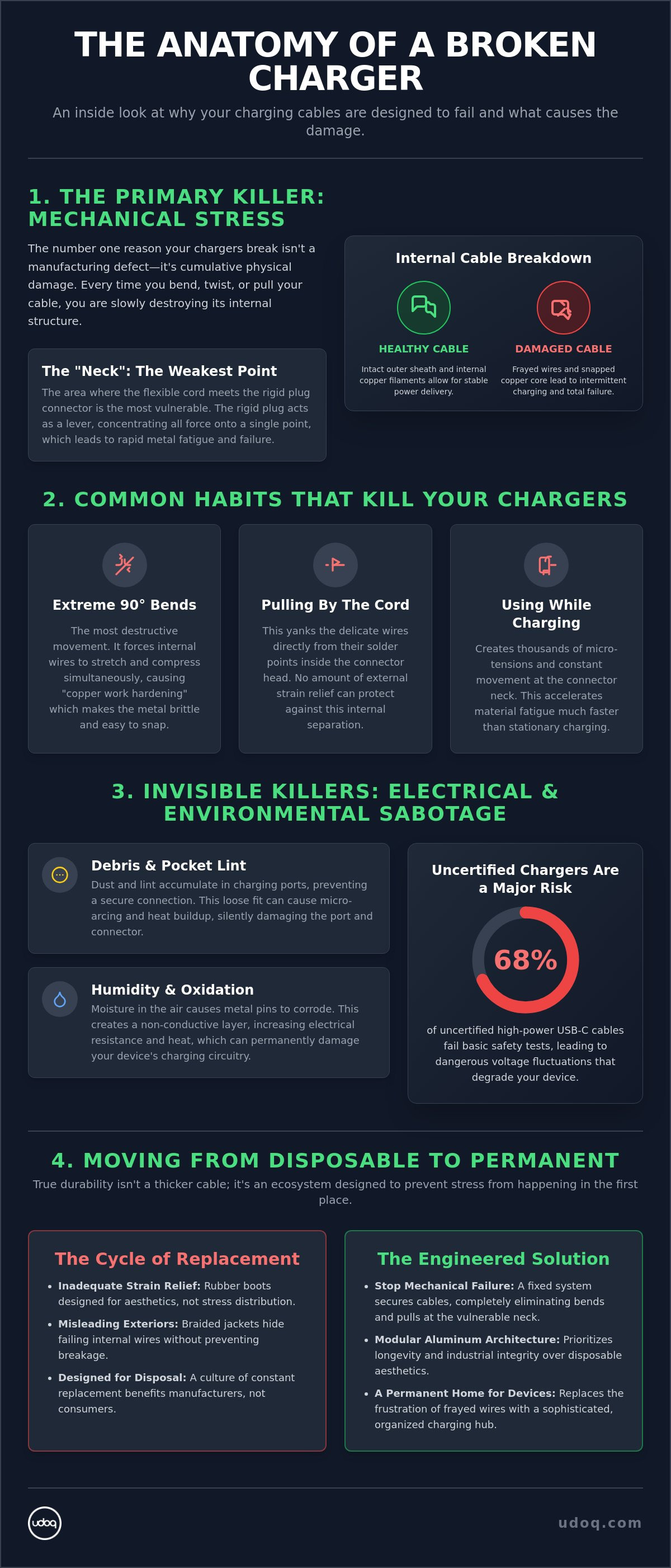
The "Neck" is the most vulnerable point of any charging accessory. This is where the flexible cord meets the rigid plug. The rigid plug acts as a lever. It concentrates all the force of your movement into a single millimeter of flexible wire. This creates a pivot point that leads to rapid material fatigue. Internal friction from constant bending generates heat and microscopic cracks. You aren't just bending a wire; you are slowly snapping a metal spine. Even if the cable looks fine, the internal highway for electrons is crumbling.
To better understand how these mechanical failures manifest in daily use, watch this helpful breakdown:
Braided exteriors are a common distraction. They suggest durability through visual weight. However, these jackets often hide failing internal architecture. A rugged nylon weave cannot stop the internal copper from becoming brittle. It merely delays the inevitable fraying of the outer layer while the core snaps. True durability requires a design that prevents the bend from happening in the first place. This is where precision engineering replaces disposable aesthetics.
The Physics of Tension and Compression
Using your device while it charges creates constant micro-tensions. These tiny pulls add up over weeks and months. Copper work hardening is the process where repeated bending makes metal brittle. Once the metal loses its ductility, it snaps. The 90-degree bend is the most destructive movement for any cable adhering to the USB-C specification. It forces the internal wires to compress on one side and stretch on the other simultaneously. This dual stress accelerates the breakdown of the conductive core.
Strain Relief: The Good, The Bad, and The Plastic
Most manufacturer-provided cables feature inadequate rubber boots. These are designed for aesthetic minimalism, not long-term utility. There is a vast difference between lifestyle design and functional industrial engineering. Even reinforced cables fail when you pull from the cord instead of the plug. This habit causes internal separation that no amount of plastic shielding can prevent. Common failures in standard strain relief include:
- Inadequate flex zones that concentrate stress rather than distributing it.
- Low-grade polymers that degrade under UV light and skin oils.
- A lack of internal reinforcement against longitudinal pulling.
When these components fail, the internal copper is left defenseless. The result is a cable that works only at a specific angle, eventually leading to a total loss of power delivery.
Invisible Killers: Electrical and Environmental Saboteurs
Mechanical stress is the visible cause of failure, but invisible environmental factors often trigger the initial decline. Understanding why do my phone chargers keep breaking requires looking into the microscopic world of your charging port and the volatile nature of electrical current. Debris, voltage instability, and thermal cycles act as silent saboteurs. They compromise your tech long before the wire actually frays.
Cheap, uncertified wall adapters are a significant part of the problem. Research from 2026 indicates that 68% of uncertified high-power USB-C cables fail basic safety tests. These low-quality components often lack proper voltage regulation. They allow current to fluctuate wildly, which stresses the internal chips of your smartphone. Over time, these surges degrade the battery and the charging circuitry itself. Humidity and oxidation also play a role. When exposed metal pins meet moisture in the air, they develop a thin layer of non-conductive residue. This forces the charger to work harder, increasing resistance and generating unnecessary heat.
The Pocket Lint Problem
Debris is a physical barrier to a stable connection. Pocket lint and dust accumulate inside your device port, preventing the connector from achieving a flush, secure seat. Without that distinctive "click," the connection remains loose. This instability allows for the micro-movements that lead to internal copper fatigue. To fix this, use a non-conductive tool like a wooden toothpick or compressed air to gently clear the port. Avoid metal needles, as they can short-circuit the delicate pins. A stationary docking station prevents this buildup by keeping the connection point elevated and away from the debris found on desks or in pockets.
Thermal Fatigue and Overheating
Modern fast-charging standards like USB PD 3.1 deliver up to 240W of power. This high-energy transfer generates significant heat. This thermal stress causes the plasticizers in your cable jackets to degrade. They become brittle and prone to cracking. Poor contact creates a "Heat Loop" where high resistance generates more heat, which further damages the connection points. Aluminum-housed systems offer superior heat dissipation compared to plastic. By drawing heat away from the connector, they preserve the integrity of the materials. You can achieve a more stable charging environment by switching to components designed for thermal efficiency and permanent placement.
Transitioning to a modular charging station eliminates the variables that lead to these invisible failures. When the connection is fixed and the environment is controlled, the cycle of broken chargers finally ends.
Common Habits That Are Killing Your Chargers
Mechanical precision and electrical standards provide the framework for durability. However, human behavior remains the most volatile variable. If you find yourself asking why do my phone chargers keep breaking, the answer often lies in daily rituals that prioritize convenience over component integrity. These habits exert forces on your tech that no consumer-grade cable is built to survive indefinitely.
The "Bedtime Bend" is a primary offender. Resting your phone on your chest or a mattress while it is plugged in forces the cable into an extreme angle. This creates a constant lateral strain on the internal filaments. Similarly, unplugging by the cord instead of the plug head is a recipe for internal separation. This "yank" method slowly detaches the copper wires from their solder points. It's a subtle destruction that eventually leads to a dead cable.
Chaos also breeds failure. Tangled "cable nests" on nightstands or desks do more than just ruin your aesthetic. Overlapping wires create localized heat and physical pressure. When cables are crushed under the weight of other objects or bent over sharp desk edges, the protective insulation thins. Storing cables in tight loops is equally damaging. This creates "coil memory" where the plastic and metal develop permanent kinks. Once a kink is established, the internal resistance increases, and the cable is one flex away from a total break.
The 'Using While Charging' Trap
This is the leading habit behind premature cable death. When you hold your phone while it's connected, the device body acts as a powerful lever against the connector. Every tilt and shift of your hand amplifies the pressure on the charging port. To break this cycle, transition to a fixed viewing angle. A stable environment removes the lever effect entirely. It ensures that the connection remains static, preserving the delicate pins and internal wiring.
Improper Storage and Portability
The "Stuff and Go" method is a common cause of sudden-death failure. Throwing a loose cable into a bag subjects it to unpredictable crushing and twisting forces. If you must transport your tech, use the "over-under" technique to coil it. This method prevents the internal wires from twisting against their natural grain. Ideally, a permanent desk setup reduces the need for constant transport. By establishing a stationary charging zone, you eliminate the wear and tear associated with portability. A high-quality charging station provides the stability necessary to keep your cables in pristine condition for years.
Beyond Hacks: Transitioning to a Systemic Solution
Bandages do not fix physics. Most DIY "hacks" like wrapping pen springs around cable necks or applying electrical tape are merely temporary distractions. They attempt to reinforce a failing structure without addressing the core reason why do my phone chargers keep breaking. The problem is not the strength of the plastic; it is the constant movement. If a cable is allowed to flex, it is destined to fail. True longevity requires a fundamental shift from disposable accessories to a fixed, industrial-grade system.
Stationary charging is the definitive answer to cable fatigue. When a cable is secured within a rigid housing, the mechanical stress on the internal copper filaments drops to zero. This concept eliminates the variables of human error and environmental wear. By centralizing your power needs into a single, high-quality station, you move away from the cycle of buying four disposable cables every year. You transition to a modular architecture that evolves with your technology rather than being replaced by it. It is a transition from chaos to order.
The Psychology of an Organized Workspace
Visual noise is a documented drain on productivity. A desk cluttered with frayed wires and tangled "cable nests" creates a sense of environmental friction. Learning how to create a minimalist desk setup is about more than just aesthetics; it is about mental clarity. Premium materials like bead-blasted aluminum offer a tactile and visual relief that plastic simply cannot match. An organized environment suggests a professional level of discipline and attention to detail. It transforms a source of daily anxiety into a streamlined, high-performance workspace.
The Modular Advantage
Loose-cable hubs are often marketed as solutions, but they still rely on the same fragile connectors that lead to failure. A fixed-cable dock is superior because it removes the possibility of lateral movement. Modularity is the key to sustainable tech ownership. It allows you to swap individual components, such as moving from an L-CABLE to a C-CABLE, without discarding the entire system. Future-proofing is the ability of a system to remain functional and relevant as industry standards and device ports inevitably change. This adaptability ensures that your investment remains viable for years, regardless of which smartphone or tablet you purchase next.
Eliminate the frustration of failing tech today. You can invest in a permanent charging system that brings professional-grade engineering to your home or office.
udoq: The Professional Answer to Broken Chargers
The udoq 250 serves as the definitive entry point for those seeking a permanent end to the cycle of why do my phone chargers keep breaking. It is a minimalist expression of German engineering. Marcus Kuchler and Marwin Product Design developed this system to replace the disposable trends of the tech industry with a sustainable alternative. The foundation of this solution is a patented sliding rail. It houses the L-CABLE and C-CABLE in a way that eliminates all mechanical movement. When the cable cannot move, the internal copper filaments cannot fail.
Sustainability is the core of the udoq philosophy. Systems like the udoq 400 are designed to evolve with your hardware for decades. When charging standards change, you do not discard the dock. You simply swap the modular connector. This architectural adaptability ensures your charging environment remains sleek and functional regardless of industry shifts. It is an investment in quality that respects both your physical space and your technology.
Engineered for Zero Strain
Standard chargers fail because they force the cable neck to support the weight of the device. The udoq architecture reverses this dynamic. The aluminum rail holds the smartphone or tablet securely. The connector remains perfectly static within the rail. This removes the micro-tensions that lead to copper work hardening and eventual snapping. The udoq 400 Premium Watch provides a dedicated mount that secures your most valuable tech without putting pressure on the charging pins. The solid aluminum rail also acts as a massive heat sink. It draws thermal energy away from the battery during high-power delivery. This protects both the cable and the device from the thermal degradation discussed in previous sections.
Customizing Your Charging Ecosystem
Organization is a personal requirement that varies by household. You can explore the udoq charging stations collection to find a configuration that matches your specific device count. The udoq 250 is optimized for minimalist desks and bedside tables. The udoq 700 functions as a centralized family hub. It eliminates the "cable nests" that typically clutter shared living spaces. Choosing a permanent system is an investment in your environment and your productivity. For those who require a blend of stationary stability and on-the-go mobility, read our analysis of The Best iPhone Charger Solutions. Transitioning to udoq means you will never have to buy a replacement cable for your home setup again.
Invest in Permanent Charging Longevity
The persistent cycle of cable failure is not an inevitability. It is a design flaw you can correct. By understanding why do my phone chargers keep breaking, you recognize that movement is the primary enemy of durability. Mechanical stress and poor habits are the true killers of your hardware. Replacing one fragile wire with another disposable alternative only resets the timer on the next failure. It's time to stop settling for temporary fixes.
True organization requires a shift toward stationary architecture. Our patented German engineering and sleek aluminum design provide a foundation that eliminates connector strain. With a 10-year adaptability guarantee, your investment evolves with your tech rather than becoming obsolete. Choose quality over convenience and order over chaos. Stop the cycle of broken cables; build your custom udoq dock today. Reclaim your space and enjoy the psychological relief of a perfectly managed environment.
Frequently Asked Questions
Why does my charger only work at a certain angle?
Internal copper filaments that are partially snapped create the need for a specific charging angle. By bending the wire, you are forcing these broken ends back into temporary contact. This is a definitive sign of advanced mechanical fatigue. It indicates that the internal structure is compromised and the cable is nearing total failure. It's a terminal condition that requires immediate replacement to avoid further port damage.
Are braided cables actually more durable than plastic ones?
Braided exteriors offer superior resistance to surface abrasion but do not solve the core problem of why do my phone chargers keep breaking. While the nylon weave prevents the outer jacket from fraying, it cannot stop the internal copper filaments from becoming brittle through repeated bending. True durability requires a fixed connection point. Reinforced jackets are merely a temporary bandage for a flawed, flexible design.
Can a broken charger damage my phone's battery?
Damaged chargers can absolutely compromise your device's battery and internal chips. Poor contact leads to micro arcing, which generates localized heat. This thermal stress degrades the chemical health of your battery over time. Inconsistent power delivery also forces the phone's power management controller to work harder. This can lead to long term hardware failure and reduced charge capacity.
How do I know if the problem is my cable or my phone's charging port?
Isolate the issue by testing your device with a known, high quality cable. If a new connector clicks into place without wiggling, your original cable is the failure point. If the connection remains loose or intermittent with multiple cables, your port likely contains debris or has suffered internal wear. Use a non conductive tool to clear the port before assuming the hardware is broken.
Is it dangerous to use a charger with exposed wires?
Using a charger with exposed insulation or visible wires is a significant safety hazard. Damaged shielding increases the risk of short circuits and electrical fires. Even if the cable still delivers power, the lack of protection makes it unstable and dangerous. Discard any cable showing signs of internal exposure immediately to protect your home and your technology.
What is the 'over-under' method for coiling cables?
The over under method is a professional coiling technique that prevents internal wire twisting. By alternating the direction of each loop, you neutralize the natural tension of the cable. This eliminates the kinks and coil memory that lead to permanent mechanical damage. It's a simple habit that significantly extends the lifespan of any portable tech you must carry in a bag.
Does fast charging make cables break faster?
High energy transfer creates thermal stress that can harden a cable's insulation. While the charging standard itself isn't the problem, the resulting heat makes cheap plastics brittle. This leads to cracks at the neck where the cable flexes most. A stationary system manages this heat more effectively than a loose cable resting on a soft surface like a bed or sofa.
Why do cheap third-party cables stop working after an iOS update?
Uncertified third party cables often fail after software updates because they lack necessary authentication chips. Manufacturers use these updates to enforce safety and performance standards across their ecosystem. If a cable doesn't meet the required specifications, the device's security handshake will reject it. This is a common reason why do my phone chargers keep breaking after an operating system transition.