The average high-tech household in 2026 manages 12.4 connected devices, yet most workspaces remain buried under a chaotic web of tangled cables. It's a common frustration: chargers that slow down when multiple devices are plugged in or become obsolete the moment a new connector standard emerges. You deserve an environment that reflects order and technical precision, not a collection of disposable plastic hubs.
Understanding what to look for in a multi-device charger is the first step toward reclaiming your desk and future-proofing your tech investment. With the April 2026 EU mandate requiring USB-C for laptops and the widespread adoption of Qi2.2 wireless standards, your hardware must be as adaptable as it is powerful. This guide provides the technical and aesthetic criteria needed to master your charging setup. You'll learn how to select a modular system that eliminates clutter, supports rapid GaN-powered speeds, and evolves alongside your devices for years to come.
Key Takeaways
- Transition from cable chaos to a streamlined organizational ecosystem that enhances focus and workspace productivity.
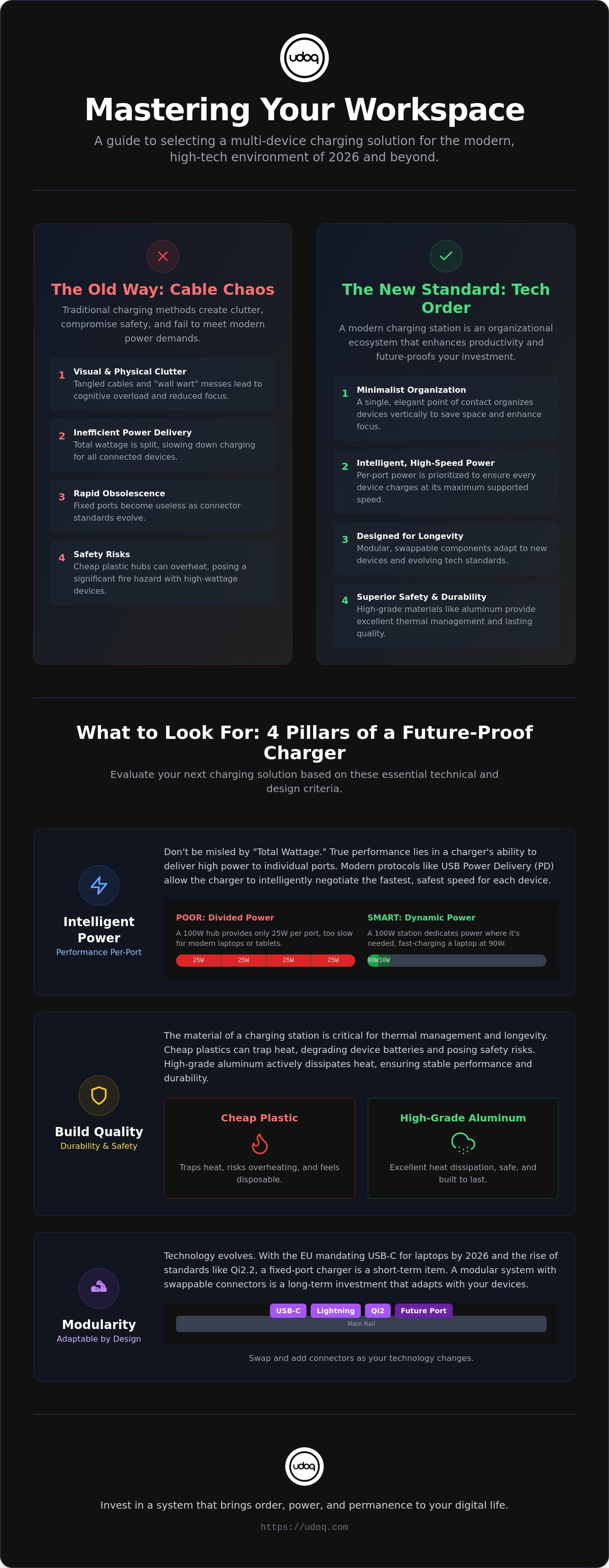
- Learn exactly what to look for in a multi-device charger by prioritizing per-port power output over misleading total wattage claims.
- Identify why high-grade materials like aluminum are essential for superior thermal management and long-term hardware durability.
- Future-proof your desk with modular components that allow you to swap connectors as industry standards and device types evolve.
- Select a tailored docking solution based on your specific device count to achieve a permanent, minimalist aesthetic.
Understanding the Shift: Why Multi-Device Charging Stations Are Essential in 2026
The charging station is no longer a peripheral accessory. It's a central pillar of the modern workspace. In 2026, we don't just need power; we need order. The "cable chaos" of previous years has reached a breaking point as the average high-tech household now manages over 12 connected devices. A true multi-device charging station acts as an organizational ecosystem. It transforms a tangle of wires into a streamlined, high-performance command center that respects your physical and mental space.
To better understand how these systems have evolved to meet modern power demands, watch this analysis of current charging technology:
We've moved beyond simple USB hubs. Today's sophisticated docking systems must handle high-wattage demands while maintaining a minimalist aesthetic. When considering what to look for in a multi-device charger, the distinction between budget plastic hubs and premium industrial designs becomes clear. Quality stations prioritize thermal management and strict adherence to the latest USB-C and Power Delivery standards to ensure your hardware remains safe and efficient. Modern users require systems that support everything from 15W smartphone top-ups to 240W laptop charging without overheating the desk surface.
The Problem with Standard Power Strips
Traditional power strips are relics of a previous era. They fail to manage the physical footprints of modern tablets, smartphones, and wearables. Overcrowded strips often lead to a "wall wart" mess that creates significant visual noise and frustration. Beyond aesthetics, cheap plastic power hubs pose real fire safety risks when forced to distribute high wattages across multiple ports simultaneously. A premium charging station replaces this hazard with a single, elegant point of contact that organizes your devices vertically to save space.
The Psychological ROI of an Organized Desk
A minimalist desk setup is more than a design choice; it's a productivity tool. Research consistently links physical clutter to cognitive overload and reduced focus. When you establish a dedicated home for your devices, you eliminate the daily anxiety of searching for misplaced cables. This shift treats the charger as functional furniture rather than a temporary accessory. Understanding what to look for in a multi-device charger allows you to invest in a long-term solution that protects your mental clarity. It's about creating a space where technology serves your workflow instead of distracting from it. This psychological relief is the true return on investment for any high-end office upgrade.
Technical Specs That Matter: Power, Ports, and Standards
High-performance charging requires more than just high numbers on the box. When identifying what to look for in a multi-device charger, you must look past the "Total Wattage" label. A 100W charger might sound impressive, but if that power is divided poorly across four ports, your tablet may still charge at a crawl. Modern devices require specific, high-output ports to trigger their fast-charging modes. Professional-grade stations prioritize per-port performance to ensure every connected piece of hardware receives its maximum supported intake.
USB-C is the non-negotiable standard for 2026, especially following the EU mandate requiring it for all new laptops. This isn't just about the physical shape; it's about the Power Delivery (PD) protocol. Current USB PD 3.1 specifications support up to 240W, allowing a single station to power everything from a smartwatch to a high-end workstation. PD allows the charger to "talk" to your device, negotiating the exact voltage needed to maximize speed without damaging the battery. This intelligent handshake is what separates a long-term tech investment from a disposable accessory.
While wireless charging offers convenience, wired docking remains the gold standard for efficiency and thermal management. Wired connections provide consistent, high-speed power without the heat buildup that can degrade smartphone batteries over time. For those managing multiple high-drain devices, a physical connection ensures the fastest possible recovery time and superior energy transfer.
Decoding Fast Charging Protocols
Intelligent power distribution is the hallmark of a premium system. It ensures that when you plug in a laptop alongside a smartphone, the charger prioritizes the device with the higher demand. Gallium Nitride (GaN) technology is the gold standard for creating compact, cool-running power sources that maintain high efficiency even under heavy loads. This innovation allows for smaller footprints without sacrificing the raw power needed for modern workflows.
Connector Versatility: Moving Beyond One-Size-Fits-All
Most households are a mix of legacy and modern technology. You likely have a combination of Apple Lightning, USB-C, and perhaps micro-USB devices. Fixed-port chargers force you to choose one or the other, leading to eventual obsolescence as standards shift. Swappable cables are the superior solution, allowing you to adapt your station as your hardware collection changes. This flexibility is a core component of what to look for in a multi-device charger if you want your setup to remain relevant for years.
Explore our range of modular charging stations to find a system that adapts to your unique device mix and power requirements.
Build Quality and Design: Why Materials Are Not Just About Looks
Superior design is more than a surface-level aesthetic. It is an expression of mechanical integrity. When evaluating what to look for in a multi-device charger, the physical construction is as critical as the internal circuitry. Most mass-market chargers rely on cheap, injection-molded plastic. This material is a thermal insulator; it traps heat generated during high-speed power transfers. A premium docking station utilizes high-grade aluminium. This choice is intentional. Metal provides the structural rigidity required for a permanent desk fixture while ensuring your devices remain cool during intensive charging cycles.
Stability is a hallmark of professional engineering. A lightweight charger is a constant source of friction. If you must use two hands to unplug a phone, the design has failed. High-quality stations possess the necessary mass to stay anchored to your desk. This weight, combined with precision-milled components, allows for effortless, one-handed operation. It reflects a "German Engineering" philosophy where every millimetre is accounted for, and every movement is smooth. This focus on durability ensures the device won't just work for years; it will look and feel like a high-end tool rather than a disposable accessory.
Aluminium vs. Plastic: A Performance Comparison
Aluminium acts as a natural heat sink. It draws warmth away from sensitive battery components, extending the lifespan of your expensive hardware. In contrast, plastic hubs often become brittle and discoloured over time due to heat stress. Beyond performance, the environmental cost of disposable plastic tech is staggering. Choosing a metal-based system is a commitment to longevity. It reduces e-waste by providing a chassis that outlasts several generations of mobile devices. You can learn more about Why Aluminium Is the Superior Material for Desk Tech in our detailed material analysis.
Ergonomics of the Docking Rail
The ergonomics of what to look for in a multi-device charger often come down to how your devices actually sit. Traditional "toaster" style docks use fixed slots. These are notoriously rigid. They rarely account for varying phone case thicknesses or the need to view your screen while it charges. A sliding rail system offers a proprietary solution. It allows you to move connectors laterally, creating a custom fit for your specific device mix. This mechanical innovation supports one-handed docking and undocking. It also ensures that your devices are displayed at an optimal viewing angle, turning your charging station into a functional part of your digital workflow.
Future-Proofing Your Investment: The Case for Modularity
Static chargers are a design dead-end. Most "all-in-one" hubs are built for the current moment but fail to anticipate the next. When a connector standard changes, these devices become immediate e-waste. This is the primary flaw in traditional docking hardware. Modularity is the essential solution when considering what to look for in a multi-device charger. It allows you to swap individual cables and adapters without discarding the high-grade aluminium chassis. You invest in the system once and upgrade the components as needed.
Sustainability is often overlooked in tech reviews. A modular system reduces environmental impact by extending the product lifecycle indefinitely. Instead of buying a new plastic hub every two years, you simply slide in a new C-CABLE or MAGNETIC ADAPTER. This mechanical adaptability ensures your workspace remains tidy and your technology remains functional regardless of industry shifts. It's a professional approach to tech ownership that values longevity over disposable convenience.
The Evolution of Connectors
The trajectory of mobile hardware is defined by constant change. We've moved from proprietary 30-pin connectors to the universal USB-C standard. Today, magnetic standards like Qi2 are redefining convenience. It's helpful to understand What Is MagSafe? and how these magnetic profiles improve charging efficiency. A modular rail accommodates these innovations, allowing you to integrate wireless charging alongside traditional wired connections without cluttering your desk.
Customizing Your Charging Capacity
Your power needs will change. A rail system like the udoq 400 or udoq 700 allows for family-wide expansion without additional clutter. You can add or remove connectors based on your current device count. This system supports a mix of wired, wireless, and magnetic charging in one cohesive unit. Modularity turns a tech accessory into a lifelong tool that adapts to your environment. It provides the freedom to scale your setup as your hardware collection grows. This adaptability is the ultimate differentiator for those seeking a premium, long-term solution.
Build a workspace that never goes out of style with a modular charging station from our collection.
Selecting Your udoq: The Logical Conclusion to Tech Order
The search for what to look for in a multi-device charger concludes with a system that matches your specific device count and workspace dimensions. udoq provides a definitive answer to cable chaos. Our range includes the udoq 250, 400, 550, and 700 models. Each utilizes our patented sliding connector technology. This mechanical innovation allows you to position your devices with mathematical precision. It ensures your workspace remains a reflection of order rather than a storage site for tangled wires.
Performance requirements dictate your choice between a standard rail and the POWER series. If your workflow involves high-drain hardware like laptops or professional tablets, the udoq POWER variants are essential. These units provide the sustained high-wattage output necessary for rapid charging across multiple ports. They integrate the technical specs discussed earlier into a single, cohesive aluminium chassis. You no longer have to choose between aesthetic minimalism and technical capability.
Finding Your Perfect Rail Size
Space optimization is a key part of what to look for in a multi-device charger. The udoq 250 is designed for personal nightstands or compact desks, comfortably holding two to three devices. For larger households or professional studios, the udoq 700 provides an expansive rail that accommodates an entire ecosystem of hardware. Smartwatch users should consider the udoq 400 premium watch variant. It features a dedicated space for wearables alongside your primary devices. If desk space is non-existent, our WALL MOUNT accessory allows you to move your charging station to any vertical surface, reclaiming your workspace entirely.
Next Steps to a Clutter-Free Life
Begin by conducting a thorough inventory of your current "cable mess." Count your devices and identify their specific connector types. Measure your available desk or wall space to determine which rail size fits your environment. This preparation ensures your investment provides the psychological relief of a tidy home from day one. Browse the full udoq charging station collection to select the foundation of your new organizational ecosystem. We remain committed to the 2026 standards of German-engineered sustainability and longevity. Your technology will evolve, but your udoq will remain the permanent, elegant anchor of your digital life.
Master Your Workspace Ecosystem
Your workspace is a reflection of your professional standards. Transitioning from a chaotic web of wires to a streamlined docking system is more than a simple aesthetic upgrade; it's a commitment to long-term efficiency. By prioritizing high-grade heat-dissipating aluminium and a sustainable modular design, you ensure your technology remains a functional asset rather than a constant source of frustration. These material choices protect your hardware while providing the stability required for a permanent desk fixture.
Understanding what to look for in a multi-device charger empowers you to move beyond disposable tech accessories. Seek out solutions that offer patented German engineering to guarantee mechanical integrity and precision for years to come. A truly premium station doesn't just power your devices; it organizes your environment and evolves alongside the ever-changing technical landscape of 2026. This adaptability is the hallmark of a wise tech investment.
Stop managing clutter and start optimizing your digital life. Build your custom udoq station today and experience the psychological relief of a perfectly ordered desk. You've already invested in high-end devices; now it's time to invest in the sophisticated space where you use them every day.
Frequently Asked Questions
Can I use a multi-device charger for both Apple and Android devices simultaneously?
Yes. Multi-device chargers are designed for universal utility, allowing you to charge mixed ecosystems side-by-side without interference. High-quality systems use independent power paths to manage different charging protocols for each port. This versatility is a key factor in what to look for in a multi-device charger. By using specific adapters like the L-CABLE and C-CABLE, you create a unified home for all family hardware regardless of the manufacturer.
Will a multi-device charging station charge my devices as fast as the original wall brick?
Yes, provided the station supports the necessary Power Delivery (PD) standards and per-port wattage. A premium station often outperforms original bricks by providing consistent, high-output power to multiple ports at once. Check the specific output of each port to ensure it meets your device's fast-charging threshold. This typically requires 20W for smartphones and 60W or more for laptops to achieve optimal speeds.
Are multi-device chargers safe to leave plugged in overnight?
Yes. Professional-grade chargers incorporate advanced safety circuits to prevent overcharging, short circuits, and overheating. Choosing a station with an aluminium chassis provides superior thermal management compared to plastic alternatives. These materials dissipate heat effectively, ensuring the internal components remain at safe operating temperatures during long-term use. This mechanical integrity is essential for any permanent desk fixture.
Do I need to take my phone case off to use a docking station?
No, a well-engineered docking station accounts for various case thicknesses. Our sliding rail system allows you to adjust the connector height manually. This ensures a secure connection for everything from minimalist skins to rugged, industrial-grade protective cases. It eliminates the daily friction of removing your case every time your device needs power.
What is the difference between a charging hub and a modular docking station?
A charging hub is a static block with fixed ports that often adds to cable clutter. A modular docking station is a structural organizational tool. It uses a rail system to hold devices vertically while allowing you to swap connectors as your tech evolves. This modularity prevents the entire unit from becoming e-waste when a new connector standard is released in the future.
Can a multi-device charger power a laptop and a smartphone at the same time?
Yes, provided the unit has a high total wattage and dedicated Power Delivery ports. High-performance models like the udoq POWER series are designed specifically for this task. They can distribute sufficient wattage to a laptop while simultaneously fast-charging several smartphones or tablets. This capability makes them the logical conclusion for a professional workstation setup.
How do I know if my devices are compatible with a specific charging station?
Compatibility is determined by the physical connector and the power requirement. If your device uses USB-C, Lightning, or Micro-USB, it will work with a modular system. When researching what to look for in a multi-device charger, verify that the station offers the specific cable adapters you need. Modular rails allow you to mix and match these connectors to fit your exact device inventory.
Is it better to have more USB-C ports or a mix of USB-A and USB-C in 2026?
Prioritize USB-C ports for all new investments. By July 2026, USB-C is the mandatory standard for most electronics, including laptops and smartphones. While keeping a single USB-A port for legacy accessories is practical, the industry has moved toward the C-standard for its superior speed and power delivery. A future-proof station must reflect this shift to remain relevant for the next decade.