Your desk shouldn't be a graveyard for outdated cables and slow, plastic hubs. Most professionals accept cable clutter as an inevitable byproduct of a multi-device life, but this chaos is actually a design failure. You've likely experienced the frustration of replacing an entire charging dock simply because a single device port changed or a faster charging standard emerged. It's an expensive, inefficient cycle that clutters your physical and mental space.
It's time to demand more from your infrastructure. This guide will show you how to eliminate cable mess forever by choosing a modular system that evolves with your technology. You'll learn how to transition to a single-outlet solution that maintains a minimalist workspace without sacrificing speed. With the April 2026 EU mandate for USB-C laptops now in effect, standardization is finally here. We'll explore how to leverage Qi2 25W wireless technology and USB PD 3.1 power to create a durable, high-performance charging station that lasts for years. Discover the relief of an environment designed for order and longevity.
Key Takeaways
- Learn why high-grade aluminum and superior thermal management are essential for protecting your device’s long-term battery health.
- Evaluate your device mix to select a charging dock that offers the precise capacity and length needed for your specific workspace.
- Discover how modular sliding rails and interchangeable C-Cables or L-Cables provide a future-proof solution to changing industry standards.
- Analyze the trade-offs between wireless convenience and wired efficiency to maximize your daily charging performance.
- Reclaim your mental clarity by implementing a single-outlet infrastructure that eliminates cluttered power strips and tangled cords.
Beyond the Plastic Stand: What Defines a Modern Charging Dock?
A modern charging dock is no longer just a peripheral accessory. It is a centralized power hub designed to anchor your digital life. By 2026, the concept of a docking station has evolved from a simple plastic stand into a foundational piece of home and office infrastructure. It serves as the primary intersection between high-end industrial design and functional power management.
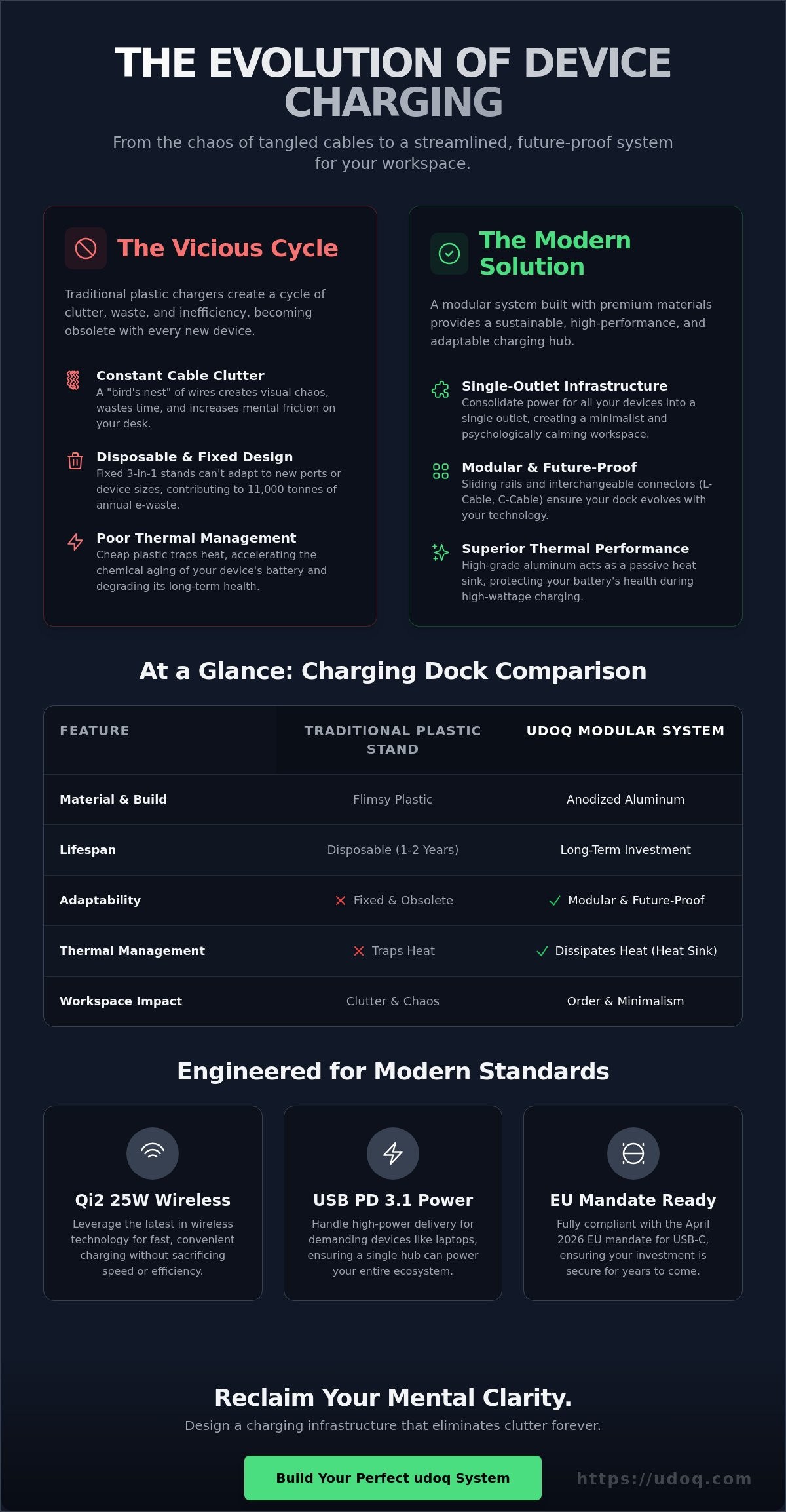
Visual chaos creates mental friction. A tangled web of cables on a desk or entryway signals disorder and wastes time. Modern charging solutions prioritize the psychological relief of a tidy environment. They replace the "bird's nest" of wires with a streamlined, professional aesthetic. This shift reflects a transition from disposable, cheap chargers to "tech furniture" built for longevity and performance.
To better understand how modern hardware integrates with these systems, watch this helpful video:
The Evolution of Multi-Device Power
Charging has moved beyond the era of the single wall outlet. Most households now manage an ecosystem of smartphones, tablets, and wearables simultaneously. A premium charging dock allows you to follow the "one outlet, ten devices" rule. This consolidation is essential for maintaining a minimalist workspace. With the April 2026 deadline for USB-C laptops in the EU now passed, your infrastructure must handle high-power delivery alongside smaller gadgets. Modern docks treat power as a home decor element, using sleek materials to hide the complexity of the internal wiring.
Fixed vs. Modular Architectures
Many users fall into the trap of buying fixed 3-in-1 stands. These products become obsolete the moment a device manufacturer changes a port location or a screen size. Fixed stands contribute to the 11,000 tonnes of annual e-waste the EU is working to reduce. Modular architectures solve this problem through adaptability. A rail-based system allows you to slide, swap, and add connections as your tech evolves. Whether you need to switch from an L-Cable to a C-Cable or add a Wireless Adapter, a modular charging dock remains relevant for years. It's an investment in a system that grows with your needs rather than a temporary fix.
Evaluating Build Quality: Why Materials and Engineering Matter
Quality isn't a luxury; it's a functional requirement for high-performance electronics. A superior charging dock must withstand the physical stress of daily use while managing the invisible threat of thermal buildup. Cheap plastic alternatives often trap heat. This accelerates the chemical aging of your device's battery, leading to degraded performance over time. High-grade aluminum serves a dual purpose. It provides the necessary weight for one-handed docking and acts as a passive heat sink. This thermal management is critical for 2026 devices that demand higher wattages, such as those utilizing Qi2 25W or USB PD 3.1 standards.
Industrial design is about more than just appearance. It's about the tactile feedback of a stable base and the confidence that your device won't tip over. German engineering sets the standard here by prioritizing mechanical precision. Every component should fit perfectly, ensuring that the weight and stability of the dock remain consistent even when supporting multiple large tablets. When you touch a well-made dock, the lack of flex and the cool temperature of the metal signal a long-term investment rather than a disposable accessory.
Aluminum vs. Plastic Construction
Plastic is a temporary solution. It scratches, fades, and eventually ends up in a landfill. In contrast, anodized aluminum maintains its structural integrity for decades. Choosing metal over plastic isn't just about style; it's a commitment to reducing your environmental footprint. You can read more about why aluminum is the superior material for a minimalist workspace. This material choice ensures your charging dock remains a centerpiece of your desk rather than a piece of clutter that needs replacing every year.
Precision Engineering and Device Safety
German engineering is defined by its obsession with precision. A well-engineered dock eliminates the connector wobble that frequently damages internal charging ports. By utilizing patented, stable connector systems, you protect the mechanical health of your smartphones and tablets. This focus on standardization and safety aligns with the common charger directive, which aims to simplify consumer tech while ensuring high safety standards. Reliable power supplies are the final piece of the puzzle. They prevent circuit overloads and provide the steady current required for fast charging. If you value your equipment, explore professional-grade organization systems that prioritize these engineering standards.
The Buying Guide: Choosing Between Fixed, Wireless, and Modular Docks
Identify your ecosystem before you invest. A charging dock should reflect your specific device mix, whether you carry a single smartphone or manage a fleet of tablets, e-readers, and wearables. Many brands push wireless-first solutions as the only future. This is a narrow view. While wireless charging offers undeniable convenience for a bedside smartphone, it lacks the efficiency and speed required for power users or large-format tablets. Wired docking remains the gold standard for rapid power delivery and secure data transfer. The most effective strategy is a hybrid approach. It combines the tactile reliability of physical connectors with the ease of a magnetic or wireless adapter for secondary accessories.
Don't settle for a fixed stand that dictates how you use your tech. Fixed 3-in-1 docks often become obsolete when you upgrade to a larger phone or a different brand. Modular systems allow you to adjust the spacing and connector types on the fly. This flexibility ensures your workspace remains organized regardless of industry shifts. By choosing a system that supports interchangeable C-Cables and L-Cables, you eliminate the need to buy a new station every two years. It's about creating a permanent infrastructure for an ever-changing collection of devices.
The Case Compatibility Checklist
Most docks fail the moment you add a protective case. You shouldn't have to choose between device safety and charging convenience. A professional-grade charging dock features height-adjustable connectors to accommodate everything from ultra-slim skins to rugged, industrial-strength cases. This precision engineering prevents the connector stress that leads to port damage. Ensure your chosen solution offers a secure, wobble-free fit. This stability is vital for maintaining a consistent connection and protecting your hardware's internal circuitry.
Future-Proofing Your Purchase
The tech world has reached a turning point with the shift to universal USB-C standards. Investing in a modular system today means you are prepared for the next five years of hardware releases. Consider the cost-per-year breakdown. A cheap, disposable plastic dock might cost less upfront, but it requires replacement with every new device generation. A modular aluminum investment like the udoq 400 or 700 series provides a significantly lower long-term cost. It adapts to new standards like Qi2 25W through simple component swaps rather than total replacement. Choose a system that values your time and your environment.
Optimizing Your Workspace: How to Plan Your Charging Infrastructure
Planning a professional workspace requires more than just selecting a surface. You must design an infrastructure that anticipates your daily needs. Most users buy a charging dock based on immediate requirements, but effective organization demands a forward-looking approach. Capacity planning is the first step. You need to account for your current device count while leaving physical space for future additions. A cluttered desk is often the result of an undersized hub that forces you back into the world of loose cables and power strips.
Cable management is where high-end engineering meets aesthetic relief. The internal rail system of a premium dock hides the "spaghetti" of wires within its aluminum profile. Only the essential connectors remain visible. This design creates a clean, minimalist environment that fosters focus. For B2B environments like hotels, boutique offices, or retail spaces, this level of order is a service standard. It provides a reliable, high-status touchpoint for guests and employees alike. When every device has a dedicated home, the chaos of the modern "multi-device life" simply disappears.
Sizing Your Dock: From 250mm to 700mm
Choosing the right rail length is critical for workspace efficiency. The udoq 250 is designed for personal essentials, comfortably housing a smartphone and a watch. For households with multiple tablets or families sharing a central hub, the udoq 400 and udoq 550 offer the necessary breadth. High-capacity users or professional studios should look to the udoq 700. It acts as a command center capable of organizing 10 or more devices in a single, streamlined row. Match your rail length to your device width to ensure a perfect, gap-free fit.
Wall Mounting vs. Desktop Use
Desk real estate is a finite resource. If your horizontal surfaces are at capacity, consider vertical integration. Utilizing a Wall Mount allows you to transform a kitchen nook or a hallway into a dedicated charging station. This keeps your primary workspace clear for actual work. Whether you prefer the accessibility of a desktop setup or the space-saving benefits of verticality, your infrastructure should adapt to your architecture. Explore our wall mountable charging stations to find the solution that fits your specific environment. Select your ideal rail length and configuration at udoq.com to begin your transformation.
The udoq System: A Sustainable Investment in Your Tech Ecosystem
The udoq system represents the culmination of modular design and mechanical precision. While other brands offer fixed slots that dictate your device placement, our patented sliding rail provides total freedom of movement. You decide the order and spacing of your tech. This adaptability is the key to a truly future-proof charging dock. As your collection grows or industry standards shift, your infrastructure remains constant. You simply slide the connectors to accommodate a new tablet or a larger smartphone.
Longevity is the ultimate form of sustainability. Most charging hubs are destined for a landfill the moment a connector becomes obsolete. The udoq system breaks this cycle. You can swap an L-Cable for a C-Cable in seconds, ensuring your station is always compatible with the latest hardware. For those requiring maximum performance, the udoq POWER series integrates high-speed charging directly into the rail. Models like the udoq 400 POWER or udoq 700 POWER provide a centralized, high-wattage source for every port. This is the last dock you'll ever need to buy.
Customizing Your udoq
Building a personalized power hub starts with our online configurator. This tool allows you to match a specific rail length, from 250mm to 700mm, with the exact connectors your family needs. You aren't limited to a single tech brand. You can mix and match C-Cables, L-Cables, and Magnetic or Wireless Adapters within a single rail. This flexibility creates a unified charging station for a diverse tech stack, ensuring that every member of the household has a dedicated, high-speed connection point.
The Premium Experience
Unboxing a udoq reveals the meticulous detail of German industrial design. Every component, from the anodized aluminum rail to the precision-milled connectors, feels substantial and professional. Our modular parts ecosystem means you can always upgrade or repair your charging dock without replacing the entire unit. This commitment to quality is backed by a support team that values your time and your environment. You're investing in a system that eliminates chaos and celebrates fine craftsmanship. Ready to organize? Build your custom udoq charging dock today and experience the relief of a perfectly ordered workspace.
Future-Proof Your Workspace Infrastructure
The era of disposable plastic hubs is over. You've seen how a modular charging dock transforms a chaotic desk into a streamlined command center. By prioritizing sustainable aluminum construction and patented German engineering, you protect your devices from thermal damage while ensuring your setup lasts for decades. Whether you're managing a single phone or a complex household ecosystem, your infrastructure must adapt to your needs.
A single udoq rail can fit up to 10 devices, which finally eliminates the need for multiple wall outlets and tangled power strips. This isn't just about delivering power; it's about reclaiming the clarity and efficiency of a minimalist environment. It's time to invest in a system that grows alongside your technology rather than being replaced by it. You deserve a workspace that reflects your high standards for quality and precision. Order is the new standard.
Build your custom, modular charging dock at udoq.com and experience the psychological relief of total order. Your environment dictates your focus, so choose a solution that empowers your daily routine.
Frequently Asked Questions
Will a charging dock work with my phone case?
Yes, provided the system features adjustable connector heights. The udoq system utilizes a patented mechanism that allows you to move C-Cables or L-Cables vertically. This precision engineering ensures a secure connection for everything from slim skins to rugged, industrial-strength cases. You don't need to sacrifice protection for charging convenience.
Can I charge an iPad and an iPhone on the same dock?
Absolutely. Modular rails are designed to host a diverse device mix simultaneously. You can slide an L-Cable for your iPhone next to a C-Cable for your iPad. The udoq 400 or 700 series provides the necessary length to support multiple large-format tablets alongside smartphones without crowding your workspace.
What is the difference between a charging station and a charging dock?
A charging station refers to the entire centralized hub where power is delivered to multiple gadgets. A charging dock is the specific mechanical interface that holds and connects the device. udoq combines these concepts into a single, high-grade aluminum infrastructure that organizes and powers your entire tech ecosystem.
Do I need a special power adapter for a multi-device dock?
Yes, charging multiple high-power devices requires a robust power source. The udoq POWER series includes integrated multi-port chargers designed to handle the simultaneous draw of tablets and phones. This prevents the slow charging speeds associated with cheap hubs and ensures each port receives its maximum supported wattage.
Are modular charging docks compatible with future iPhone models?
Yes, modularity is the ultimate solution for future-proofing your investment. If a future iPhone changes its physical port or charging standard, you simply swap the internal cable. You won't need to replace the entire aluminum rail. This adaptability makes the system a long-term investment rather than a disposable accessory.
How do I hide the cables in a multi-device charging station?
The udoq system eliminates cable chaos by utilizing the hollow space within its aluminum profile. Every C-Cable or L-Cable slides into the rail, with the excess wire tucked neatly out of sight inside the structure. Only the connectors remain visible, resulting in a clean, professional appearance that maintains a minimalist aesthetic.
Is wired charging faster than wireless charging on a dock?
Wired charging remains the superior choice for speed and energy efficiency. While a WIRELESS ADAPTER offers undeniable convenience, a direct connection via a C-Cable utilizes USB PD 3.1 standards for significantly faster power delivery. This is critical for tablets and high-capacity smartphones that require rapid top-offs during the day.
Can I mount my charging dock to the wall?
Yes, you can reclaim desk real estate by using a dedicated WALL MOUNT. This accessory transforms any udoq rail into a vertical charging nook. It's an ideal solution for entryways, kitchens, or boutique office environments where horizontal space is at a premium. The installation is secure and maintains a sleek, industrial aesthetic.