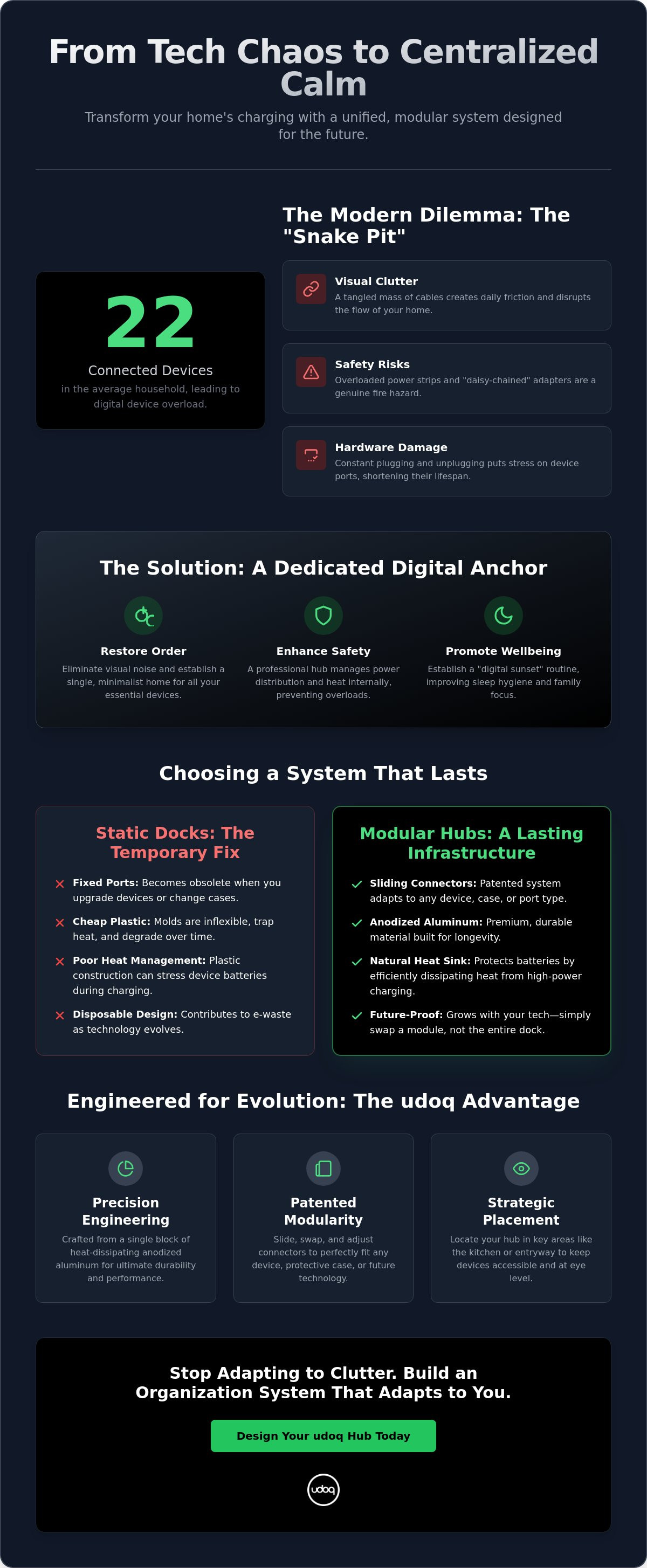
The average household now manages 22 connected devices, a staggering number that often results in a tangled "spaghetti" of cords across your kitchen counters and entryways. You've likely felt the daily friction of hunting for a lost tablet or refereeing an argument over who gets the "good" charger. It's a common environmental frustration that disrupts the flow of a modern home. We believe your living space should reflect order and precision, not technical clutter.
Discover how to transform this chaos into a sophisticated, modular central charging hub for home that evolves with your technology. This article will show you how to build a future-proof ecosystem that handles USB-C, Lightning, and wireless charging within a single, minimalist frame. We'll explore the shift from disposable plastic accessories to high-end infrastructure that prioritizes longevity and craftsmanship. You will learn how to establish an organized routine for the whole family, ensuring every device is powered and exactly where it belongs.
Key Takeaways
- Restore psychological relief to your environment by centralizing power into a single, unified organization station.
- Understand the critical difference between disposable static docks and a modular central charging hub for home designed for long-term viability.
- Locate strategic anchors in your home to eliminate visual clutter while keeping essential devices accessible and at eye level.
- Categorize your family’s hardware by usage frequency to ensure your charging system scales with your specific digital footprint.
- Discover how precision-milled aluminum and patented sliding technology create a charging infrastructure that grows with your technology.
What Is a Central Charging Hub and Why Does Your Home Need One?
A central charging hub for home is more than a simple power source. It is a unified station designed to organize and energize your entire digital ecosystem in one fixed location. This infrastructure replaces the haphazard collection of wall adapters with a single, high-performance anchor. By consolidating power, you eliminate the visual noise of scattered cables and restore a sense of architectural intent to your living space. Most modern connectivity relies on the Universal Serial Bus standard, and a dedicated hub optimizes this technology to ensure every device receives the precise current it requires without the clutter.
To better understand how this system transforms a living environment, watch this demonstration of a high-performance setup:
Beyond aesthetics, a centralized station offers significant safety advantages. Standard power strips are often "daisy-chained" or overloaded with bulky transformers, creating a genuine fire risk in shared family areas. A professional hub manages heat and power distribution internally. It also serves a psychological purpose. By establishing a dedicated "home" for tech, families can implement a "digital sunset" routine. When devices are docked in a common area at night, it signals a transition to tech-free time, improving sleep hygiene and focus.
The Problem: The "Snake Pit" of Modern Charging
Standard wall outlets simply cannot keep up with the 22 connected devices found in the average 2026 household. This leads to the "snake pit" effect: a tangled mass of cords in the kitchen or entryway that is both unsightly and inefficient. "Borrowed" cables and missing adapters become a source of daily friction. Constant plugging and unplugging in cramped spaces also puts physical stress on device ports. Over time, this cord chaos damages internal components and shortens the lifespan of your expensive hardware.
The Solution: A Dedicated Digital Anchor
Transforming your home starts with moving from "charging anywhere" to a dedicated digital anchor. A central charging hub for home provides a permanent, minimalist dock for every smartphone, tablet, and wearable. A tidy environment has a direct impact on productivity and stress levels. It removes the mental load of searching for a charger or checking battery percentages. In the 2026 smart home, organization is no longer a luxury. It is a functional requirement for a streamlined life.
Modular vs. Static Hubs: Choosing a System That Lasts
Static docks are a temporary fix. Most are molded from cheap plastic with fixed ports that offer zero flexibility. If you buy a thicker protective case or upgrade to a device with a different port, the dock becomes obsolete. This is the primary failure of static hubs. They treat your home's power needs as a fixed variable rather than an evolving ecosystem. In contrast, a sophisticated central charging hub for home functions as a dynamic rail system that respects the longevity of your hardware.
A high-quality dedicated charging station should be built as home infrastructure. Modularity allows you to slide, swap, and adjust connectors in seconds. This flexibility is essential as we navigate the 2026 EU mandate requiring USB-C for all new portable electronics. Material choice is equally vital. While plastic traps heat and degrades, heat-dissipating anodized aluminum protects your device batteries from thermal stress. High-power charging, like the USB-C PD 3.1 standard, generates significant heat. Aluminum rails act as a natural heat sink, ensuring your hardware stays cool and efficient during every charge cycle.
The Modular Advantage
Modular systems adapt to your specific hardware mix. You can adjust the height of connectors to fit rugged cases or slim tablets perfectly. If your family moves from Lightning to USB-C, you simply swap a C-CABLE for an L-CABLE module. You don't need to replace the entire dock. You can even expand your capacity by selecting larger rails, such as the udoq 700 POWER, which provides ample space for seven or more devices. This scalability ensures your organization station never becomes a bottleneck as your tech collection grows.
Sustainability in Tech Organization
Choosing a modular system is a commitment to sustainability. Most electronic accessories end up in landfills within twenty-four months due to port changes or physical breakage. A rail-based system made of high-grade aluminum is designed for decades of use. It's a "buy it once" philosophy that saves money and significantly reduces e-waste. Invest in quality that mirrors the precision of your devices. Explore the full range of modular options to find a solution that fits your aesthetic and technical requirements.
Strategic Placement: Where to Anchor Your Family’s Digital Life
Placement is a strategic decision. Many organization guides suggest hiding your tech in cabinets or drawers to achieve a clean look. This is a mistake. "Out of sight" often leads to forgotten devices and dead batteries when you need them most. A central charging hub for home should be an accessible anchor, not a hidden chore. By positioning your hub in high-traffic areas, you transform a technical necessity into a lifestyle upgrade. Visible organization reinforces the habit of docking devices, ensuring they are always ready for use.
The Entryway "Drop Zone"
The entryway is your first line of defense against digital intrusion. Establishing a "drop zone" here encourages an immediate transition from the connected world to family life. It prevents devices from migrating into bedrooms, where they disrupt sleep and evening routines. A rail-based hub at the door handles smartphones, smartwatches, and even keys in one elegant footprint. This setup makes it easy to implement a family "tech-free" dinner rule. If the devices are already docked at the entrance, the temptation to bring them to the table vanishes.
The Kitchen Counter and Eye-Level Access
Kitchens are the heart of the modern home. They are also high-risk zones for "cord spaghetti" on countertops. A tabletop hub keeps tablets at eye level, making it easy to follow recipes or stream media while cooking. This shared use encourages a communal approach to tech. It ensures that the family tablet is always charged and ready for the next user. A dedicated station in the kitchen prevents cables from dangling near sinks or stoves, improving both safety and aesthetic clarity.
Optimizing the Home Office
Your workspace demands precision. Integrating a minimalist desk setup requires clearing the clutter of individual power bricks and tangled cables. A rail-based dock allows you to manage professional and personal devices within a single, streamlined footprint. The udoq 400 Premium Watch is particularly effective here, keeping your essential tools accessible and visible. It eliminates the need to dig through drawers for a specific cable during a busy workday.
Wall-mounted vs. Tabletop
Choosing between a wall-mounted or tabletop configuration depends on your lifestyle. A tabletop unit offers portability and ease of adjustment. It is perfect for desks or kitchen islands. A wall-mounted central charging hub for home saves valuable surface space and creates a permanent, architectural feature. Both options provide the psychological relief of a tidy environment. Select the configuration that best complements your home's existing industrial design and daily traffic patterns.
Designing Your Hub: How to Inventory Your Devices for a Perfect Fit
Precision is the foundation of a clutter-free home. Before selecting a central charging hub for home, you must perform a meticulous audit of your digital landscape. This inventory ensures your station is neither undersized nor unnecessarily bulky. Most users make the mistake of planning only for the devices they see on their nightstand. A professional-grade system accounts for the entire household ecosystem. By categorizing your hardware, you create a blueprint for a station that remains functional for years.
Start by identifying your daily drivers. These are the smartphones, smartwatches, and primary tablets that require a full charge every morning. These devices need permanent slots on your rail. Next, account for occasional devices. E-readers, gaming controllers, and power banks may only need power twice a week. You don't necessarily need a dedicated rail spot for every one of these; instead, plan for a "rotating" slot. Finally, calculate your total power requirements. High-performance charging requires a power source capable of delivering high wattage across multiple ports simultaneously. Without sufficient overhead, your devices will charge slowly or compete for current.
Matching Rail Length to Device Count
The udoq system offers a range of lengths from 250mm to 700mm to accommodate different spatial needs. A standard smartphone requires approximately 80mm of rail width. A large tablet can occupy 200mm or more. Visualizing these footprints is essential for maintaining a minimalist aesthetic. We recommend leaving at least 15 percent of your rail empty. This growth space allows you to integrate new technology or guest devices without disrupting your organized layout. It ensures your hub remains a long-term investment rather than a temporary fix.
Choosing the Right Adapters
The modularity of your hub depends on the connectors you choose. Integrate wireless charging for the convenience of quick-drop power with your primary phone. For devices that require a secure, high-speed connection, utilize a MAGNETIC ADAPTER or specialized modules like the C-CABLE and L-CABLE. These components slide effortlessly into the aluminum rail, allowing you to reconfigure your setup as port standards evolve. This flexibility is the hallmark of a truly sophisticated organization system. Explore our modular components to build a configuration that matches your specific device inventory.
Elevate Your Organization with udoq: The Minimalist’s Choice
Achieving a clutter-free environment requires more than just a place to plug in. It demands a system that mirrors the precision of the technology it supports. udoq is the realization of meticulous German engineering, designed to transform your central charging hub for home into a permanent piece of high-end infrastructure. Every rail is precision-milled from high-grade aluminum, providing a heat-dissipating foundation that plastic alternatives cannot match. This isn't a disposable accessory; it's a long-term investment in your home's aesthetic and functional order.
Our patented sliding connector system offers the ultimate in modular flexibility. You aren't locked into a specific layout or port standard. Instead, you can slide, swap, and reorder your C-CABLE and L-CABLE modules as your hardware collection evolves. This mechanical innovation allows for single-plug simplicity. A single udoq 700 POWER can energize up to 10 devices using only one wall outlet, effectively eliminating the need for bulky power strips and daisy-chained adapters. The result is a clean, minimalist profile that complements the most sophisticated interior designs.
The udoq Difference
Generic charging station options often feel lightweight and fragile, sliding across the counter when you try to dock a device. udoq provides a premium, weighted tactile experience. The solid aluminum base stays exactly where you place it, offering a secure anchor for your full ecosystem of Apple, Android, and wearable devices. Whether you're docking a heavy iPad Pro or a delicate pair of earbuds, the connection is seamless and stable. This level of craftsmanship ensures that your central charging hub for home functions as a reliable "home" for your tech, not just a temporary stop.
Getting Started with Your Custom Hub
Building your ideal ecosystem starts with selecting the right foundation. Explore the udoq collections to find the base size that fits your space, from the compact udoq 250 to the expansive udoq 700. Once you've chosen a rail, use our configurator tool to customize your layout with the exact mix of magnetic adapters and cables your family requires. This tailored approach ensures a perfect fit for your current "daily drivers" while leaving room for future upgrades. Take the next step toward an organized home in 2026. Refine your environment, eliminate the chaos, and give your technology the sophisticated home it deserves.
Master Your Digital Environment
Ending cord chaos requires a fundamental shift in perspective. Move away from temporary, plastic accessories that fail as standards change. A permanent central charging hub for home is an investment in your daily peace of mind and home aesthetic. By inventorying your devices and choosing strategic anchors like the entryway or home office, you create a system that serves your lifestyle rather than cluttering it. This transition from chaos to clarity improves your productivity and restores architectural intent to your living spaces. You've seen the impact of a tidy environment; now it's time to make it permanent.
udoq offers the definitive solution through patented German engineering. Each rail is precision-milled from high-grade aluminum, ensuring durability and superior heat management for your expensive hardware. Our modular system remains compatible with all mobile brands, allowing you to swap connectors effortlessly as your technology evolves. It's time to replace the "snake pit" with a unified, sophisticated anchor that stands the test of time. Build your custom central charging hub with udoq today and experience the psychological relief of a perfectly organized environment. Your home deserves a foundation built on quality and order.
Frequently Asked Questions
How many devices can a central charging hub actually charge at once?
A high-capacity central charging hub for home can energize between four and twelve devices simultaneously. The udoq 700, for instance, provides enough rail width to accommodate multiple smartphones, tablets, and wearables in a single footprint. Your total capacity depends on the width of your individual devices and the wattage of your power supply. Most families find that a 550mm or 700mm rail offers ample space for all daily drivers plus occasional hardware.
Is it safe to leave multiple devices charging on one hub overnight?
It's entirely safe if your station utilizes high-grade materials and intelligent power management. Premium hubs milled from aluminum act as natural heat sinks, preventing the thermal buildup often seen with plastic docks. Integrated circuitry prevents overcharging by tapering the current as batteries reach capacity. This level of technical precision ensures your devices remain cool and protected throughout the night, far exceeding the safety profile of standard, daisy-chained power strips.
Can a central charging hub handle different brands like Apple and Samsung together?
Universal compatibility is the primary benefit of a modular system. You can mix Apple, Samsung, and other Android devices by simply sliding the appropriate C-CABLE or L-CABLE into the rail. This adaptability solves the frustration of changing industry standards and mixed-brand households. Because the connectors are independent modules, you can reconfigure the layout in seconds to suit your current hardware mix without replacing the entire infrastructure.
Do I need to remove my phone case to use a modular docking station?
You don't need to remove your protective gear. Modular connectors are designed with height-adjustable adapters that accommodate various case thicknesses, from slim silicone covers to rugged, heavy-duty shells. This adjustment happens at the mechanical level within the rail. It ensures a secure, direct connection to the port without compromising the safety of your device. This feature eliminates the daily friction of stripping cases just to achieve a reliable charge.
What is the best location in a house for a family tech hub?
Strategic placement depends on your household's traffic patterns. The entryway is ideal for creating a "drop zone" that encourages tech-free family time and prevents devices from migrating into bedrooms. Alternatively, a kitchen counter keeps tablets accessible for shared use and recipe viewing. Choose a high-visibility area that acts as a central anchor, ensuring every family member knows exactly where their devices belong when not in use.
How do I future-proof my charging station for new phone models?
Future-proofing is achieved through a modular rail system rather than a static dock. When new port standards emerge, you simply swap the internal cable module instead of discarding the entire station. This "buy it once" philosophy is essential as technology evolves toward universal USB-C standards. By investing in a high-quality aluminum rail today, you ensure your central charging hub for home remains relevant and functional for the next decade of device upgrades.
Does a central hub charge devices slower than a wall adapter?
Charging speed depends entirely on the wattage of your power source, not the hub itself. Utilizing a high-performance power supply ensures every port receives the maximum current supported by your device. Modern hubs support fast-charging protocols like USB-C Power Delivery 3.1. This allows you to charge smartphones and tablets at the same speed as a high-end wall adapter, but with the added benefit of organized, centralized power management.
What is the difference between a charging station and a docking station?
A basic charging station often refers to a simple multi-port USB block with scattered cables. A docking station, specifically a rail-based modular hub, provides vertical organization and a fixed physical "home" for each device. While both provide power, a docking station eliminates cord chaos by securing connectors in a specific layout. This creates a minimalist aesthetic and protects device ports from the wear and tear associated with loose, dangling cables.