Your workspace should be a sanctuary of focus, not a graveyard for tangled cables and underpowered hubs. Every unnecessary cord across your desk represents a friction point in your daily productivity. By 2026, the standard for a professional setup has shifted toward intentional organization and technical efficiency. Integrating a single plug charging station for multiple devices is the most direct path to reclaiming your environment and your peace of mind.
It is exhausting to juggle a dozen different adapters just to keep your essential tools powered. You value order and high-quality engineering, yet the reality of your desk often feels chaotic. This guide helps you discover how to consolidate your tech into a single-outlet solution that eliminates cable clutter while future-proofing your workspace. We will explore the shift to USB PD 3.2 standards, the impact of the EU common charger regulations, and the specific modular systems that turn your charging setup into a permanent piece of infrastructure.
Key Takeaways
- Reclaim your workspace by consolidating power into a single plug charging station for multiple devices to achieve immediate visual silence.
- Understand how Gallium Nitride (GaN) technology maximizes charging efficiency while maintaining a compact, minimalist footprint.
- Identify why high-grade aluminum is the superior material choice for long-term heat dissipation and structural durability.
- Learn to inventory your hardware ecosystem to transition seamlessly from legacy connectors to the latest USB-C standards.
- Discover the benefits of a modular rail system that adapts to your evolving tech needs rather than requiring total replacement.
Why Your Workspace Needs a Single Plug Charging Station for Multiple Devices
A professional workspace demands more than just power; it requires architectural order. A single plug charging station for multiple devices serves as a high-density power hub, capable of supporting 5 to 10+ devices from one wall outlet. This isn't just a convenience. It is a fundamental shift from a cluttered cable nest to a streamlined docking station approach. By consolidating energy into one source, you eliminate the visual noise that fractures your focus during the workday. This "visual silence" allows your mind to prioritize tasks rather than managing the chaos of your environment.
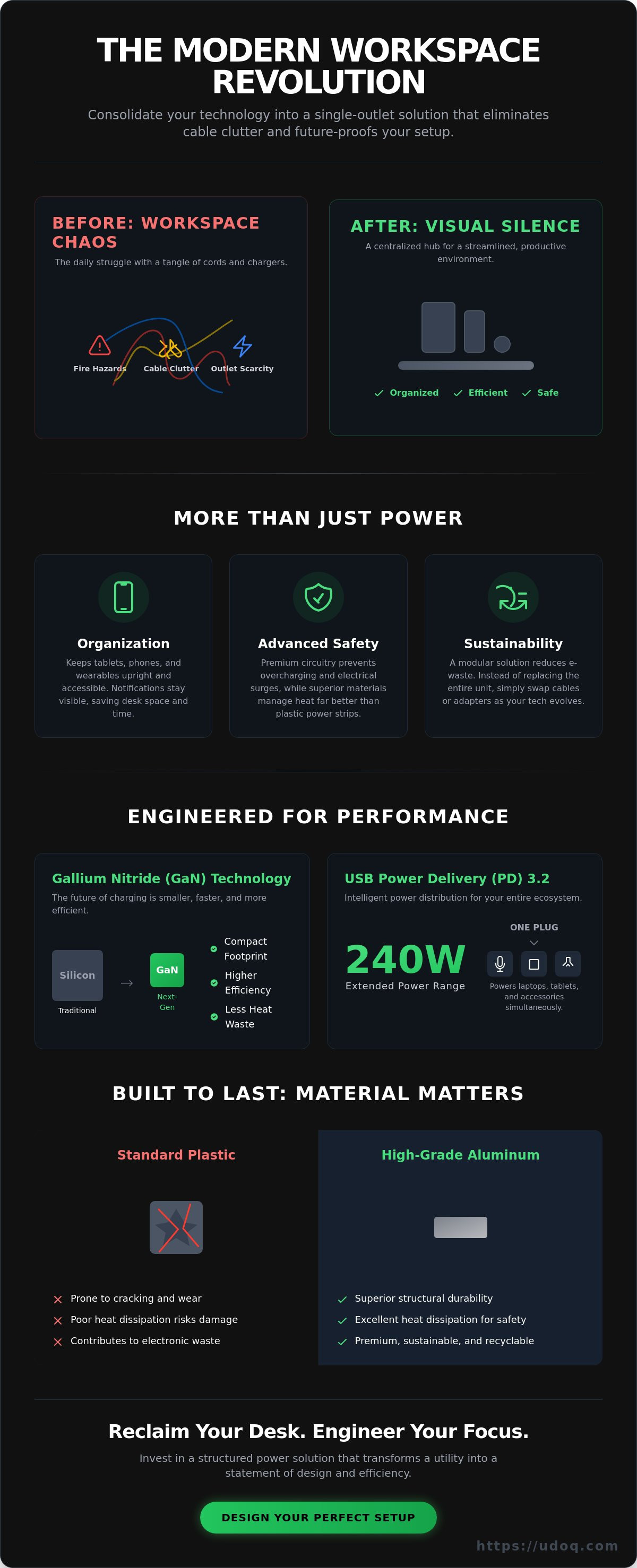
Modern offices and homes suffer from chronic outlet scarcity. We own more hardware than our walls were designed to support. Standard power strips are temporary fixes that often create fire hazards and unsightly tangles. A centralized station solves this by organizing cables internally and presenting a clean, intentional interface for your daily tools. The single plug charging station for multiple devices is no longer a luxury; it's a productivity requirement for anyone managing a sophisticated tech ecosystem.
To see how high-performance charging technology has evolved, watch this detailed comparison:
The Evolution of the Home Charging Hub
Charging has moved beyond the era of bulky wall warts and disposable plastic hubs. The shift toward universal USB-C standards, accelerated by EU regulations in late 2024 and 2026, means your workspace can finally achieve a unified design. A sleek, centralized rail system replaces the chaos of multiple cables snaking across your desk. This transition is essential for modern efficiency. A cluttered environment leads to a cluttered mind. Centralized hubs provide a permanent home for your electronics, ensuring they are always ready for use.
Key Benefits: More Than Just Power
Beyond the aesthetic upgrade, these systems offer tangible functional improvements that protect your investment in technology. High-quality charging stations provide a level of reliability that cheap power strips simply cannot match.
- Organization: Keep tablets, phones, and wearables upright. This keeps notifications visible without sacrificing desk space or requiring you to pick up the device.
- Safety: Integrated stations manage heat better than overloaded power strips. Premium systems use advanced circuitry to prevent overcharging and electrical surges.
- Sustainability: Choosing a modular solution reduces e-waste. Instead of replacing the whole unit when industry standards change, you simply swap a cable or adapter.
Investing in a structured power solution is a commitment to your long-term environment. It transforms a utility into a design statement, proving that technical necessity doesn't have to compromise style.
Decoding Power: How Multi-Device Stations Manage One-Plug Input
A high-capacity single plug charging station for multiple devices is a masterpiece of electrical engineering. It manages a complex "power budget" to ensure every connected tool receives the exact current it requires. Total wattage is often a marketing headline, but the technical reality lies in how that power is distributed across individual ports. Professional systems prioritize high-draw devices like laptops while maintaining a steady trickle for smaller accessories. This intelligent negotiation between the charger and your hardware is the difference between a full battery and a morning of frustration.
Gallium Nitride (GaN) technology has redefined the efficiency of these hubs. GaN components handle higher voltages and dissipate less heat than traditional silicon-based chargers. This allows for a smaller, more elegant footprint without sacrificing performance. When paired with the latest USB Power Delivery (USB PD) 3.2 standards, a single station can now support Extended Power Range (EPR) outputs up to 240W. This is sufficient to power high-performance workstations and tablets simultaneously from a single wall outlet. If your setup includes wireless pads, understanding how to choose the best wireless charger is essential, especially with the 2026 Qi2.2 standard now offering up to 25W of wireless power.
Understanding Total Wattage vs. Per-Port Distribution
Shared power requires sophisticated internal management. When you plug in a smartphone alongside a tablet, the station must instantly recalculate its distribution. Cheap hubs often split power equally, which leads to agonizingly slow charging for larger devices. Premium stations use dynamic allocation to send maximum wattage where it is needed most. An internal power supply ensures that voltage remains consistent even as you add or remove devices from the rail. This prevents the "re-handshaking" glitch where existing devices stop charging for a second whenever a new one is connected.
Safety Standards and Thermal Management
Managing high-wattage input in a compact space creates significant heat. Safety is a non-negotiable requirement for permanent infrastructure. Quality stations include integrated overcharge, short-circuit, and surge protection to shield your expensive hardware. They also employ advanced thermal management to maintain peak speeds without risk. Thermal throttling is the safety process where a charger automatically reduces its power output to prevent internal components from reaching dangerous temperatures. High-grade materials and efficient circuitry minimize this need, ensuring your devices charge at maximum velocity for the duration of the cycle. Explore the udoq POWER series to see how German engineering handles these thermal demands within a minimalist aluminum frame.
Beyond Plastic: Evaluating Build Quality and Aesthetic Integration
A charging station is a permanent fixture in your environment. Its material composition dictates its longevity, safety, and visual impact. While mass-market options rely on injection-molded plastics or trendy bamboo, these materials often fail the rigorous demands of a high-performance workspace. Plastic degrades over time, becoming brittle and prone to cracking under the weight of multiple tablets. Wood, while aesthetically pleasing to some, acts as a thermal insulator. It traps heat against your devices rather than drawing it away, which can negatively impact battery health over years of use.
Selecting a single plug charging station for multiple devices requires a focus on structural integrity. A dock must be heavy enough to remain stationary when you connect or remove hardware. Lightweight plastic docks often slide across the desk or tip over when supporting a large iPad Pro. A weighted, metal-based solution provides the necessary friction and balance. This stability is a hallmark of a modern desk setup where every object has a clear, unshakeable purpose.
The Case for High-Grade Aluminum
Aluminum is the gold standard for premium docking solutions. It offers exceptional heat dissipation, effectively acting as a passive heat sink for your charging electronics. This thermal efficiency is critical for maintaining high-speed charging without triggering safety-related power drops. Beyond performance, aluminum matches the industrial design of modern smartphones and laptops. It creates a cohesive, professional aesthetic that plastic simply cannot replicate. It is also infinitely recyclable, making it a more responsible long-term investment than composite materials that eventually end up in a landfill.
Form Meets Function in Docking Design
Design should solve problems, not create them. An upright viewing angle is a key feature of a well-engineered station. It keeps your screens visible for facial recognition and notifications while they charge. This turns your devices into functional secondary displays rather than dormant slabs on your desk. Rail-based systems take this further by allowing you to slide and space your devices exactly as needed. This modularity ensures your dock remains relevant even as your hardware collection evolves. Choosing aluminum for tech longevity ensures that your infrastructure outlasts the devices it supports. A high-quality single plug charging station for multiple devices is not a disposable accessory. It is a foundational element of a refined, organized office.
Selection Guide: How to Future-Proof Your Charging Setup
A single plug charging station for multiple devices is a long-term investment in your infrastructure. To ensure your choice remains relevant through 2026 and beyond, you must look past the immediate convenience of all-in-one gadgets. Follow these steps to build a system that evolves with your technology rather than becoming obsolete within a year.
- Inventory your ecosystem: Document every connector type currently in use. Don't forget legacy hardware or specialized wearable chargers. Technical precision at this stage prevents future clutter and ensures you have the correct adapters from day one.
- Anticipate hardware shifts: Account for upcoming upgrades. The EU mandate for USB-C is now fully active for all mobile devices and laptops. Your next smartphone or high-performance laptop will require a C-Cable regardless of its brand. Planning for this shift now saves money and reduces waste later.
- Scale for growth: Select a rail length that accommodates your current collection with room for expansion. The udoq 400 is ideal for professional desks, while the udoq 700 provides ample space for shared family environments.
- Prioritize modularity: Ensure the system allows you to swap individual cables and adapters. A truly modular station lets you slide, remove, or add connectors as your hardware collection change.
- Define your placement: Choose between a stable desk stand or a space-saving wall mount. Professional environments often benefit from the accessibility of a desk rail, while high-traffic entryways are better served by a permanent wall installation.
The Pitfall of Fixed-Port Stations
Fixed-port hubs are designed for a "buy-and-replace" cycle. When a connector becomes obsolete, the entire device becomes e-waste. This is a significant liability in an era of rapid standard changes. A modular single plug charging station for multiple devices allows you to simply swap a single cable for a few dollars rather than discarding a $100 station. This adaptability is the core of technical longevity and environmental responsibility. You can learn more about the transition to universal standards in this guide on USB-C.
Sizing Your Dock for Family or Office Use
Calculating the "linear inch" requirement for your collection is essential for a tidy result. Measure the width of your devices within their protective cases. This prevents overcrowding and ensures easy access to every screen. A compact udoq 250 serves a minimalist desk for a phone and tablet. High-traffic family hubs often require the udoq 700 to manage multiple iPads, smartphones, and e-readers simultaneously. Balancing the physical footprint with your device capacity ensures your workspace remains organized rather than cramped. Ready to customize your own setup? Configure your professional charging station today.
The udoq Advantage: Precision Engineering for the Modern Ecosystem
udoq is not a temporary accessory. It is a patented infrastructure system designed to outlast your current hardware. This single plug charging station for multiple devices is a product of meticulous German engineering. It embodies a heritage of craftsmanship that values longevity over disposable trends. While generic hubs fail under pressure, udoq remains a stable, high-status centerpiece for your workspace. It draws from a single wall outlet to power up to ten devices simultaneously. The core of this system is the elegant aluminum rail. It allows you to slide, space, and swap connectors in seconds to match your exact needs.
Modular Components for a Lifetime of Use
True technical innovation requires adaptability. The udoq 400 Premium Watch demonstrates how a single rail can manage diverse hardware ecosystems. You aren't limited by fixed ports that become obsolete. The system utilizes individual connectors like the C-CABLE and L-CABLE that integrate directly into the rail. This modularity ensures your station remains functional as standards evolve. You can easily add a WIRELESS ADAPTER for your earbuds or a MAGNETIC ADAPTER for specialized devices. This approach transforms your charging setup into a long-term investment in your environment. It eliminates the friction of replacing hardware every time a new connector standard is introduced.
From Desktop to Wall: Customizing Your Install
Your power hub should adapt to your physical space as well as your digital tools. A desktop rail provides immediate accessibility for professional environments. However, high-traffic areas like kitchens or entryways often require a more permanent "command center." The udoq WALL MOUNT allows you to move your devices to a vertical plane. This reclaims valuable surface area while keeping your electronics organized and visible. It is the ultimate solution for maintaining order in a busy household.
Performance remains uncompromised regardless of your chosen mounting style. The udoq POWER series provides the high-wattage internal charging required for modern tablets and smartphones. It manages complex electrical demands with technical precision, ensuring every device charges at its maximum potential. This is the intersection of lifestyle elegance and functional innovation. Visit the Charging Stations collection to configure your proprietary solution. Reclaim your workspace with a system that values your time and your environment.
Reclaim Your Workspace and Future-Proof Your Power
A professional environment requires technical precision and aesthetic clarity. You've seen how a single plug charging station for multiple devices eliminates the friction of cable nests while managing complex power budgets with ease. By choosing high-grade aluminum and modular rail systems, you invest in infrastructure that adapts to the shifting standards of 2026 and beyond. This isn't just about utility. It's about creating a sanctuary of focus where your tools are always ready and your desk remains pristine.
The chaos of disposable plastic hubs belongs in the past. Embrace the longevity of patented German engineering and sleek, heat-dissipating materials that protect your expensive hardware. It's time to transition from a cluttered, underpowered surface to a streamlined docking system that evolves as your technology collection grows. Your workspace should reflect your standards of quality and efficiency.
Build Your Custom udoq Modular Charging Station Now
Take control of your environment today. Experience the deep psychological relief of a workspace designed for excellence and long-term technical viability.
Frequently Asked Questions
Can a single plug charging station really charge 10 devices at full speed?
Yes, provided the internal power supply possesses sufficient wattage to meet the collective draw of every connected device. High-performance systems like the udoq POWER series are engineered to manage these high-density loads without dropping voltage. Intelligent power allocation ensures each device receives its maximum supported current until the battery is fully replenished.
Is it safe to leave a multi-device charging station plugged in 24/7?
Professional stations are designed for continuous operation and include multiple layers of electrical protection. Premium systems feature integrated surge protection and overcharge prevention to shield your hardware from damage. These safety standards ensure the station remains cool and efficient even when left active indefinitely in a professional or home setting.
What happens if my next phone uses a different charging cable?
Modular systems allow you to swap individual connectors in seconds without replacing the entire dock. If you transition from an older standard to a C-CABLE, you simply slide out the old adapter and insert the new one. This adaptability is the primary advantage of a single plug charging station for multiple devices, as it prevents technical obsolescence.
Do these stations support fast charging for both iPhone and Android?
Yes, professional stations support universal standards like USB Power Delivery (USB PD) to accommodate both ecosystems. By using the appropriate C-CABLE or L-CABLE, you can achieve maximum charging velocities for any modern smartphone. The station communicates with each device to negotiate the fastest safe power profile available for that specific hardware.
How do modular charging stations help with cable management?
Modular stations hide the majority of the cable length within a structural rail, exposing only the connector head. This eliminates the "cable nest" typically found on desks and nightstands. By routing all power through one internal hub, you achieve a minimalist look while keeping every device upright and accessible for immediate use.
Can I charge a laptop and multiple phones from the same station?
High-wattage stations equipped with USB PD 3.2 can easily power a laptop alongside several smaller devices. You must ensure the station's total output meets the requirements of your specific laptop model. This consolidation makes a single plug charging station for multiple devices the ideal hub for a complete mobile office setup.
What is the benefit of a rail-based charging system over a standard hub?
A rail-based system offers physical organization and modular flexibility that a standard USB hub cannot match. It allows you to adjust the spacing between devices and keeps them in an upright, viewable position. This patented mechanical innovation ensures your infrastructure is as organized as it is technically capable, providing long-term utility.
Does udoq work with thick protective cases on phones and tablets?
udoq connectors are adjustable in height to accommodate almost any protective case on the market. You can fine-tune the protrusion of the C-CABLE or L-CABLE to ensure a secure connection without removing your device's armor. This meticulous attention to detail ensures universal compatibility regardless of your hardware's specific physical dimensions or protective brand.