By 2026, the global market for portable chargers has reached $25 billion, yet many high-end venues still treat guest power as a source of friction. You see it every shift. Guests hand phones across the bar or hunt for outlets under the table. It's a chaotic interruption. Tangled, cheap cables clutter your surfaces and distract from the dining experience. Investing in technology that becomes obsolete when mobile connectors change is a waste of your resources.
A restaurant table charging station for customers should enhance your environment, not compromise it. We believe your tech should be as sophisticated as your service. This guide explores how to eliminate battery anxiety with modular, future-proof solutions that adapt as technology evolves. You'll learn how to implement sleek, industrial-grade stations like the 250 or 400 series from udoq German design multiple charging station for any mobile device. These systems provide reliable power without the mess. We'll show you how to maintain a minimalist aesthetic while offering the high-status utility your guests now expect.
Key Takeaways
- Learn why guest charging has evolved from a luxury amenity into a baseline hospitality requirement for the modern diner.
- Evaluate the operational trade-offs between portable power banks and a permanent restaurant table charging station for customers.
- Identify the psychological impact of industrial design and why premium materials like aluminum outperform plastic in professional settings.
- Master the modularity principle to ensure your charging infrastructure remains functional as device connectors and sizes continue to change.
- Discover how to configure the udoq 250 and 400 series to create a clutter-free, high-status charging experience at every table.
Why a Restaurant Table Charging Station is the New Hospitality Standard
Dining in 2026 is an inherently digital experience. Guests use smartphones for everything from checking menus to capturing the perfect plate for social media. This reliance has shifted guest charging from a thoughtful amenity to a non-negotiable expectation. A true restaurant table charging station for customers is no longer just a wall outlet tucked behind a booth. It's a dedicated, sophisticated piece of infrastructure designed to integrate seamlessly with the dining environment. It provides a reliable power source that complements your aesthetic rather than detracting from it.
When guests see a visible, high-quality power solution, it changes their behavior. They stop scanning the walls for sockets and start focusing on your menu. This accessibility from udoq German design multiple charging station for any mobile device eliminates the nomadic search for power. It keeps customers seated and engaged with your brand rather than their battery percentage. To better understand how these systems integrate into modern dining spaces, watch this helpful overview:
Providing power at the table also solves a significant operational headache. Every minute your staff spends managing guest phones behind the bar is a minute they aren't serving tables. It removes the liability of handling expensive hardware and the clutter of mismatched cables in your service areas. By moving the charging point to the table, you reclaim your bar space and your team's time.
Solving the 'Battery Anxiety' Epidemic
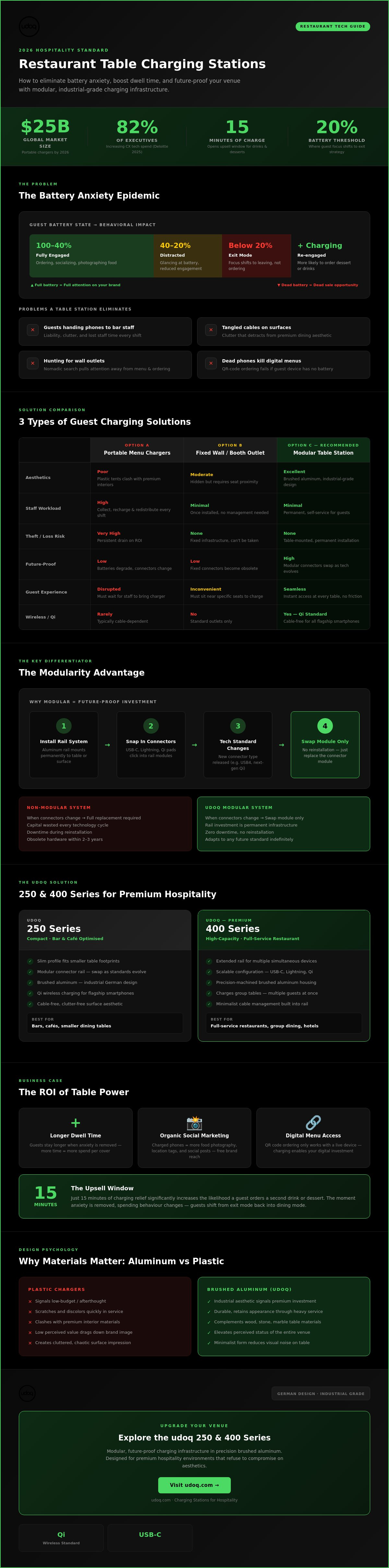
Battery anxiety is a psychological reality for the modern diner. When a guest's device drops below 20 percent, their focus shifts from the meal to their exit strategy. Providing visible power access offers immediate relief. It signals that your venue values their time and their connectivity. A 2025 Deloitte survey found that 82 percent of restaurant executives plan to increase spending on customer experience technology, and few investments provide as much immediate psychological relief as a reliable charge. It solves a core problem before it becomes a frustration.
Beyond Convenience: The ROI of Table Power
Modern hospitality relies on digital interaction. Charging stations facilitate the use of QR codes and tableside ordering systems, ensuring the technology you've invested in remains accessible. If a phone is dead, the digital menu is invisible. Keeping devices alive also encourages organic marketing. Guests are more likely to post food photography or tag your location if they aren't worried about their phone dying before the check arrives. Providing just 15 minutes of charging creates a window of opportunity where a guest is significantly more likely to order a second drink or a dessert. Many of these systems, including the udoq 250 and 400 series, utilize the Qi wireless charging standard to provide effortless power for the latest flagship smartphones without the need for additional cables.
Comparing the 3 Main Types of Guest Charging Solutions
Selecting a restaurant table charging station for customers requires a balance between aesthetic appeal and operational efficiency. As guest expectations evolve toward a New Hospitality Standard, three primary architectures have emerged. Each offers a different level of permanence, scalability, and technical reliability. Understanding these differences is essential for a long-term investment.
The Pitfalls of Portable 'Menu' Chargers
Portable "menu" chargers often seem flexible. In practice, they create a logistical burden. Staff must collect, recharge, and redistribute dozens of units every night. Batteries in these portable units degrade quickly under constant use. Theft remains a persistent drain on ROI. Visually, these plastic "tents" often clash with premium interiors. They create a cluttered, low-end feel that distracts from the dining experience. While they provide power, they don't provide the psychological relief of a permanent, organized station.
Fixed vs. Modular: Which Investment Lasts?
Integrated furniture embeds charging directly into tables. It looks clean initially. However, it's an architectural trap. Technology moves faster than furniture cycles. When mobile connectors change, your expensive custom tables become obsolete. Replacing built-in components is costly, invasive, and requires taking tables out of service. A permanent restaurant table charging station for customers should be an asset, not a future liability.
Modular docking rails solve this through adaptable design. They allow for instant cable swaps without replacing the entire unit. If industry standards shift, you simply slide out the old connector and slide in a new C-CABLE or L-CABLE. This modularity also addresses a major gap in the market: the business diner. Professional guests often carry multiple devices, including tablets and secondary phones. Standard chargers can't handle the size or power requirements of a tablet. Modular systems like the udoq series allow you to mix and match connectors and adjust spacing to support any device combination.
Speed is the final differentiator. Diners don't stay for hours. A slow charge is a frustration, not a service. Power Delivery (PD) is essential for modern hospitality. It provides the rapid charge needed during a 45-minute lunch window. If your station lacks PD, it won't meet the needs of guests in 2026. Refine your guest experience with the original modular charging solution that combines industrial durability with high-speed performance.
Aesthetics and Brand Image: Why Materials Matter
Design is a silent communicator. In a premium dining environment, every object on the table speaks to your brand's commitment to quality. A cheap, plastic restaurant table charging station for customers feels out of place next to fine linen or polished wood. It suggests a temporary fix rather than a curated experience. Choosing materials like high-grade aluminum signals that your establishment values longevity and craftsmanship. It transforms a technical necessity into a high-status design element.
Research from the National Restaurant Association highlights how guest charging solutions significantly enhance the diner's journey. However, the visual execution determines if that technology delights or distracts. A minimalist approach ensures the focus remains on the culinary presentation. It removes the visual noise that often accompanies digital amenities.
Matching the Decor: Sleek vs. Obtrusive
Minimalist design is timeless. It adapts as interior trends shift, making it the safest choice for evolving restaurant spaces. Milled aluminum provides a neutral, sophisticated finish that complements both industrial and classic decors. It doesn't scream for attention with gaudy advertisements. For those seeking design inspiration beyond the dining room, our guide on How to Create a Minimalist Desk Setup offers deeper insights into achieving a clean, professional aesthetic in any environment.
Clutter is the enemy of a premium atmosphere. Traditional chargers often result in a "spaghetti" of tangled wires across the table. This mess is visually stressful and physically intrusive. A well-designed restaurant table charging station for customers hides the technical chaos. It organizes cables within a sleek rail, presenting only the necessary connectors to the guest. This order creates a sense of psychological relief, allowing the guest to relax and enjoy their meal without the distraction of cable clutter.
Durability in the Hospitality Sector
Hospitality environments are demanding. Surfaces face constant exposure to spills, cleaning agents, and high-frequency handling. Plastic units often yellow, crack, or stain under these conditions. They also lack the weight needed for stability, leading to accidental tips that can damage guest devices. Weighted, aluminum bases provide a secure foundation that stays exactly where you place it. German-engineered precision reduces long-term maintenance costs by ensuring every mechanical component fits perfectly and resists the wear of daily guest interaction. Systems like the udoq 400 ensure your investment withstands high-traffic use while maintaining its aesthetic edge for years to reach.
Future-Proofing Your Venue: The Modularity Advantage
Technology moves fast. Connectors change. Device sizes shift. A static restaurant table charging station for customers becomes a relic the moment a new flagship phone is released. Modularity is the only logical response to this cycle. It ensures your infrastructure evolves alongside guest hardware. By choosing a system designed for adaptation, you protect your ROI and your guest experience from technical obsolescence.
The industry is consolidating around universal standards. Our Ultimate Guide to USB-C explains why this single connector is becoming the dominant force in hospitality. However, a future-proof venue must remain flexible. You might need a mix of different connector types today, but that ratio will shift tomorrow. A modular rail allows you to pivot without replacing the entire housing.
Sustainability is a business imperative. Most guest charging solutions are disposable. When a cable frays or a connector becomes obsolete, the entire unit usually goes to a landfill. Modularity ends this cycle of e-waste. You replace the specific component, not the system. It's a cleaner, more responsible approach to hospitality tech.
Adapting to the Next Generation of Devices
The rail system from udoq German design multiple charging station for any mobile device allows for a 5-second connector swap. This speed is critical for busy managers who don't have time for complex repairs. It also supports tablets for digital wine lists or interactive menus. The rail doesn't care about device height or width. You simply slide the connectors to fit the hardware at hand, whether it's a slim smartphone or a large-format tablet.
Installation Strategies for Different Layouts
Bar-top charging serves solo diners and business travelers effectively. It keeps them engaged at the bar longer, often leading to additional orders. For communal tables, centralized power allows multiple guests to charge from a single point. This follows the "One Outlet" rule. You power the entire station from one wall socket, which simplifies your wiring and reduces installation costs. In booths, use a WALL MOUNT to keep the table surface completely clear for service. This keeps the focus on the food while providing the utility guests demand.
Invest in a system that grows with your business and your guests. Explore the modular udoq ecosystem today.
The udoq Solution for Premium Hospitality Environments
Implementing a restaurant table charging station for customers requires a balance of technical reliability and aesthetic restraint. The udoq 250 and 400 models are engineered specifically for the hospitality sector. They provide a compact, stable footprint ideal for individual dining tables and bar tops. Unlike generic alternatives, these stations are milled from high-grade aluminum. This material choice ensures they withstand the rigors of high-traffic environments while maintaining a pristine appearance.
German engineering is at the core of the udoq philosophy. It translates into a product that functions with meticulous precision. Every component fits perfectly. Every connector slides smoothly along the rail. This level of quality is a shorthand for reliability. It tells your guests that you haven't just provided a utility; you've invested in a superior experience. The udoq POWER series further simplifies this by offering a "plug and play" solution. You don't need complex electrical work to offer high-speed charging at every seat.
Tailoring the Experience for Your Guests
Every venue has unique spatial requirements. Choosing the right rail length is the first step in creating an organized environment. The udoq 250 is perfect for two-top tables or narrow bar sections. For larger booths or communal areas, the udoq 400 provides additional capacity without creating clutter. You can further enhance this by adding WIRELESS ADAPTERS to your setup. This creates a hybrid charging experience that accommodates both cable-based and Qi-enabled devices simultaneously. If security is a concern, permanent mounting options ensure the station remains exactly where you intended it to be.
Ordering and Implementation
Successful implementation begins with a thorough assessment of your seating capacity and guest profile. Consider your peak hours. If your venue attracts business travelers during lunch, a higher density of stations at the bar is essential. For family-oriented dining, focus on booth integration. udoq supports multi-location hospitality groups with streamlined bulk ordering processes. This ensures brand consistency across your entire portfolio. You receive a standardized, high-quality solution that is easy for your staff to maintain and for your guests to use.
Order is the foundation of a premium atmosphere. By eliminating cable chaos and providing reliable power, you remove a major friction point from the dining experience. Your guests stay longer. Your staff works more efficiently. Your brand image remains untarnished by cheap, disposable technology. Explore our professional charging stations to upgrade your guest experience today.
Elevate Your Guest Experience with Modular Power
The transition from a simple amenity to a hospitality standard is complete. Providing a restaurant table charging station for customers is no longer optional; it's a defining element of the modern dining environment. Success lies in choosing hardware that respects your venue's aesthetic while providing technical reliability. By 2026, the expectation for seamless power has shifted. Guests value the psychological relief of a tidy, organized environment. Avoid the clutter of disposable cables and the logistical burden of portable batteries. Instead, prioritize systems that offer longevity through superior materials and adaptable components.
Our patented modular design and German-engineered aluminum construction ensure your investment remains relevant as technology shifts. Each rail supports up to 10 devices, allowing you to scale capacity without compromising table space. You've curated your menu and your decor with precision. Your technology should reflect that same commitment to excellence. Upgrade your restaurant with udoq professional charging stations and redefine how your guests connect with your brand. It's time to replace chaos with clarity.
Frequently Asked Questions
Are restaurant charging stations safe for all phone types?
Professional charging stations are safe for all modern smartphones when they utilize certified connectors and regulated power supplies. High-quality systems prevent overcharging and overheating by communicating with the device's battery management system. Cheap, uncertified cables pose the greatest risk to guest hardware. Investing in industrial-grade components ensures consistent voltage delivery and protects expensive mobile devices from electrical damage during the dining experience.
How do I prevent guests from stealing the charging cables?
Security is built into the design of a professional restaurant table charging station for customers. udoq rails use a mechanical locking system that secures the L-CABLE or C-CABLE within the aluminum profile. This makes it impossible for a guest to remove the connector without a specific tool. Unlike loose cables or portable banks, this permanent installation eliminates the theft and loss common in high-traffic hospitality environments.
What is the fastest way to charge a customer's phone at a table?
Wired charging via Power Delivery (PD) is the fastest method available in 2026. While wireless options are convenient, a direct connection through a C-CABLE can deliver significantly more power in a shorter timeframe. This is critical for restaurants where the average dwell time may only be 45 minutes. High-speed PD ensures that even a brief lunch visit provides a meaningful battery boost for your guests.
Do I need to hire an electrician to install table charging stations?
No, most tabletop solutions don't require professional electrical installation. Systems like the udoq POWER series are designed for immediate use; they plug directly into standard wall outlets. You can easily route the power cord through existing cable management holes in your furniture. This simplicity allows you to upgrade your guest experience without the expense or downtime associated with electrical contractors or structural modifications.
Can these stations charge tablets used for digital menus?
Modular docking systems are ideal for charging tablets. Because the connectors slide along a rail, you can adjust the spacing to accommodate the larger footprint of an iPad or Android tablet. This is particularly useful for venues using digital wine lists or interactive ordering systems. A single udoq 400 can simultaneously power multiple smartphones and a tablet, keeping your digital menu infrastructure fully operational throughout the shift.
How do I clean and sanitize the charging stations between guests?
Maintaining hygiene is straightforward with aluminum-based hardware. Sanitize the station using a soft, lint-free cloth and standard non-abrasive restaurant cleaning agents. The smooth, anodized surface of the aluminum rail resists staining and doesn't harbor bacteria like porous plastic alternatives. Avoid spraying liquids directly into the charging connectors. Apply the cleaner to the cloth first to ensure a safe, thorough sanitization process that protects the electronics.
What happens when a new phone connector is released?
Future-proofing is the core benefit of a modular restaurant table charging station for customers. When industry standards change, you don't replace the entire station. You simply slide out the obsolete connector and replace it with the new version, such as an updated C-CABLE variant. This 5-second swap ensures your infrastructure remains compatible with the latest flagship devices without requiring a significant reinvestment in new furniture or hardware.
Is wireless charging better than wired charging for restaurants?
Both have distinct advantages, but a hybrid approach is often superior. Wired charging offers the speed and reliability necessary for short dining windows. Wireless charging provides a sleek, cable-free aesthetic that appeals to minimalist design preferences. Using a WIRELESS ADAPTER on a udoq rail allows you to offer both options. This flexibility ensures you meet the needs of all guests, regardless of their device's specific charging capabilities.