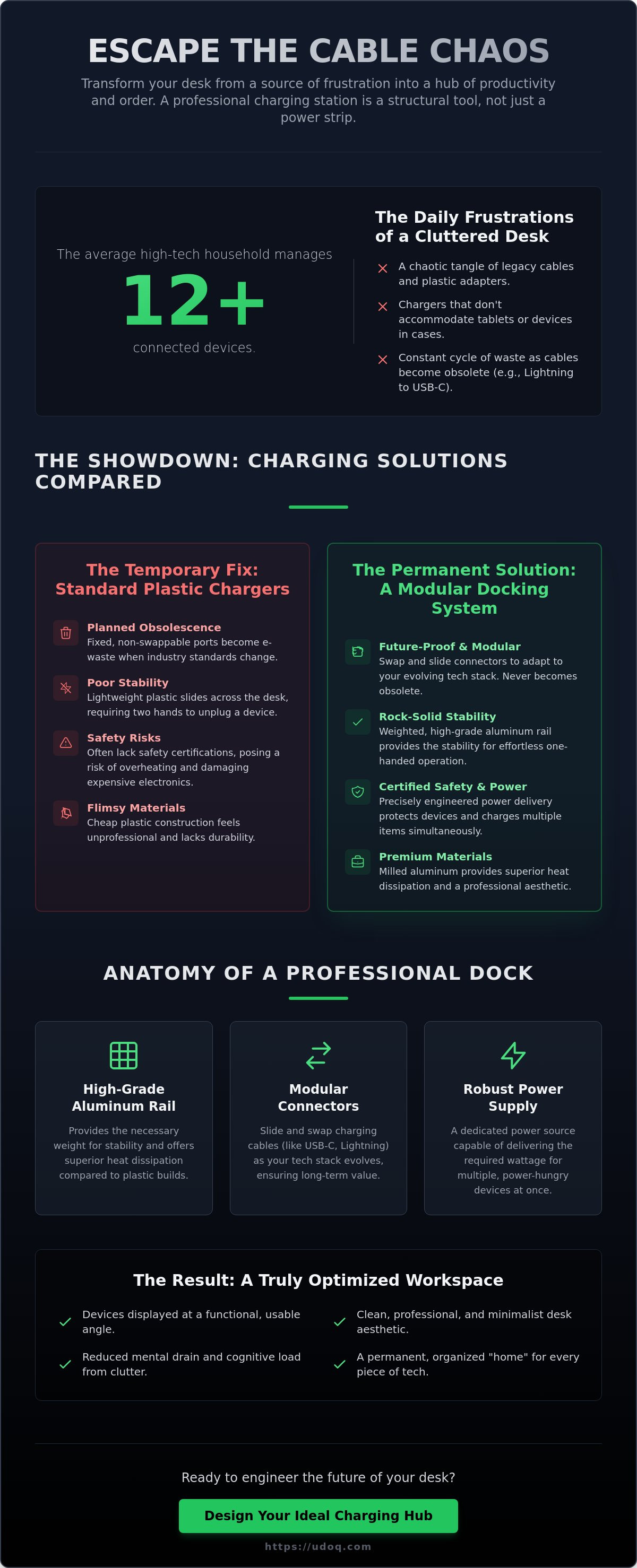
The average high-tech household now manages over 12 connected devices, a figure confirmed by May 2026 research. Yet, most workspaces still rely on a chaotic tangle of legacy cables and plastic adapters that fail to keep pace. Your home office desk charging station should be a precision tool; it shouldn't be a source of daily frustration.
You likely agree that desktop cable chaos is a mental drain. You've dealt with chargers that won't accommodate tablets in cases and the annoyance of cables becoming obsolete during the industry-wide shift to USB-C. It's a cycle of waste that compromises your minimalist aesthetic and your focus.
This article will show you how to eliminate cable chaos for good. You'll learn to select a modular system that adapts to your evolving tech stack while providing fast charging for multiple devices simultaneously. We'll explore how to achieve a clean, professional setup that displays your devices at a usable angle, ensuring your desk remains an optimized environment for years to come.
Key Takeaways
- Understand why a professional home office desk charging station serves as a structural hub rather than a simple power strip.
- Identify the mechanical flaws of fixed-cable chargers that cause planned obsolescence and desktop clutter.
- Calculate the precise rail length and power output required for your specific device mix.
- Explore the advantages of modular systems that allow you to swap connectors as industry standards change.
- Position your devices at a functional angle for a more professional and organized aesthetic.
What is a Professional Home Office Desk Charging Station?
A professional home office desk charging station is the precise intersection of power and order. It functions as a dedicated hub that organizes, displays, and powers multiple mobile devices simultaneously. Unlike a basic power strip that hides under a desk, this station is a stable, visible dock that integrates connectors directly into its frame. In a 2026 workspace where smartphones, tablets, and wearables are essential tools, this setup eliminates the daily friction of searching for tangled cables.
While competitors often focus solely on high-speed wattage, a true station prioritizes the physical environment. It transforms a scattered collection of electronics into a unified, high-performance command center. This structural approach ensures your devices are always charged and positioned for immediate use. Plastic alternatives often slide across the desk when you attempt to disconnect a phone; a weighted aluminum rail provides the stability required for effortless, one-handed operation.
To better understand this concept, watch this helpful video:
The Difference Between a Hub and a Dock
The distinction between these two categories is critical for productivity. Traditional hubs focus on port expansion, often resulting in a messy "cable octopus" that clutters your surface. A docking station, however, emphasizes device positioning and accessibility. By securing devices at a usable angle, a dock facilitates seamless video calls and notification monitoring without needing to lift the hardware. This creates a permanent "home" for every piece of tech, providing a psychological sense of relief that reduces cognitive load during the workday.
Key Components of a Premium Setup
Quality is defined by material integrity and technical adaptability. High-grade aluminum is the standard for a premium home office desk charging station. It provides the necessary weight to stay put and offers superior heat dissipation compared to cheap plastic builds. A professional setup must also offer connector flexibility. Rather than being locked into fixed USB-A or USB-C ports, a modular system allows you to slide and swap components like the udoq C-CABLE or L-CABLE as your tech stack evolves.
Finally, the power supply must be robust and consistent. A professional station requires a dedicated source capable of delivering the specific wattage needed for power-hungry tablets and smartphones at the same time. Investing in a system like the udoq rail series ensures your infrastructure is as sophisticated as the technology it supports, protecting your devices from the fluctuations of inferior power sources.
The Hidden Flaws of Standard Multi-Device Chargers
Most multi-device chargers are temporary fixes. They ignore the long-term reality of your tech stack. A typical home office desk charging station found on mass-market sites is often a hollow plastic shell with fixed connectors. These units are designed for the devices you own today, not the ones you will buy tomorrow. This design philosophy leads directly to planned obsolescence. When industry standards shift, these static stations become electronic waste.
Material integrity is another common failure point. Lightweight plastic builds lack the physical mass to stay stationary. You shouldn't need two hands to unplug a single smartphone. High-quality alternatives use weighted, industrial-grade materials to ensure the base remains firmly planted on your workspace. Beyond stability, many generic chargers create a "rat's nest" effect. They might look tidy from the front, but they simply migrate the cable chaos to the back of the device, failing to solve the underlying problem of organization.
Safety is the most critical concern. Generic high-wattage chargers often lack the necessary certifications to manage heat and power distribution safely. Charging multiple high-drain devices simultaneously requires precise engineering. Using uncertified hardware risks damaging your expensive electronics or, in extreme cases, creating a fire hazard. Professional environments demand a higher standard of electrical reliability.
The Problem with Planned Obsolescence
Consider the recent industry-wide transition from Lightning to USB-C. If your station features fixed ports, an iPhone upgrade renders the entire unit useless. This cycle of disposal is expensive and environmentally irresponsible. A premium home office desk charging station avoids this trap through modularity. By allowing you to swap individual cables, a modular system ensures your infrastructure evolves alongside your hardware. Research published in the Harvard Business Review highlights the benefits of a clutter-free desk for cognitive focus. Investing in a permanent, adaptable solution is a commitment to long-term productivity.
Desktop Ergonomics and Visibility
Flat-lay chargers are inefficient. They consume up to three times more desk surface than a vertical dock. This footprint is valuable real estate that should be reserved for your primary tasks. Furthermore, horizontal charging makes it impossible to use your device effectively while it powers up. Vertical docks solve this by positioning screens at an optimal angle for facial recognition and notification monitoring. This alignment supports modern software features like "StandBy" mode, turning your idle phone into a functional desk clock or calendar. If you value a workspace that stays organized through every tech cycle, consider a system designed for longevity rather than a disposable accessory.
Modular vs. Fixed Charging Stations: Which Is Better for You?
Fixed stations are the industry standard. They're simple. You buy them, plug them in, and hope your devices don't change. But they always do. A modular home office desk charging station offers a different path. It treats your workspace as a living environment. Instead of a rigid block, you use a patented rail system. This allows you to slide and swap connectors as your technology evolves. It's the difference between a temporary accessory and a permanent piece of infrastructure.
The sustainability factor is undeniable. When a new connection standard emerges, owners of fixed stations must discard the entire unit. This is both expensive and wasteful. Owners of a modular rail simply swap a single cable. Replacing a C-CABLE or L-CABLE is a minor maintenance task rather than a major reinvestment. This approach values your time and your capital, ensuring your desk remains functional for years.
The Case for Modularity
Standard chargers often fail when you add a protective case. The fixed connector simply doesn't reach. A modular system solves this by allowing for mechanical adjustments. You can configure your rail to accommodate thick battery packs or rugged tablet covers without compromise. This versatility extends to your device mix. You can host an iPad, a Kindle, and an Android phone on the same rail. It's a universal solution for a multi-platform world. For a deeper dive into modern connectivity, read The Ultimate Guide to USB-C.
Durability and Industrial Design
A premium home office desk charging station is a permanent fixture. It's not a disposable plastic accessory. Milled aluminum provides the structural integrity that mass-market builds lack. It feels substantial. It stays put when you dock a device. This material choice also ensures aesthetic harmony with high-end hardware like a MacBook or a professional monitor.
German engineering standards ensure that every sliding part moves with precision. There's no rattle or play in the assembly. This level of craftsmanship reflects a commitment to longevity. You aren't just buying a charger; you're investing in a piece of industrial design that complements a sophisticated office. Choose a system that matches the quality of the devices it powers. Explore the udoq rail series for a setup that remains relevant as your tech stack grows.
Designing Your Ideal Home Office Power Hub
Designing your ideal home office power hub requires a strategic assessment of your physical space and technical needs. Start by measuring your device footprint. A 250mm rail serves as a compact entry point for those with minimal hardware. If you manage a larger ecosystem, the 400mm or 550mm rails provide the necessary real estate to keep everything organized. For power users with extensive hardware collections, the 700mm rail offers maximum capacity. Your home office desk charging station should feel like a custom-fit tool, not a generic compromise.
Power requirements are the next consideration. Tablets and high-performance smartphones demand higher wattage than standard peripherals. Ensure your power supply can deliver consistent energy to every port without slowing down as you add devices. Placement is equally critical for productivity. Centering the dock under your monitor creates a symmetrical, high-end look. Alternatively, placing it in a desk corner preserves open surface area for analog tasks. Integrating a WIRELESS ADAPTER into the rail allows you to power AirPods or secondary devices without a physical connector, maintaining the clean aesthetic of your workspace.
Scaling for Your Device Ecosystem
The most common configuration for professionals is the "Apple Trio," consisting of an iPhone, iPad, and Apple Watch. The udoq 400 Premium Watch is specifically engineered for this mix. It provides enough width to dock an iPad Pro vertically, ensuring it doesn't block your secondary monitor. This vertical orientation is vital for larger tablets. It keeps the screen accessible for reference while keeping the footprint small. If you use a Kindle or a secondary Android phone, you can simply add a C-CABLE to the same rail to maintain a unified system.
Cable Management Best Practices
True organization means eliminating visible wires entirely. A professional system allows you to power up to ten devices from a single wall outlet. This significantly reduces the clutter behind your desk. The patented rail design serves a dual purpose: it supports your devices and hides the excess cable length inside the aluminum frame. You only see the connectors you need. For more strategies on refining your workspace, consult our guide on how to create a minimalist desk setup. Achieving a professional look requires this level of attention to detail.
Build your custom home office desk charging station today by exploring the full range of modular rails and adapters designed for long-term utility.
The udoq System: Engineering the Future of Desk Charging
The udoq system represents a definitive departure from disposable technology. It's a patented rail system designed as a lifetime investment for your workspace. While most brands offer static bricks that quickly become obsolete, udoq provides a dynamic foundation that grows with your needs. The udoq 250 serves as the ideal entry point for a minimalist home office desk charging station. It offers ample space for two to three essential devices while maintaining a compact, elegant footprint on your desk surface.
Precision is at the heart of the 'swap and slide' mechanism. This innovation allows you to adjust your dock in seconds without tools. If you upgrade to a device with a new connection standard, you don't discard the station. You simply slide out the existing connector and slide in a new C-CABLE or L-CABLE. This mechanical flexibility ensures every device sits securely and at the optimal viewing angle. It's a sustainable choice for the design-conscious professional who values long-term utility over temporary trends.
Craftsmanship and Origin
Marcus Kuchler founded udoq with a singular design philosophy: eliminate environmental chaos through superior engineering. The choice of heat-treated, milled aluminum reflects this commitment. It isn't just about the premium aesthetic; it's about material durability and environmental responsibility. Aluminum is robust, stays cool under load, and is infinitely recyclable. This no-compromise approach extends to the connector quality. Every component is engineered for a perfect fit, ensuring your hardware remains protected and powered through years of daily use.
Ready to Transform Your Workspace?
The shift from a "rat's nest" of cables to a streamlined power hub is a significant upgrade for your productivity. It's a mental reset that allows you to focus on your work rather than your wires. By implementing a professional home office desk charging station, you choose order over chaos. You invest in a system that respects your time, your space, and your technology. It's time to move beyond cluttered surfaces and embrace a workspace designed for the future of professional performance.
Take the final step toward a clutter-free environment. Explore the udoq Charging Station Collection and discover the configuration that fits your professional life.
Elevate Your Workspace Architecture
Your desk is the structural foundation of your daily productivity. Transitioning from a cluttered surface to a streamlined hub requires a commitment to quality over temporary convenience. You've seen how modularity serves as the only effective defense against planned obsolescence. By choosing a system that adapts to shifting connection standards, you ensure your infrastructure remains relevant as your hardware evolves. This shift in mindset transforms your desk from a storage area into a high-performance command center.
High-grade milled aluminum construction and patented German engineering provide the stability and precision that standard plastic alternatives lack. This is a sustainable modular design built for longevity. Investing in a professional home office desk charging station is a decision to prioritize order, quality, and mental clarity in your daily environment. It is an investment in your focus.
Build your custom udoq docking station today and experience the psychological relief of a truly organized workspace. Your future self will appreciate the efficiency of an environment designed for excellence. Start your journey toward a clutter-free 2026 now.
Frequently Asked Questions
What is the best charging station for a home office with multiple devices?
A modular rail system is the most effective choice for a workspace with multiple devices. It allows for custom spacing and specific connector types that adapt to your hardware. The udoq 400 or 550 rails provide the necessary width to organize smartphones and tablets without overlapping. This structural approach ensures every device remains accessible while maintaining a clean, professional aesthetic.
Can a desk charging station fast-charge my iPhone and iPad at the same time?
Yes, professional stations with dedicated power supplies can fast-charge multiple high-drain devices simultaneously. Using a udoq POWER version ensures that each port receives the specific wattage required for rapid energy delivery. This eliminates the power drops often seen in cheap, shared-circuit chargers. You get consistent, high-speed performance for your entire mobile ecosystem.
Do I need to take my phone case off to use a docking station?
No, you don't need to remove your phone case if the station uses adjustable connectors. The udoq system features a mechanical sliding mechanism that moves the connector to accommodate thick protective covers or battery packs. This design prioritizes convenience without compromising device protection. It's a precise solution that works with the gear you already use.
What happens to my charging station if Apple changes its charging port again?
A modular home office desk charging station is immune to port changes because the cables are replaceable. If a new standard emerges, you simply swap the internal cable for a new one, such as a C-CABLE. This prevents the entire dock from becoming obsolete. It protects your long-term investment and keeps your desk infrastructure current with the latest technology standards.
Is it safe to leave my devices on a charging station overnight?
Modern, high-quality charging stations are perfectly safe for overnight use. They incorporate advanced power management to prevent overcharging and overheating. Using certified components ensures that your hardware remains protected while you sleep. This meticulous engineering maintains battery health over time, giving you peace of mind and fully charged devices every morning.
How do I hide the cables from my desk charging station?
You hide cables by using a system that integrates cord management directly into its frame. The udoq rail acts as a hollow conduit, allowing you to tuck excess cable length inside the aluminum structure. Only the necessary connectors remain visible on the surface. This design eliminates the "rat's nest" of wires and creates a truly minimalist, clutter-free workspace.
What is the difference between a charging station and a power strip?
The primary difference is organization and device display. A power strip provides energy but creates a chaotic tangle of loose wires on your desk. A home office desk charging station organizes devices at a functional angle, turning a utility necessity into an ergonomic asset. It provides a permanent home for your tech while keeping screens visible for notifications.
Can I charge an Apple Watch and a Samsung phone on the same station?
Yes, a universal rail system can host hardware from different manufacturers side-by-side. You can install an L-CABLE for an iPhone and a C-CABLE for a Samsung device on the same udoq rail. Adding a MAGNETIC ADAPTER or WIRELESS ADAPTER further expands compatibility for wearables and other peripherals. This versatility makes it a future-proof solution for any device mix.