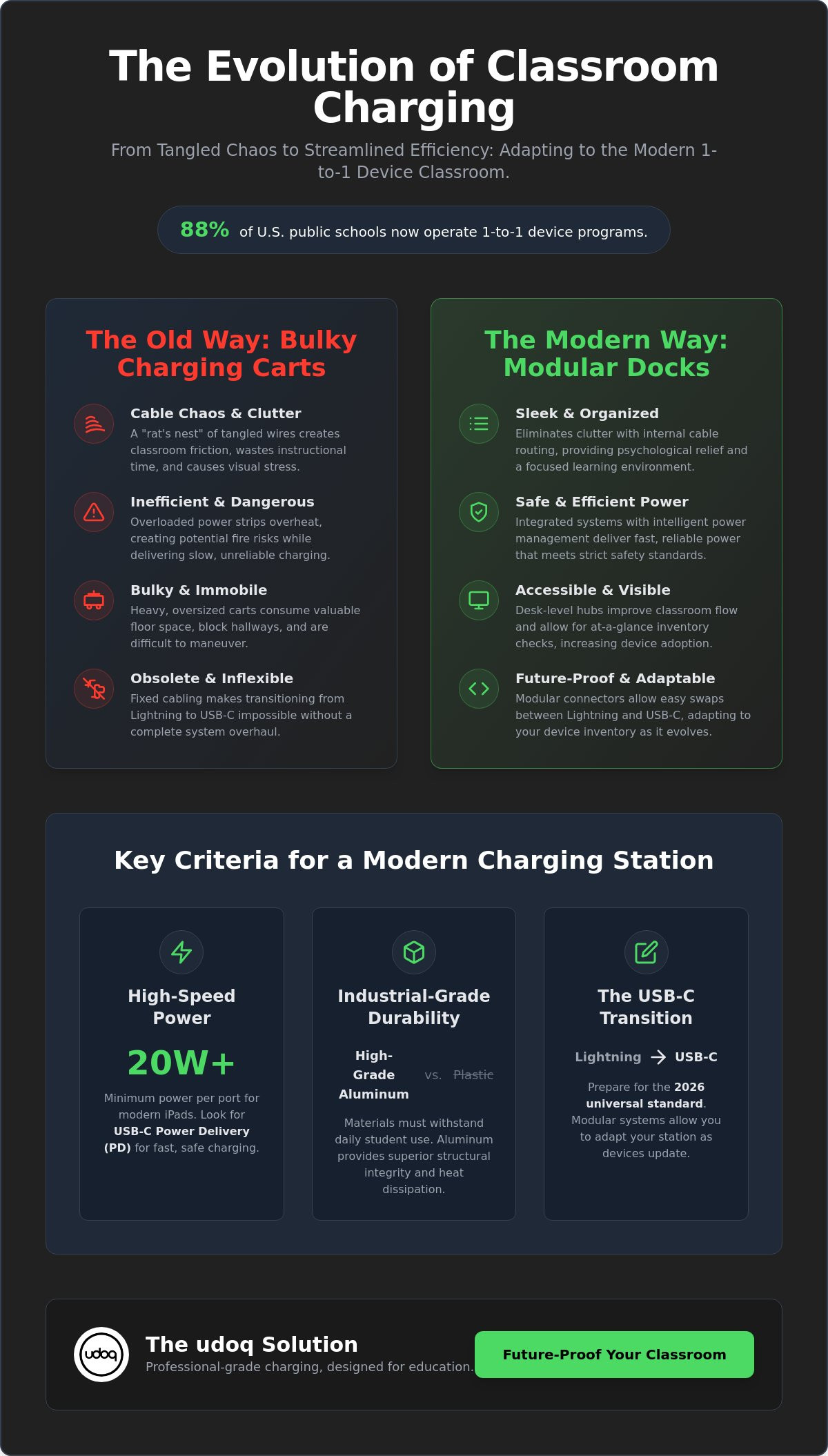
Why are we still hiding premium technology in bulky metal lockers that feel like industrial relics? Most educators agree that the traditional charging station for school ipads has become a primary source of classroom friction. You've likely felt the frustration of untangling a web of Lightning cables or maneuvering a heavy cart through a crowded hallway. With 88% of U.S. public schools now operating 1-to-1 device programs, the need for order is urgent. Chaos shouldn't be the price of digital integration.
It's time to future-proof your environment. This guide explores how to eliminate cable clutter and adapt to the 2026 landscape where USB-C is the universal standard. You'll discover how modular, rail-based docking solutions provide the psychological relief of a tidy workspace while delivering fast, reliable power. We'll examine the transition away from static hardware toward flexible systems that evolve alongside Apple's updates. Explore a more refined, efficient way to keep your classroom connected and ready for instruction.
Key Takeaways
- Transition from cumbersome charging carts to sleek desktop hubs that improve classroom flow and device accessibility.
- Identify the technical requirements for modern power delivery to ensure your iPads are always ready for instruction.
- Resolve the transition from Lightning to USB-C with a modular charging station for school ipads that adapts to your current and future inventory.
- Master cable management by utilizing internal routing systems that eliminate cluttered wires in learning environments.
- Scale your setup using professional-grade rails like the udoq 700 POWER to meet specific classroom device counts.
The Shift in Classroom Tech: Why Traditional iPad Charging Is Failing
The classroom environment is evolving rapidly. A modern charging station for school ipads is no longer just a storage box; it's a high-performance functional hub designed for the modern curriculum. For years, schools relied on massive metal lockers to house their technology. These solutions are failing. They prioritize storage over utility, creating bottlenecks during the start and end of every lesson. Transitioning to visible, accessible docking stations allows technology to serve the student, not the other way around.
A visible, organized tech environment provides immediate psychological relief for both educators and students. Teachers can focus on instruction rather than managing a tangled "rat's nest" of wires. Beyond aesthetics, safety is a critical factor. Relying on standard power strips with multiple individual adapters is inefficient and dangerous. It creates unnecessary heat and potential fire risks in high-traffic educational spaces. Professional systems replace this chaos with streamlined, integrated power that meets strict safety standards.
To better understand how centralized systems are evolving, watch this helpful video:
The Problem with Bulky Charging Carts
Traditional carts are physical obstacles. They block hallways and consume valuable floor space in compact classrooms. Because the technology is hidden behind heavy doors, students cannot verify if their device is actually charging. This leads to "dead on arrival" iPads during crucial testing periods or digital exams. Most carts also feature fixed internal cabling. This makes it difficult to swap between different iPad generations without a complete system overhaul. This lack of flexibility makes traditional carts a poor investment as hardware standards shift toward USB-C.
The Rise of Desk-Level Modular Docks
Proximity changes how technology is used. Placing modular docks directly in the learning area increases device adoption and ensures iPads are always within reach. Visibility is the key to effective Mobile Device Management (MDM) and physical asset tracking. When every device has a dedicated, visible slot on a charging station, teachers can account for their inventory at a glance. This transparency reduces the time spent on administrative check-ins.
A minimalist setup also reduces tech-related stress. Clean lines and hidden cables remove visual distractions, helping students stay focused on their tasks. Transitioning to desk-level docking stations simplifies the classroom flow. It makes technology a seamless part of the day rather than a logistical burden. Order creates a better environment for learning.
Key Criteria for Evaluating a School iPad Charging Station
Selecting a charging station for school ipads requires looking beyond simple storage. It's an investment in daily classroom productivity. You need a system that balances technical performance with physical resilience. A poorly designed dock becomes a graveyard for tangled cables and broken ports. A professional-grade solution streamlines your workflow and protects your hardware investment for years. Every detail counts when managing a fleet of student devices.
Understanding Power Requirements for Schools
Standard USB ports are no longer sufficient for modern iPad fleets. Current iPad Air and Pro models require at least 20W per port to charge effectively between periods. USB-C Power Delivery (PD) is the standard that makes this possible. Power Delivery (PD) is a high-speed charging protocol that negotiates the exact wattage required to charge school iPads safely and rapidly. Without it, devices may take hours to reach a usable state. Intelligent power management is also vital. It prevents the overheating common in cheap plastic hubs when multiple tablets draw maximum current simultaneously. Reliable power ensures your tech is ready when the bell rings.
Durability and Industrial Design
Classroom hardware must withstand years of daily student interaction. Plastic cabinets and thin steel trays often warp or crack under heavy use. High-grade aluminum provides superior structural integrity. It also acts as a natural heat sink, dissipating energy away from sensitive batteries. This is where German engineering makes a difference. Precision manufacturing ensures that the rail system remains stable even at full capacity. Modular connectors are another critical detail. They allow for precise alignment. This prevents lateral stress and port damage on the iPads themselves. This design philosophy prioritizes the longevity of both the station and the devices it supports.
Efficiency is measured in square inches. A compact footprint allows you to maximize device count without sacrificing valuable desk space. Effective cable management must be invisible. Internal routing eliminates the "rat's nest" of wires that typically plagues school tech areas. By hiding the cables within the rail, you create a focused, professional environment. This order reduces student distraction and simplifies teacher oversight. You can easily organize your classroom tech with a system designed for high-traffic educational use.
Trolleys vs. Modular Docks: Choosing the Right Scale
The choice between a mobile trolley and a modular dock depends entirely on your school's deployment strategy. Large trolleys serve a specific purpose. They are necessary when you must share a fleet of 30 or more iPads across multiple classrooms. However, for most modern learning environments, the mobility of a heavy cart is rarely worth the loss of floor space. Modular docks are the superior choice for creating dedicated, classroom-specific "iPad stations" of five to ten devices. This localized approach ensures that technology is always where students need it most.
A high-performance charging station for school ipads should simplify the user experience. Traditional carts often require students to fish for loose cables inside dark cabinets. This fumbling leads to bent pins and damaged ports over time. In contrast, a modular dock allows students to slide their device directly onto a fixed connector. It is a one-handed operation that feels intuitive and premium. This design also solves the persistent "cable theft" problem in schools. When cables are integrated into a locked rail system, they cannot be borrowed, lost, or misplaced. This level of organization ensures that the next class always finds a fully functional station.
The Case for the udoq 400 and 700 Series
The udoq 400 is an ideal mid-sized solution for educational settings. It fits perfectly on a teacher's desk or a small group collaboration table without creating visual clutter. For larger groups, the udoq 700 acts as a central hub for up to ten iPads. These systems allow for a mix of devices. You can charge an iPad Pro next to an older iPad Air without needing separate stations. This flexibility is essential for schools managing diverse hardware inventories.
Cost-Effectiveness Over Time
Modular systems offer a significantly lower total cost of ownership compared to static carts. Static carts are expensive to purchase and even more expensive to replace. When Apple transitioned from Lightning to USB-C, many schools were forced to discard perfectly functional metal trolleys because the internal wiring was obsolete. Modular docks eliminate this waste. By allowing for individual cable upgrades, you extend the life of your hardware indefinitely. This sustainable approach aligns with modern school budgets that prioritize longevity over temporary fixes. You can explore a variety of charging stations designed to adapt as your technology evolves.
Future-Proofing: Navigating the Lightning to USB-C Transition
The transition from Lightning to USB-C has created a significant logistical hurdle for schools. Since the European Union's Directive (EU) 2022/2380 mandated USB-C for all new tablets by late 2024, the industry has shifted entirely. Managing a mixed fleet now requires a charging station for school ipads that doesn't force a "one or the other" choice. Fixed-cable stations are a liability. If your hardware is locked into a specific connector type, your entire infrastructure becomes obsolete the moment you upgrade your tablets. Modular systems solve this by treating the connector as a swappable component rather than a permanent fixture.
IT administrators should conduct a thorough audit before investing in new docking hardware. This ensures the system can handle current needs while preparing for future upgrades. Consider these factors during your evaluation:
- The exact ratio of Lightning to USB-C devices in your current inventory.
- Planned procurement cycles for the next 24 to 36 months.
- The variety of protective cases used across different grade levels.
- The total wattage required to support simultaneous high-speed charging.
The Advantage of Swap-and-Slide Connectors
The udoq system uses a patented rail that allows you to slide C-CABLE and L-CABLE connectors exactly where you need them. This horizontal flexibility is crucial for classroom use. It allows you to accommodate different iPad case thicknesses without removing the protective covers. You can learn more about this standard in The Ultimate Guide to USB-C. This mechanical precision ensures that every device fits perfectly. It prevents the port stress that occurs when students try to force devices into misaligned slots.
Adapting to New Tech Without Replacing the Dock
Sustainability is a core requirement for school tech procurement. Moving away from "disposable" plastic chargers reduces environmental impact and saves budget in the long term. The udoq aluminum rail is a permanent installation. It won't warp or degrade like cheaper alternatives. When Apple releases new device dimensions or connector standards, you only replace the small, inexpensive connectors. You don't need to discard the entire docking station. This modularity ensures your investment remains relevant for a decade or more. It is a smarter, more responsible way to manage classroom technology. This approach values longevity over disposable trends.
Ensure your classroom is ready for the next generation of Apple hardware. Explore our modular charging solutions to build a system that grows with your school.
The udoq Solution: Professional Grade Charging for Education
Precision is the hallmark of the udoq ecosystem. The udoq 250, 400, 550, and 700 rails offer a scalable foundation for any educational setting. These systems replace the industrial "locker-room" look of traditional carts with a sophisticated, minimalist aluminum design. For environments requiring rapid turnaround between class periods, the udoq POWER series delivers high-wattage performance across every port. This ensures that a charging station for school ipads is a high-performance tool rather than a simple storage shelf. Order creates the psychological space for better learning.
The aesthetic benefit of this system extends beyond simple organization. A clean tech environment reduces visual noise and helps students stay focused on their digital curriculum. Every rail is built with the durability of German engineering, designed to withstand the rigors of a K-12 environment. This is a long-term investment in your school's infrastructure. It provides a premium feel that encourages students to respect and care for the technology they use daily. For school-wide deployments, we offer tailored B2B quotes to help administrators manage large-scale transitions efficiently.
Customizing Your School Docking Station
No two classrooms have identical technology needs. The udoq configurator allows you to build a system that matches your exact iPad count and model mix. You can easily explore our full range of charging stations to find the right length for your available space. Teachers can also customize their own desk setups. By mixing in phone or Apple Watch connectors alongside student iPads, the dock becomes a unified hub for all classroom hardware. This level of modularity ensures the system remains relevant as your device inventory changes.
Installation Flexibility: Desk vs. Wall Mount
Space is a premium commodity in modern schools. While desktop placement is common for collaboration zones, the udoq WALL MOUNT offers a powerful alternative for crowded rooms. Mounting the rail at eye level keeps iPads off the floor and away from potential spills. This setup ensures student safety and provides easy access during device check-outs. Proper positioning is key to a functional minimalist desk setup or classroom hub. Whether on a surface or a wall, the system maintains its sleek profile and high-status aura. It transforms tech management from a daily chore into a seamless, organized process.
Elevating Your Classroom Infrastructure
The era of bulky carts and tangled wires is ending. By prioritizing visibility and accessibility, you transform a simple storage area into a high-performance functional hub. Transitioning to a modular charging station for school ipads ensures your infrastructure remains resilient as technology evolves. You now understand how to navigate the shift to USB-C and why high-wattage power delivery is non-negotiable for modern learning. Order in the classroom directly supports student focus.
Our patented German engineering provides the structural stability your environment demands. The modular "Slide & Swap" connector system allows for immediate adjustments without costly hardware replacement. Every rail is crafted from high-grade sustainable aluminum; it's a long-term investment in classroom order and environmental responsibility. Eliminate the daily friction of tech management and refocus on instruction. Precision in your tools leads to precision in the classroom.
Request a custom quote for your school iPad charging stations and secure a sophisticated, future-proof solution today. Build a learning space that inspires clarity, efficiency, and peak student performance.
Frequently Asked Questions
Can I charge iPads with thick protective cases on a udoq dock?
Yes, the udoq system is engineered to accommodate almost any protective case. Each connector can be adjusted vertically to ensure a secure fit even with heavy duty ruggedized shells. The horizontal sliding mechanism also allows you to space devices exactly as needed to accommodate bulky edges. This flexibility ensures your hardware remains protected while it powers up.
How many iPads can I charge from a single wall outlet using udoq?
A single udoq 700 POWER unit can charge up to 10 devices simultaneously from one wall outlet. This efficiency reduces the need for multiple power strips and simplifies your classroom electrical layout. It's a streamlined way to manage a high capacity charging station for school ipads without overloading your existing infrastructure. You gain maximum capacity with minimal cable clutter.
Is the udoq system fast enough to charge a class set of iPads between periods?
The udoq POWER series utilizes USB-C Power Delivery (PD) to provide high speed charging for every device. This technology ensures that modern iPad models receive the maximum wattage they can handle for a rapid turnaround. You can significantly boost battery levels during a standard break or planning period. This speed keeps your digital curriculum moving without interruption.
What happens when we upgrade our school iPads to a new model with different connectors?
You simply swap the individual connectors within the existing rail. There is no need to replace the entire station when moving from Lightning to USB-C. Purchase the necessary C-CABLE or L-CABLE components and slide them into your current aluminum frame to maintain a modern setup. This modularity protects your long term budget by preventing hardware obsolescence.
Is the aluminum rail durable enough for daily use by younger students?
The high grade aluminum construction is built for industrial level resilience. It won't crack, warp, or degrade like plastic alternatives commonly found in educational settings. This material choice ensures your investment lasts through years of heavy student interaction while maintaining its premium aesthetic. It's a professional tool designed for the rigors of a high traffic classroom.
Can we wall-mount the charging station to save classroom space?
The udoq WALL MOUNT accessory allows you to secure the system directly to any flat surface. This is an ideal solution for crowded classrooms where desk space is limited. Mounting the station also keeps technology visible and organized at eye level for easier asset tracking. It transforms any wall into a functional and tidy charging hub.
Does udoq support both Apple Lightning and USB-C iPads on the same rail?
The modular design allows you to mix and match different connector types on a single rail. You can charge older Lightning based iPads alongside the latest USB-C models without using separate stations. This universal utility makes it the perfect charging station for school ipads when managing a mixed device fleet. Every student can charge their device regardless of its generation.
How does udoq prevent cables from being pulled out or stolen by students?
All connectors are mechanically locked into the aluminum rail during the initial assembly. Students cannot pull the cables out or remove them without the proper tools. This integrated design eliminates the common problem of missing or misplaced cables in school environments. It ensures that your charging area remains functional and fully equipped for every class session.