What if the primary threat to your team's daily output isn't a server outage, but a tangled pile of frayed cables in the corner of the office? Most organizations prioritize high-end software while completely neglecting the physical logistics of managing company-issued mobile device charging. This oversight creates a cycle of uncharged hardware, lost cables, and the persistent fire risk of cheap, uncertified power strips.
You recognize that professional environments require professional infrastructure. We'll show you how to eliminate this visual and operational chaos by implementing modular docking solutions that grow with your fleet. This guide explores the transition to a centralized, scalable charging hub that reduces downtime for mobile workers. We'll also cover how to stay ahead of 2026 USB-C mandates while maintaining a minimalist, high-status aesthetic in your workspace. It's time to treat your hardware with the same precision you apply to your business strategy.
Key Takeaways
- Identify why software management alone cannot solve the physical bottlenecks of device readiness and fleet maintenance.
- Discover how a modular, patented rail system simplifies managing company-issued mobile device charging across diverse hardware generations.
- Reduce corporate liability and fire risks by replacing uncertified charging hubs with professional-grade, industrial-designed solutions.
- Implement a strategic office audit to identify high-traffic power zones and optimize your team's daily workflow.
- Build a scalable infrastructure that adapts to evolving connector standards like USB-C without requiring a total hardware replacement.
The Logistics of Scale: Why Charging Company-Issued Devices is an Operational Bottleneck
Managing a fleet of devices is often viewed through the narrow lens of digital security. Companies invest heavily in Mobile Device Management (MDM) to track data and enforce policies. However, the physical reality of keeping those devices powered is frequently overlooked. This neglect leads to "cable chaos," a state where tangled wires and mismatched adapters clutter common areas. It isn't just an aesthetic failure; it's an operational bottleneck that slows down your entire team.
Effectively managing company-issued mobile device charging requires moving beyond individual wall warts. When cables are scattered, they get lost or damaged. When they are lost, they are often replaced with cheap, uncertified alternatives that pose significant technical risks. A professional environment demands a more sophisticated approach to hardware logistics.
To better understand how physical management integrates with digital security, watch this brief overview:
The Hidden Cost of Device Downtime
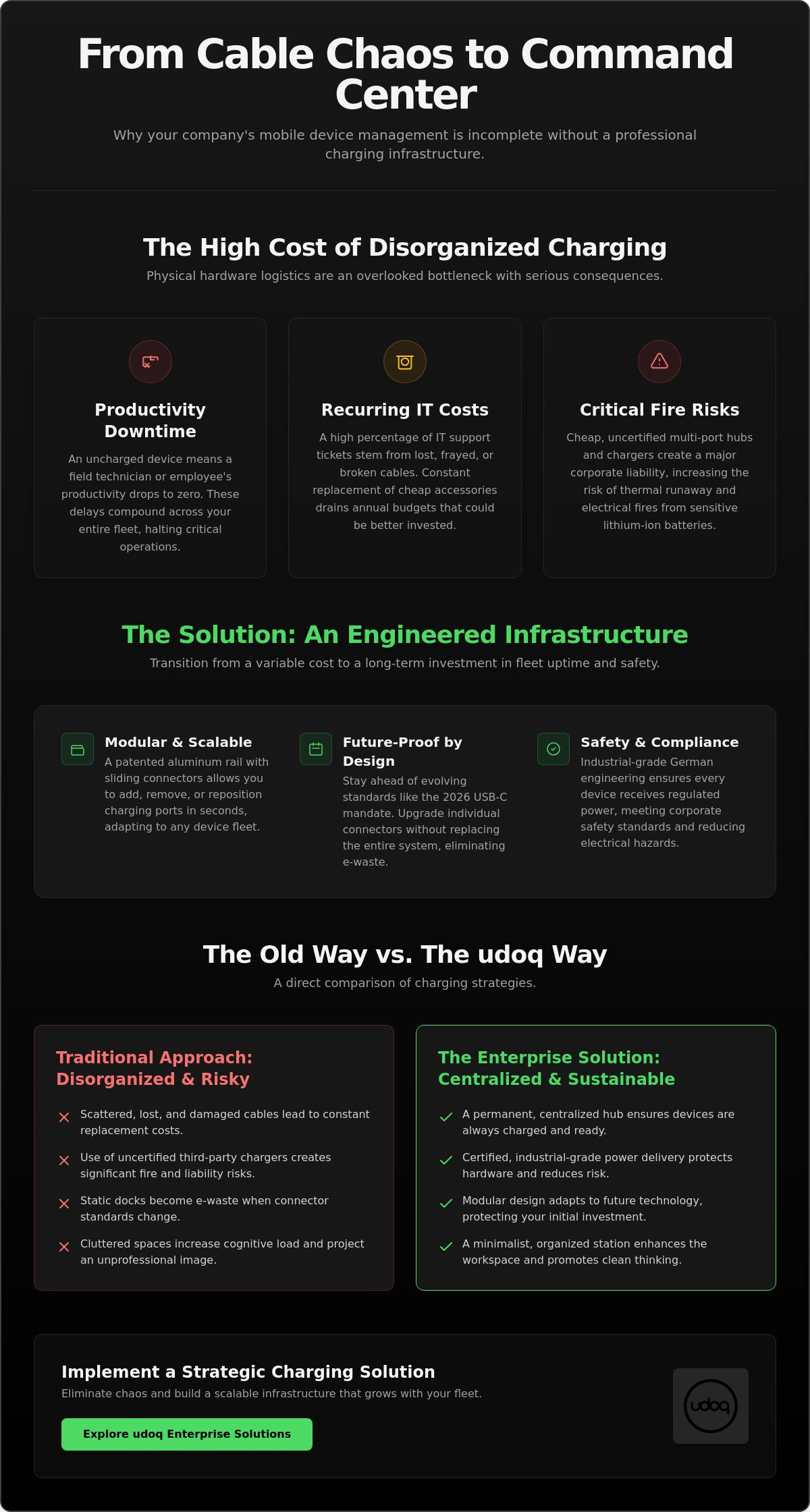
The math of device downtime is simple but punishing. If a field technician's tablet is dead at 8:00 AM, their productivity drops to zero until a charge is secured. These delays compound across a large fleet. Loose cables also create a "missing cable" syndrome. IT departments often report that a high percentage of support tickets stem from physical connectivity issues rather than software bugs. Replacing these cables is a recurring expense that drains annual budgets. A centralized, permanent docking solution turns a variable cost into a long-term investment in fleet uptime.
Fire Safety and Compliance in the Office
Safety is the most critical reason to centralize your power infrastructure. Lithium-ion batteries are sensitive to voltage fluctuations. Using non-certified third-party chargers increases the risk of thermal runaway and electrical fires. In an office environment, a single "bargain" multi-port hub can become a major liability. Centralized charging stations ensure that every device receives regulated power. This approach meets corporate safety standards and reduces electrical hazards. It replaces a cluster of potential fire starters with a single, engineered point of contact.
Beyond safety, there's a psychological benefit to order. A minimalist tech environment reduces cognitive load for employees. When a worker sees a tidy, organized charging hub, they feel the company values their time and their tools. It replaces environmental frustration with professional calm. Clean spaces foster clean thinking.
Modular Architecture: The Engineering Behind Sustainable Device Management
Traditional charging docks are static. They're designed for a single device generation. When standards shift, these docks become electronic waste. This is a significant failure in managing company-issued mobile device charging at scale. Enterprise logistics require a foundation that evolves alongside your hardware fleet. You need a system that anticipates change rather than reacting to it with more plastic clutter.
The udoq philosophy centers on a minimalist aluminum rail. It's a piece of industrial art rooted in German engineering. Instead of fixed ports, it utilizes patented sliding connectors. You can reposition, add, or swap cables in seconds. Managing company-issued mobile device charging becomes a seamless background process when the hardware is designed for change. Whether you're deploying a C-CABLE for new Android units or an L-CABLE for existing iPhones, the infrastructure remains constant. This mechanical innovation ensures your investment lasts for years, not months.
Adaptability as a Corporate Asset
Future-proofing is no longer optional. With 2026 mandates for universal USB-C charging, many legacy docks are already obsolete. Modularity transforms this challenge into an asset. By using the udoq 250, small office environments can manage essential devices without clutter. You don't replace the dock when you upgrade the phone. You simply slide in a new connector. This approach drastically reduces electronic waste and keeps your IT budget focused on innovation rather than replacement cables. It's a sustainable choice for a modern fleet.
Premium Materials for Premium Workspaces
Function must meet form in the professional office. Plastic hubs feel cheap and disposable. High-grade, milled aluminum offers a weight and durability that plastic can't replicate. This material choice is vital in executive suites or client-facing areas where every detail reflects corporate identity. It's a statement of quality and permanence. For a deeper look at selecting the right hardware for your needs, consult The Ultimate Guide to Choosing a Charging Station in 2026.
Reliability is the benchmark for corporate hardware. Our docking systems are designed to withstand the rigors of daily enterprise use. They provide a stable, heat-dissipating environment for your batteries, extending the lifespan of your mobile assets. If you're ready to upgrade your workspace, explore our full range of charging stations to find the configuration that fits your fleet perfectly.
Beyond MDM: Why Physical Charging Infrastructure is Critical for IT Compliance
Digital oversight is only half the battle. While Mobile Device Management (MDM) software secures the data within your fleet, it remains blind to the physical condition of the hardware. If a device is uncharged, it's effectively invisible to your network. Managing company-issued mobile device charging is the essential physical counterpart to your digital security protocols. Without a powered connection, your tracking, updates, and remote wipes are useless.
Centralized docking creates a reliable audit trail. It establishes a "Check-in/Check-out" culture that holds employees accountable. When every tablet and smartphone has a designated slot, inventory management becomes a visual task rather than a digital scavenger hunt. You can spot a missing asset from across the room. This physical organization is the first line of defense against loss and theft.
The Physical-Digital Management Gap
Software tracking fails at zero percent. A dead battery doesn't just halt work; it severs the link between the IT department and the asset. By using professional charging stations as a permanent home for corporate devices, you ensure they are always reachable. Clear charging protocols reduce the frequency of "lost" devices that are simply sitting uncharged in a drawer. It's about bridging the gap between digital policy and physical reality.
Optimising Battery Longevity
Fleet health depends on power quality. Inconsistent voltage from cheap adapters accelerates battery degradation, forcing early replacements that drain IT budgets. udoq power supplies are engineered to provide the stable current required for long-term cell health. Technical studies suggest that maintaining stable power delivery and avoiding extreme discharge cycles can extend lithium-ion battery life by up to 20%. This precision ensures your mobile assets remain in the field longer, maximizing your hardware ROI. It's a long-term investment in your environment.
Implementing a Centralised Charging Strategy: From Desks to Common Areas
Transitioning from a chaotic tangle of wires to a streamlined infrastructure requires a systematic approach. It isn't just about buying hardware. It's about designing a workflow that respects both the technology and the user's time. Successfully managing company-issued mobile device charging starts with a physical audit of your current assets. You must understand the specific needs of your fleet before deploying a solution.
Follow these five steps to establish a professional charging environment:
- Step 1: Audit your connectors. Identify the ratio of USB-C, Lightning, and Micro-USB devices. With the 2026 mandates in the EU and California requiring USB-C for all new mobile electronics, prioritize C-CABLE configurations for future-proofing.
- Step 2: Identify 'power zones.' Locate high-traffic areas where employees naturally congregate or check in. IT rooms, reception desks, and breakrooms are primary candidates for centralized hubs.
- Step 3: Select your rail size. Match the hardware to the volume. A udoq 250 is ideal for individual workstations, while a udoq 700 accommodates high-density environments.
- Step 4: Deploy wall mounts. Elevate your charging. Using a WALL MOUNT clears desk real estate and keeps devices at eye level for quick status checks.
- Step 5: Establish a policy. Create a clear 'Check-in/Check-out' protocol. Consistency is the key to maintaining 100% fleet readiness.
Maximising Space with Wall Mounts
Desk space is a premium asset in the modern office. Loose cables and bulky power strips consume valuable square footage and create visual friction. By utilizing vertical surfaces, you turn empty walls into high-capacity charging hubs. This approach is particularly effective in executive suites where a clean aesthetic is mandatory. For these high-status environments, the udoq 400 Premium Watch offers a sophisticated solution that handles phones, tablets, and wearables simultaneously. Learn more about optimizing your workspace in How to Create a Minimalist Desk Setup: The Ultimate 2026 Guide.
Scalable Solutions for Large Fleets
Large-scale deployments demand industrial-grade reliability. The udoq 700 is engineered for high-density environments, capable of managing up to 10 devices on a single rail. This scalability allows IT managers to customize connectors for mixed Android and iOS environments without changing the base infrastructure. You can slide, swap, and reconfigure cables as your fleet evolves. This modularity ensures that your physical management strategy remains relevant regardless of changing industry standards. To begin your infrastructure upgrade, explore our enterprise docking solutions today.
udoq: The Enterprise-Grade Solution for Modern Fleet Management
Order is a prerequisite for productivity. Throughout this guide, we've identified the hidden costs of physical chaos and the limitations of software-only management. udoq addresses these gaps with a patented, modular docking system that serves as a permanent anchor for your fleet. Managing company-issued mobile device charging becomes an effortless ritual rather than an administrative burden. It's the final piece of the puzzle for organizations that value meticulous organization and technical precision.
The efficiency of this system is most evident in its power management. A single udoq 700 POWER unit can charge up to 10 devices using only one wall outlet. This consolidation eliminates the need for unsightly power strips and reduces the load on your office's electrical infrastructure. It's a clean, industrial solution for environments that demand both high capacity and high aesthetics. By centralizing power, you create a dedicated hub that naturally encourages the accountability we discussed in earlier sections.
Why udoq is the Choice for IT Professionals
IT managers prioritize reliability and flexibility above all else. Our German-made aluminum rails are milled with technical precision to withstand heavy-use environments, from busy hotel lobbies to high-traffic IT check-out stations. The system is designed to integrate seamlessly with our MAGNETIC ADAPTER and WIRELESS ADAPTER, providing a friction-less experience for users regardless of their device type. This durability ensures your investment remains viable for years.
We understand that enterprise needs vary. That's why we provide direct support for bulk B2B and wholesale orders. Whether you're outfitting a single executive floor or a global hotel chain, we offer tailored quotes to ensure your infrastructure is perfectly sized. This direct partnership ensures you have the right mix of C-CABLE and L-CABLE components from day one, delivered with the authoritative quality your brand deserves.
The Future of Corporate Charging
Your tech stack will inevitably change. As we move through 2026 and beyond, new connector standards and device dimensions will emerge. udoq is the only physical infrastructure that evolves with you. By establishing a physical standard for your mobile assets, you close the loop on device management. You're not just buying a temporary accessory; you're investing in a long-term system that values longevity over disposable trends. It's a commitment to a tidy, efficient environment.
The psychological relief of a minimalist, professional workspace cannot be overstated. When technology is organized, the mind follows. It replaces environmental frustration with a sense of high-status calm and clarity. Explore our professional charging stations for your office and transform your corporate environment today.
Master Your Corporate Power Infrastructure
Physical order is the foundation of digital readiness. By bridging the gap between software policies and hardware logistics, you protect your investment and your team's time. A modular approach ensures that your infrastructure remains relevant as global standards shift toward universal connectivity. Professional environments don't just tolerate technology; they master its presence through deliberate design.
Mastering the complexities of managing company-issued mobile device charging requires a system built for longevity. udoq offers a patented modular system made in Germany that simplifies fleet maintenance. It powers up to 10 devices from a single outlet, replacing environmental chaos with industrial precision. This is why leading hotels and global enterprises trust our rails for high-density charging environments.
It's time to replace cable clutter with a permanent standard of excellence. Streamline your corporate device charging with udoq and experience the psychological relief of a perfectly organized workspace. Build an environment that reflects the uncompromising quality of your brand.
Frequently Asked Questions
How do I manage charging for a large fleet of company iPhones and iPads?
Manage large fleets by deploying high-density rails like the udoq 700 POWER in dedicated charging zones. This approach centralizes hardware and simplifies inventory audits. It's the most effective strategy for managing company-issued mobile device charging across multiple departments. You'll ensure every unit is accounted for and powered.
Can one charging station handle both USB-C and Lightning devices?
Yes. The patented sliding mechanism allows you to combine C-CABLE and L-CABLE connectors on a single aluminum rail. This flexibility is essential for mixed-device environments. You can reconfigure the layout in seconds as your hardware needs evolve. It's a future-proof solution for changing standards.
Is it better to have individual chargers or a centralized docking station for the office?
Centralized docking stations are superior for enterprise environments. They eliminate the "missing cable" syndrome and reduce IT support tickets related to dead batteries. Individual chargers create visual clutter and increase the risk of lost assets or the use of uncertified, dangerous cables.
How do modular charging docks save money for businesses in the long run?
Modular docks save money by extending cable life and protecting device batteries through stable power delivery. You only replace individual connectors rather than the entire dock when standards change. This allows you to stay compliant with 2026 USB-C mandates without a total infrastructure overhaul.
What are the fire safety benefits of using a professional docking station?
Professional docking stations use certified power supplies and high-grade aluminum that assists with heat dissipation. This setup eliminates the fire risks associated with cheap, uncertified multi-port chargers and tangled power strips. It's a critical safety upgrade that protects your facility and your mobile assets.
Can I wall-mount a multi-device charging station to save desk space?
You can easily wall-mount our systems using the dedicated WALL MOUNT accessory. This saves valuable desk real estate and keeps devices at eye level for quick status checks. It's a minimalist solution for high-traffic corridors, reception areas, or compact IT rooms where space is at a premium.
How do I ensure company-issued devices are charged and ready for every shift?
Establish a strict check-in protocol at a centralized charging hub. When employees return devices to a designated udoq station at the end of their shift, they're guaranteed a full charge for the next user. This routine reduces operational downtime and ensures 100% fleet readiness.
What is the best way to organize cables for a company-wide mobile deployment?
The best way to organize cables is to conceal them entirely within the udoq rail. This engineering choice removes visual clutter and prevents cables from being frayed, tangled, or stolen. It creates a tidy, professional appearance that reflects your company's commitment to quality and order.