What if the disappearance of power cables isn't a parenting failure, but a structural one? Most households treat charging as a transient activity. They rely on loose wires that inevitably migrate to bedrooms, backpacks, or the trash. You've likely felt the frustration of a dead tablet minutes before a school run. You've seen the visual exhaustion of tangled cords on a clean countertop. If you're wondering how to stop kids from losing chargers, the answer lies in your infrastructure. The average person spends 2.5 days every year searching for lost items. In a digital home, those items are usually the lifelines to your devices.
Traditional cables are built for mobility, which is why they fail in a busy home. This article explores how to transition from chaos to permanent order using a design-led system. You'll learn why anchored tech is the only way to keep devices accessible and rooms clutter-free. We'll preview how modular docks like the udoq 400 or 700 series transform disposable accessories into a long-term investment. Stop replacing lost cables. Start building a reliable power hub that stays where you put it.
Key Takeaways
- Shift your perspective from managing behavior to managing infrastructure. Loose cables are transient by design; permanent order requires a fixed foundation.
- Master how to stop kids from losing chargers by implementing an anchored system that keeps every C-CABLE and L-CABLE exactly where it belongs.
- Move beyond ineffective labels and color-coding. Systemic design creates a path of least resistance that naturally guides your family toward organization.
- Audit your household device ecosystem to select a modular dock size that scales with your tech needs, from the compact udoq 250 to the expansive 700 series.
- Experience the psychological relief of a tidy environment. High-grade aluminum construction ensures your charging station is a long-term investment, not a disposable accessory.
The Psychology of the 'Disappearing' Charger
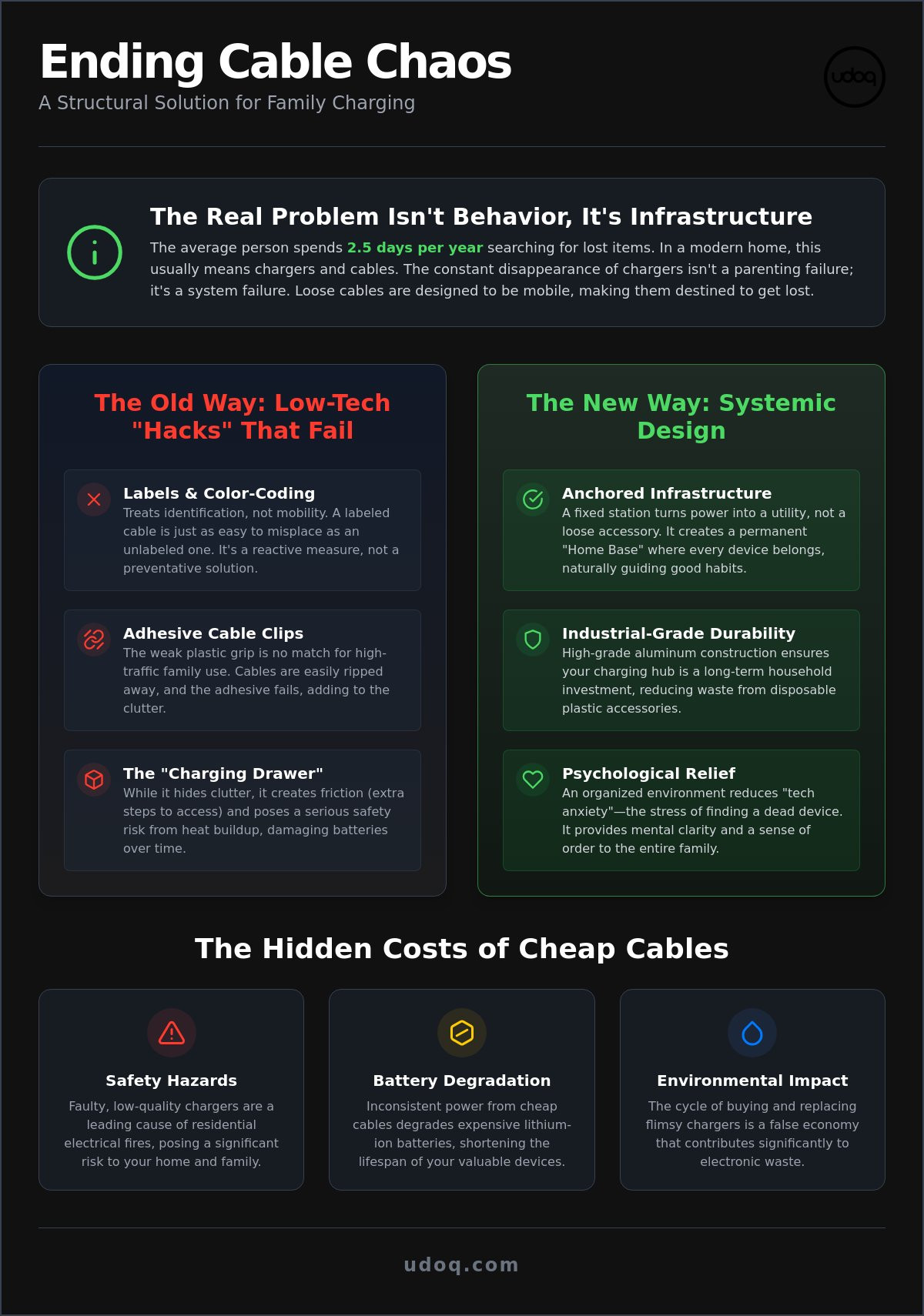
Loose cables are transient by design. They lack a permanent anchor, which is why they inevitably drift toward the path of least resistance. In a busy household, this path usually leads to a bedroom, a backpack, or the trash. This environmental flaw causes the psychological pain of losing things. It creates a cycle of frustration for parents and children alike. Understanding how to stop kids from losing chargers requires a shift from behavioral management to structural organization. We must stop blaming the user and start fixing the environment.
The lack of a designated charging zone creates "tech anxiety." This is the stress of discovering a dead tablet minutes before a school run or a long flight. When power is a moving target, devices are never where they need to be. Kids don't set out to be irresponsible. They simply prioritize convenience. Without a fixed hub, the closest cable becomes the only option, regardless of where it belongs. This creates a cluttered environment that weighs on the mental clarity of the entire family.
To better understand this concept, watch this helpful video:
Loose Cables vs. Fixed Stations
Most households operate with an "accessory mindset." They treat chargers like disposable pens. This mindset encourages "borrowing" and displacement. A fixed station turns power into a utility. When a C-CABLE or L-CABLE is locked into a charging station, it ceases to be a loose object. It becomes part of the home's architecture. This physical anchor provides psychological relief. It ensures every device has a "Home Base" where it is protected and accessible. This structure naturally guides children toward better habits without the need for constant discipline.
The True Cost of Disposable Tech
Cheap replacements are a false economy. Beyond the repeated expense of replacement cables, low-quality wires pose significant safety risks. Faulty chargers are a leading cause of electrical fires in residential settings across the country. They also provide inconsistent power that degrades expensive lithium-ion batteries. Research shows that 60% of Americans have lost a personal item in the past year, with mobile phones being the most common. Choosing high-grade aluminum over plastic ensures your hub remains a permanent fixture. Premium materials turn a temporary accessory into a long-term household investment that reduces environmental waste.
Evaluating Solutions: Low-Tech Hacks vs. Systemic Design
DIY solutions often treat the symptom rather than the structural cause of cable loss. Many parents search for how to stop kids from losing chargers only to find suggestions like marking cables with colored tape or Sharpies. This approach assumes the problem is identification. In reality, the problem is mobility. A labeled cable is just as easy to lose as an unlabeled one. It simply identifies the owner after the object has already disappeared. It is a reactive measure in a proactive world.
Common DIY Fixes and Why They Fail
Color-coding is excellent for clarity in a drawer full of wires, but it offers zero prevention. Similarly, adhesive cable clips are designed for light organization, not high-traffic family use. A child's "grab and go" habit easily overcomes the weak plastic grip of a standard clip. The cable is ripped away, the adhesive eventually fails, and the chaos resumes. The Velcro strategy, which involves using hook-and-loop strips to bundle wires, also fails aesthetically. These strips attract dust and debris, quickly losing their clean appearance and becoming just another layer of visual noise in your living space.
Some families attempt to centralize power in a "charging drawer." While this reduces visual clutter, it introduces technical friction and safety risks. Enclosed spaces are prone to heat buildup, which can degrade lithium-ion batteries over time. It also creates a psychological barrier. Kids must open a drawer to connect a device, leading them to prefer the path of least resistance, which is usually a loose cable left on the couch or floor.
The Move to Industrial-Grade Organization
True order requires a shift from buying accessories to investing in infrastructure. High-grade aluminum stations offer a level of durability and weight that plastic alternatives cannot match. When cables are anchored into a heavy, metallic rail, they cease to be portable objects. They become part of the home's furniture. This "Docking Philosophy" changes how children interact with technology. They no longer hunt for a wire; they return their device to a fixed, reliable location every evening.
Implementing a minimalist desk setup influences behavior through environmental design. A clean, organized space signals that every object has a designated place. This visual clarity reduces the impulse to move equipment for temporary use. By choosing a systemic solution like the udoq 400 or 700 series, you establish a permanent hub that scales with your family's evolving needs. Explore our range of anchored charging stations to end the cycle of replacement and reclaim your physical space.
The Power of Anchored Infrastructure
Anchored infrastructure is a fixed charging point where cables remain mechanically secured. Unlike a standard multi-port hub, these cables cannot be removed or relocated without specific tools. This structural shift is the definitive answer to how to stop kids from losing chargers. It moves the responsibility of organization from the child to the environment itself. When a cable is physically locked into a rail, it ceases to be a portable accessory and becomes a permanent household utility.
A sliding rail system provides the necessary flexibility for a growing family without sacrificing this security. It allows you to position connectors exactly where they are needed while keeping them firmly attached to the base. This design also enables one-handed docking. Younger children often struggle with two-handed cable management, leading to frayed wires or dropped devices. A fixed, stable connector allows them to slide a tablet or phone into place with ease. By eliminating "cable spaghetti," you reduce the visual clutter and the mental load of managing a chaotic tech environment.
Why Modular Rails Are Superior to Multi-Port Hubs
Most multi-device stands are static and rigid. They fail to account for the "Case Problem," where rugged, protective covers prevent devices from reaching the charging pin. Modular rails solve this by allowing for adjustable connector heights. Whether your child uses a slim silicone sleeve or a thick, drop-proof enclosure, the L-CABLE or C-CABLE can be tuned to fit perfectly. This adaptability ensures your station remains relevant as your family tech evolves. The udoq 250 serves as a compact entry point, providing enough space for a smartphone, a tablet, and an e-reader in one sleek footprint.
Security Through Design, Not Discipline
Managing tech through discipline is exhausting and often ineffective in high-traffic households. Security through design is a more reliable alternative. Because the connectors are fixed, children cannot "borrow" a cable for another room or a car trip. This physical limitation creates a natural "Return to Base" expectation. The device must come to the power source, rather than the power source traveling to the device. A modular dock acts as a permanent charging anchor that transforms mobile accessories into fixed household utilities. This system establishes a reliable routine, ensuring that every device is charged and ready for school or travel every single morning.
Implementing a Family Charging Protocol
A protocol is the bridge between premium hardware and a tidy home. To master how to stop kids from losing chargers, you must define exactly where technology lives. Start with a comprehensive device audit. List every smartphone, tablet, and e-reader in your household. This list determines the rail length you require, whether it is the compact udoq 250 or the expansive udoq 700. Arrange your connectors in a logical sequence. Grouping by user or device type reduces friction during the evening rush. It ensures every family member has a dedicated slot on the rail.
Implement the "Nightly Dock" rule as a non-negotiable standard. Every device must return to the station before sleep. This simple habit ensures 100% battery readiness for school or work the next morning. It also prevents tablets from being left on floors or tucked into couch cushions where they are easily damaged. Maintenance of the system is effortless. Wipe the high-grade aluminum with a dry microfiber cloth to maintain its sleek, industrial finish. Periodically check that the connectors are tightened within the rail to ensure maximum stability during docking.
Choosing the Right Location
Identify your home's natural "drop zones." The kitchen and entryway are typically the highest traffic areas. An entryway dock catches devices the moment kids walk through the door, preventing tech from migrating into bedrooms. A kitchen dock keeps devices central for easy supervision. Consider the benefit of wall mounting your station. This preserves valuable counter space and keeps cables organized. It elevates your charging hub into a functional piece of wall art that complements a minimalist aesthetic.
The 'One In, One Out' Rule for Tech Upgrades
Your family's technology is never static. Your charging station shouldn't be either. The udoq system allows you to swap a C-CABLE for an L-CABLE in seconds without replacing the entire unit. This modularity handles mixed ecosystems with ease. You can charge an Android tablet next to an iPad without adding a single loose wire to your environment. For those with wearable tech, the udoq 400 Premium Watch integrates smartwatch charging directly into the main rail. This creates a unified power hub that evolves as your family's needs grow. Ready to eliminate cable chaos? Explore our modular charging collections to build your custom family hub.
The udoq Solution: German Engineering for Family Chaos
The patented udoq rail system originated from a desire to merge industrial precision with domestic order. It is a product of meticulous German engineering, designed to solve environmental friction through mechanical innovation. By anchoring every connector into a high-grade aluminum rail, you establish a permanent hub that defies the typical cycle of loss. This is the definitive answer for how to stop kids from losing chargers. While plastic docks eventually crack or fail, our aluminum profiles offer material durability that lasts for decades.
Sustainability is at the core of our design. Most tech accessories are disposable, destined to become e-waste when a port standard changes. The udoq system is different. It is modular. When the industry shifts from Lightning to USB-C, you simply swap the connector, not the entire station. This adaptability makes it the last charging hub you'll ever need to purchase. Whether you start with the compact udoq 250 for essential devices or scale up to the massive udoq 700 for a multi-child household, the quality remains uncompromising.
Aesthetic Excellence Meets Functional Rigor
We embrace a "Less is More" philosophy. A single udoq station can power up to 10 devices from just one wall outlet, instantly removing the visual clutter of multiple power bricks. This centralization isn't just about beauty; it's about safety. Reducing the number of active wall connections minimizes electrical risks. By using high-quality udoq POWER supplies, you ensure stable energy delivery and significantly reduce fire hazards associated with cheap, uncertified adapters.
Investing in Long-Term Order
Consider the financial reality of your current tech management. Replacing five years of lost or frayed cables often costs more than a single, permanent charging station. The investment pays for itself through longevity and the prevention of device damage. More importantly, it provides the psychological relief of a tidy environment. You no longer wake up to dead tablets or missing wires. You gain the confidence of an "always-ready" charging hub. End the daily search for power. Explore our modular charging stations and establish permanent order in your home today.
Reclaiming Your Physical and Mental Space
The transition from loose cables to anchored infrastructure is more than an organizational upgrade. It is a commitment to a calmer, more efficient home environment. By shifting from a mobile accessory mindset to a fixed utility model, you eliminate the root cause of tech-related stress. You've learned that behavior follows environment. When devices have a permanent "Home Base," the cycle of loss ends naturally. This systemic shift is the ultimate resolution for how to stop kids from losing chargers.
Investment in quality ensures your home remains a sanctuary of order. Our patented German engineering provides a sustainable modular design that adapts as your technology evolves. Power up to 10 devices from a single outlet while maintaining a sleek, minimalist aesthetic. It's time to replace temporary hacks with a long-term solution that respects your space and your time. Build your custom udoq docking station and reclaim your cables. Experience the psychological relief of a home where everything stays exactly where it belongs.
Common Questions About Charging Infrastructure
How do I stop my kids from unplugging the charging station itself?
The most effective method is to transform the unit from a portable accessory into a permanent fixture. Using a WALL MOUNT secures the station to a vertical surface, making it nearly impossible for children to relocate the entire hub. Additionally, the weight of our high-grade aluminum profiles provides a level of stability that standard plastic hubs cannot match. This physical presence discourages casual tampering and establishes the station as a fixed part of your home's architecture.
Will a docking station work with thick, protective cases like Otterbox?
Yes, our patented sliding rail system specifically addresses the "Case Problem." You can adjust the height of every L-CABLE and C-CABLE connector to accommodate even the most rugged, drop-proof enclosures. This precision ensures a secure connection without requiring your children to remove their protective cases. It eliminates the friction that often leads to devices being left uncharged or cables being forced into awkward angles.
What happens when Apple or Android changes their charging port again?
Modularity is the core of our design philosophy. When industry standards evolve, you simply swap the individual cable or adapter within the existing rail. You don't need to replace the entire station. This sustainable approach ensures your infrastructure remains current, whether you are transitioning from older Lightning ports to the latest USB-C standards. It is a long-term investment that adapts to your family's changing technology.
Is it safe to charge multiple tablets and phones from one wall outlet?
Charging multiple devices from a single outlet is significantly safer when using a centralized, high-quality power supply. Systems like the udoq 400 POWER are engineered to manage current distribution across several devices simultaneously. This reduces the fire risk associated with "daisy-chaining" multiple cheap wall warts into a single power strip. Our components meet rigorous safety standards to protect both your home and your expensive electronics.
How can I prevent my kids from 'borrowing' the charging cables for their rooms?
The cables in our system are mechanically secured into the aluminum rail. They cannot be removed without the use of specific tools, which effectively ends the cycle of migrating wires. If you've been searching for how to stop kids from losing chargers, this physical lock is the definitive answer. By making the cables impossible to "borrow," you ensure that the power source always stays in the designated High-Traffic zone.
Are docking stations better for battery health than cheap wall warts?
Premium docking stations provide a stable, regulated voltage that is essential for long-term battery health. Cheap, uncertified chargers often produce voltage spikes and excessive heat, both of which degrade lithium-ion batteries over time. Our power solutions ensure a consistent energy flow that preserves the lifespan of your family's smartphones and tablets. Investing in quality infrastructure protects the significant capital you've already spent on your mobile devices.
Can I mount a charging station to the wall to keep it away from toddlers?
Wall mounting is an excellent strategy for keeping technology out of reach of smaller children. Our WALL MOUNT accessory allows you to position the station at any height, effectively toddler-proofing your charging zone. This also clears valuable counter space in kitchens or entryways. It turns your charging hub into a sleek, organized wall feature that remains accessible to older children while staying safely away from curious toddlers.
Which udoq size is best for a family of four with multiple devices?
The udoq 550 or udoq 700 series are the optimal choices for a typical family of four. These wider rails provide enough lateral space to dock four to six devices, including a mix of large tablets and smartphones, without crowding. This ensures that everyone has a dedicated spot, which is a key component of how to stop kids from losing chargers. Selecting a larger rail also provides the necessary room to add a wireless adapter or a smartwatch dock as your family's tech needs grow.