Your entryway is the digital airlock of your home, yet for most, it remains a chaotic graveyard of tangled cables and scratched screens. It is frustrating to fumble with a connector or watch a device slide off a narrow table while you are rushing out the door. You deserve a transition point that matches the sophisticated order of your lifestyle. This guide will help you transform that clutter into a high-performance entryway phone charging station that looks like an intentional part of your home architecture.
We will show you how to build a minimalist landing strip that offers one-handed docking and eliminates cable chaos for good. With the average high-tech household in 2026 now managing over 12 connected devices, a static dock is a liability. You need a modular system that evolves. We will explore how to integrate industrial-grade materials and the latest standards, such as Qi2 and universal USB-C compliance, into a system built for longevity. It is time to replace disposable plastic with a permanent investment in your home’s efficiency and aesthetic order.
Key Takeaways
- Define your entrance as a "digital airlock" to streamline the transition between the outside world and your home sanctuary.
- Select high-grade aluminum over plastic to ensure your hardware stays cool and benefits from industrial-grade durability.
- Invest in a modular entryway phone charging station that lets you slide and swap connectors as your tech collection grows.
- Apply the "One Outlet" rule to power all your family's devices from a single plug, eliminating the mess of tangled cords.
- Position your dock at the ideal height for effortless, one-handed device retrieval during your busiest daily transitions.
What Is an Entryway Phone Charging Station?
An entryway phone charging station serves as the central nervous system for your home’s entry and exit points. It is a purpose-built hub that organizes the influx of mobile technology. We call this the "Digital Airlock." Just as a physical airlock manages the transition between two distinct environments, this station manages the shift from the connected outside world to your private sanctuary. A professional system combines a high-wattage power supply with sophisticated cable management and ergonomic device support.
To better understand how this setup can transform your daily routine, watch this overview of a multi-device solution:
Many homeowners rely on a "charging bowl" or a kitchen counter catch-all. These improvised solutions are inefficient. They lead to tangled cables, overheated batteries, and cluttered surfaces. A professional dock replaces this chaos with a structured landing strip. By leveraging modern charging station technology, you consolidate multiple power bricks into one streamlined unit. This approach eliminates the need for numerous wall outlets and creates a clean, architectural look that complements your home's design.
The Psychology of the Digital Airlock
Placing a dock at the front door creates a powerful mental boundary. It encourages a "set and forget" mentality that separates professional demands from personal time. This transition point offers immediate psychological relief. You arrive home, dock your phone, and reclaim your attention. It also ends the daily anxiety of the "missing device" search. Knowing your hardware is secure and charging allows you to focus on your family. It reduces the friction of the morning commute by making device retrieval a mindless, one-handed task.
From DIY Hacks to Industrial Design
Old DIY hacks, such as drilling holes in furniture or using decorative pots, are no longer viable. Today's technology demands more. Modern USB-C and Qi2 standards require stable, heat-conductive environments to maintain battery health. Repurposed wood or plastic containers often trap heat, which degrades your device over time. The shift toward minimalist, aluminum-based infrastructure reflects a need for durability and technical precision. A modern charging station is a high-performance utility that serves as a permanent anchor for your digital life. It is an investment in order that adapts as your technology collection expands.
Choosing the Best Entryway Dock: Aesthetics vs. Functionality
Selecting an entryway phone charging station requires a balance of visual appeal and technical performance. Most consumers prioritize aesthetics, but functional engineering ensures longevity. A dock in a high-traffic zone must withstand daily use while protecting expensive hardware. It isn't just a stand; it's a piece of home infrastructure. High-quality materials and smart spatial planning prevent your landing strip from becoming a cluttered bottleneck. You need a system that handles the physical demands of a busy household while maintaining a refined look.
Material Science: The Aluminum Advantage
Material choice impacts both durability and device health. While wood offers a rustic look, it acts as an insulator. This traps heat generated during fast-charging cycles. Aluminum is a superior thermal conductor. It draws heat away from your smartphone’s battery, which helps extend its lifespan. This material choice mirrors the minimalist desk setup aesthetic that values clean lines and industrial strength. Anodized aluminum doesn't chip or fade like painted wood. It stays pristine despite the friction of daily docking and the occasional bump from keys or bags.
Device Density and Space Optimization
Entryways are often narrow. Space is at a premium. A bulky dock creates a physical obstacle in your hallway. Vertical docking is the most efficient solution. By positioning devices upright, you maximize device density without expanding the footprint. You can calculate the required rail length based on your family's specific inventory. A standard smartphone requires about 80mm of space. A large tablet may need up to 250mm. Modular rails allow you to arrange these devices according to your needs. This ensures a heavy tablet stays stable next to a lightweight smartphone. It keeps every device accessible for a quick exit.
High-performance docking also requires robust power delivery. Charging multiple devices simultaneously generates significant thermal energy. Modern smartphones often pull 20W to 30W, while tablets can exceed 45W. A single wall outlet can't safely support five individual power bricks without a mass of tangled cords. Industrial-grade docks consolidate this power into a single, high-capacity source. This approach reduces electrical clutter and ensures every device receives the optimal charge speed. Safety is paramount in high-traffic areas where children or pets are present. You can explore modular docking systems that prioritize both safety and sophisticated design. Choosing the right foundation today prevents a disorganized mess tomorrow. It's about creating a system that works as hard as the devices it supports.
The Modular Advantage: Future-Proofing Your Home Entrance
Static docks are a poor investment for the modern home. Most consumer-grade stands are built for a specific device model or connector type. When you upgrade your phone or the industry shifts standards, these fixed units become obsolete. They end up in a drawer or a landfill. A modular entryway phone charging station solves this problem through adaptable architecture. Instead of fixed ports, it utilizes a rail system. This allows you to slide, swap, and rearrange connectors as your device mix changes. It is a system designed to last decades rather than months.
Swappable Connectors and Longevity
The core of a modular system is the sliding connector mechanism. You can adjust the lateral position of each plug to accommodate different device widths and cases. This flexibility is essential for a family hub where an iPhone, a Samsung tablet, and a Kindle must coexist. Transitioning from legacy connectors to new standards is simple. You don't need to buy a new dock when you move from Lightning to USB-C. You simply swap the internal cable. Specialized components like the MAGNETIC ADAPTER or the udoq Apple Watch accessory integrate wearables into the same sleek profile. This adaptability ensures your entryway remains a high-performance zone regardless of tech trends.
Sustainable Tech Architecture
Choosing modular hardware is a commitment to sustainability. The USB-C transition is a prime example of why fixed docks fail. As universal standards become law, proprietary docks become e-waste. A rail-based system reduces environmental impact by keeping the heavy aluminum chassis in service while only the inexpensive connectors change. This reflects a German engineering philosophy: build it once, build it right. Every component is precision-milled for a lifetime of use. Modular architecture transforms your charging hub from a temporary accessory into a permanent asset. This modularity equals long-term cost savings because you never have to replace the foundation of your digital airlock. It is a one-time purchase that evolves with your household's needs.
The ability to mix and match brands in a single row is a distinct advantage. You can charge an iPad Pro, a Pixel phone, and a set of wireless earbuds side-by-side without a mess of conflicting stands. This consolidation creates a unified look that elevates your home's aesthetic. It eliminates the visual noise of mismatched plastic chargers. By investing in a premium modular dock, you ensure your entryway is ready for whatever technology 2026 and beyond might bring. Order is maintained. Chaos is avoided. Your hardware remains protected and powered.
Organizing Your Landing Strip: Placement and Cable Management
Effective organization begins with the "Golden Zone." This is the precise area in your entryway, typically between 36 and 48 inches high, where devices are most accessible. Placing your entryway phone charging station at this height ensures ergonomic, one-handed docking. It integrates seamlessly with your existing routine of dropping keys and sorting mail. A well-placed station eliminates the need to bend down or reach across furniture, making your entry and exit transitions effortless. Space is at a premium in most hallways. Your docking hub should be a fixed point of order in this high-traffic zone.
The "One Outlet" rule is a core principle of minimalist design. Traditional setups require a separate wall-wart for every device, creating a visual disaster. A professional docking system consolidates these into a single power source. High-capacity power supplies can manage up to ten devices from one wall plug. This hides the industrial "guts" of the charger while keeping the power delivery consistent and safe. Your entryway phone charging station becomes a clean, architectural element rather than a mess of wires. It protects your hardware from power surges while maintaining a tidy environment.
Wall Mounting vs. Tabletop Placement
Choosing between a tabletop or a wall-mounted setup depends on your spatial constraints. A WALL MOUNT is the ultimate space-saver for narrow hallways. It lifts your technology off the furniture, creating a floating aesthetic that feels integrated into the room's architecture. This is particularly effective for households with pets or small children. It keeps expensive hardware out of reach. Tabletop placement offers stability through high-friction feet. This prevents the dock from sliding when you pull your device away. Both options should prioritize family-wide accessibility. Ensure the height works for every member of the household.
The "Single Cable" Cleanliness Standard
Internal cable management separates a professional hub from a DIY hack. Excess slack is tucked away inside the hollow core of the aluminum rail. This leaves only the connector tips visible. You achieve a uniform look by using specific, high-quality cables:
- C-CABLE: Engineered for universal USB-C devices and high-speed power delivery.
- L-CABLE: Optimized for Apple hardware with a precision-fit connector.
Using these dedicated components ensures that the visible portion of the dock remains clean and symmetrical. It eliminates the chaos of mismatched cords of varying thicknesses. Tucking cables into the rail prevents dust accumulation and protects the wiring from physical wear. You don't have to settle for a mess of wires at your front door. A tidy environment provides immediate psychological relief. It signals that you are in control of your space the moment you walk through the door. You can achieve this level of organization by selecting the right foundation for your home. Shop our modular charging solutions to reclaim your entryway from digital clutter and experience the efficiency of a professional landing strip.
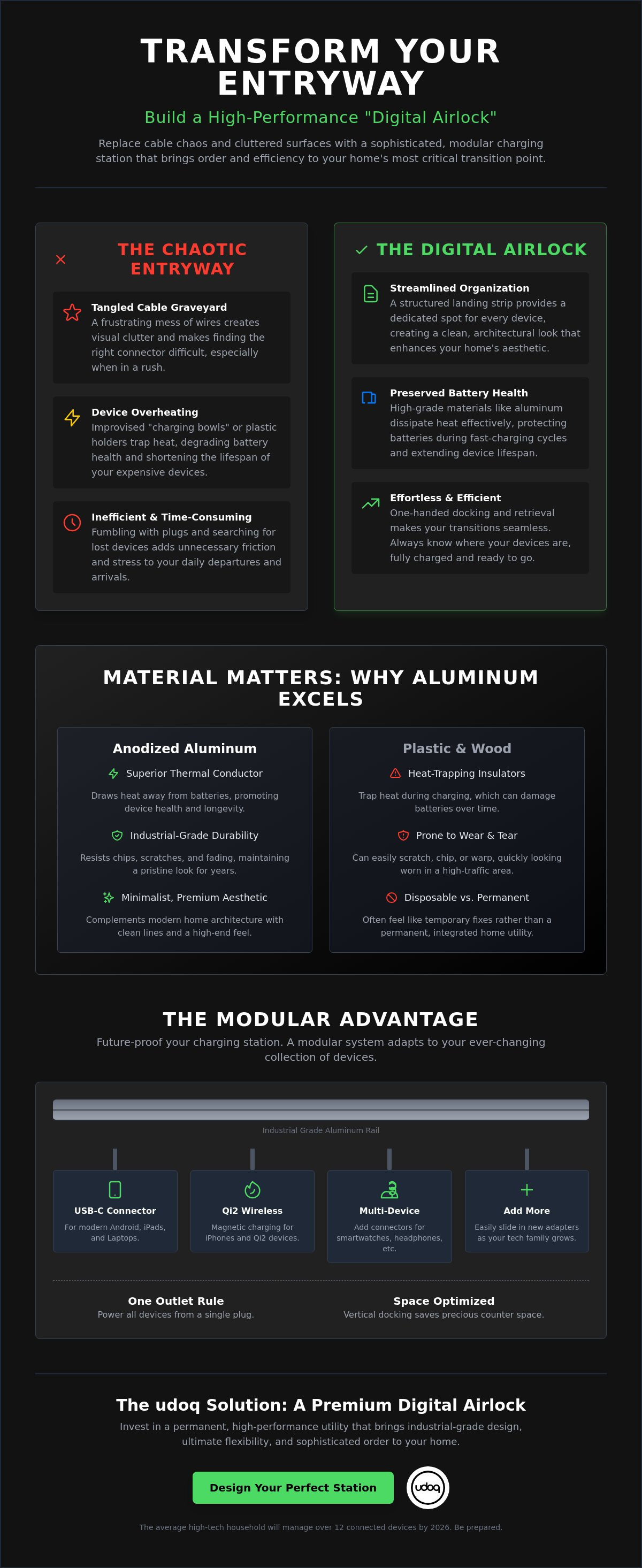
The udoq Solution: A Premium Digital Airlock for Your Home
Implementing a digital airlock requires hardware that matches the technical demands of 2026. udoq offers a system that bridges the gap between industrial performance and high-end home aesthetics. Our patented entryway phone charging station is built on a foundation of high-grade, heat-dissipating aluminum. It is not a temporary accessory. It is a permanent upgrade to your home's infrastructure. Whether you are managing a single smartphone or a full family suite of tablets and wearables, the system adapts to your specific device mix. You can start with a base rail and expand as your technology collection grows.
The udoq 250: Compact Power
Smaller homes and urban apartments require maximum efficiency. The udoq 250 is designed for these constrained environments. It provides a minimalist footprint that fits perfectly on narrow console tables or small wall-mounted shelves. This model supports between two and four essential devices without sacrificing power delivery. It maintains the same premium feel as our larger rails, ensuring that even a compact setup feels like a deliberate architectural choice. It's the ideal entry-level premium choice for those who value order in limited spaces. You get the benefits of a professional landing strip without the bulk.
The udoq 400 and Beyond: Family-Scale Organization
Larger households face greater digital chaos. The udoq 400 provides the lateral space needed to organize multiple smartphones, tablets, and smartwatches in a single row. This scale allows for a truly centralized hub where every family member has a dedicated docking spot. You can further enhance this setup by integrating the WIRELESS ADAPTER. This adds the convenience of magnetic, grab-and-go charging for Qi2-compatible devices. For those with extensive hardware collections, you can explore the full charging station collection to find rails up to 700mm in length. This ensures that even the most tech-heavy homes remain clutter-free.
Building your custom configuration is a straightforward process. You select the rail length that fits your space, then choose the specific mix of C-CABLE and L-CABLE connectors your devices require. This bespoke approach ensures that no space is wasted. Every component serves a purpose. The result is a high-performance entryway phone charging station that eliminates the psychological weight of a messy home. It is a system built for the long term. It respects your time, your space, and your technology. Start building your digital airlock today to experience the relief of a perfectly organized entryway.
Mastering the Modern Landing Strip
Transitioning your home’s entrance into a high-performance landing strip is a definitive move toward a more organized lifestyle. By choosing a modular system, you move away from disposable tech accessories and toward permanent home infrastructure. You now understand that material choice matters. High-grade 6061 aluminum provides the heat dissipation and industrial durability necessary for today’s high-wattage devices. A professional entryway phone charging station does more than just power your hardware; it establishes a psychological boundary that helps you disconnect the moment you walk through the front door.
Order is an investment in your daily efficiency. Our systems feature patented German Engineering, ensuring total compatibility with all major brands and connector standards. It's time to eliminate cable chaos and protect your hardware with a system designed for longevity. Design your custom entryway charging station with the udoq Configurator and experience the clarity of a perfectly managed environment. Your digital airlock is ready for its upgrade.
Frequently Asked Questions
Will an entryway charging station fit phones with thick cases?
Yes, you can adjust the connector height to accommodate rugged or thick protective cases. The system uses a sliding mechanism that lets you raise or lower the plug to ensure a secure connection without removing your device's protection. It's a practical solution for active families who prioritize device safety but need a quick docking experience.
Can I charge an Apple Watch and an Android phone on the same rail?
You can absolutely charge different brands side-by-side on a single rail. The system is designed for universal utility, allowing you to slide an L-CABLE for an iPhone next to a C-CABLE for an Android device. Specialized components like the MAGNETIC ADAPTER or the udoq Apple Watch accessory integrate wearables into the same sleek, industrial profile.
How do I hide all the messy cables behind the charging station?
Messy cables are concealed within the hollow core of the aluminum rail. Once you thread your connectors through the track, the excess slack stays hidden from view, leaving only the plug tips visible. This internal management system ensures your entryway phone charging station maintains a minimalist, architectural look that enhances your home’s entrance rather than cluttering it.
Is it better to wall-mount or use a tabletop charging station in a hallway?
Use a WALL MOUNT if your hallway is narrow or if you want to clear surface space on your console table. It creates a floating effect and keeps expensive hardware away from pets or small children. Tabletop placement is better if you prefer the flexibility to move the station or if you have a wide, stable surface available for docking.
Do modular charging stations support the new USB-C standards?
Modular stations are fully compatible with the latest USB-C standards and the EU’s Common Charger Directive. You simply swap your old connectors for a C-CABLE to bring your dock up to current specifications. This adaptability makes the system a long-term investment that won't become e-waste when industry standards inevitably evolve.
How many devices can I safely charge from one wall outlet?
You can safely charge up to ten devices from a single wall outlet using a high-capacity power supply. Our specialized POWER blocks are engineered to distribute current efficiently across multiple rails without overloading your home's electrical circuit. This consolidation eliminates the need for a cluttered row of individual wall adapters and reduces the risks associated with tangled power strips.
Is an aluminum charging station safe for my devices?
Aluminum is one of the safest materials for high-performance charging because it acts as a heat sink. Unlike plastic or wood, which trap thermal energy, an aluminum entryway phone charging station draws heat away from your devices. This superior thermal management helps preserve battery health and prevents overheating during intensive fast-charging cycles.
Can I add wireless charging to a modular docking station?
You can easily add wireless capabilities to your modular setup by installing a WIRELESS ADAPTER. This component slides into the rail just like a wired connector, offering a magnetic landing spot for Qi2-compatible devices. It provides a convenient, grab-and-go option for users who prefer the speed of magnetic alignment over physical plugging.