The most popular charging brand in your drawer might be the biggest source of your desk's chaos. While anker has provided reliable power for years, a fast charger doesn't solve the "cable spaghetti" that clutters 68% of executive workspaces. You've likely experienced the frustration of a high-end tablet sliding across your desk or the waste of discarding cables when connector standards change. It's time to stop settling for a mess of wires that contradicts your professional aesthetic.
We agree that power should be seamless and invisible. Discover how to replace temporary plastic hubs with a sophisticated, modular alternative that matches your high-end decor. This comparison reveals why German engineering offers the only truly future-proof charging solution for 2026. We will show you how a patented sliding track system creates the relief of a permanent, organized environment that lasts for years.
Key Takeaways
- Identify why even high-performance Anker chargers can lead to "cable spaghetti" and how to achieve true desk minimalism.
- Discover the architectural advantages of a patented sliding rail system over traditional, fixed-port charging hubs.
- Evaluate the longevity of your tech investments by comparing mass-market plastics with premium, anodized aluminum construction.
- Learn how to future-proof your charging station with modular components that adapt to any new device or connector standard.
- Master a professional framework to audit your device needs and transform cluttered surfaces into organized, productive workspaces.
Beyond the Brick: Why Anker Is Not Always the Answer for Desk Organization
Anker has earned its reputation as a global leader in portable power. By 2026, their mastery of Gallium Nitride (GaN) technology has made high-wattage charging bricks smaller and more efficient than ever. However, a powerful brick does not solve the fundamental problem of the modern workspace: the "Cable Spaghetti" effect. Even the most advanced multi-port charger leaves a tangle of wires across your desk, creating a visual noise that conflicts with a professional environment. To better understand the current state of high-end charging hardware, watch this detailed review: While anker products deliver raw energy, they often fail to address the psychological impact of clutter. A 2011 study by the Princeton University Neuroscience Institute revealed that physical clutter in your surroundings competes for your attention, resulting in decreased performance and increased stress. For the professional seeking a minimalist sanctuary, a pile of loose cables is a productivity tax you cannot afford to pay.The Evolution of the Charging Hub
The transition from traditional silicon to GaN technology allowed brands to shrink the physical footprint of the wall plug. This evolution followed the growth of the USB Power Delivery standard, which now facilitates high-speed charging for everything from earbuds to laptops through a single port type. Despite these technical leaps, the "horizontal" charging mess remains a reality for most. Devices lay flat on nightstands and desks, consuming valuable surface area. By 2026, sophisticated users are moving away from mere "chargers" and toward integrated docking solutions. They prioritize industrial aesthetics and spatial efficiency alongside technical specs. They want their technology to disappear into the room's design, not dominate it with a web of plastic cords.The Hidden Cost of "Cable Chaos"
Cable chaos is more than an eyesore; it is a functional drain. Users often waste minutes every week untangling cords or searching for the specific connector end that slipped behind a desk. This constant friction wears down the internal wiring of the cables and puts unnecessary lateral stress on device ports as they sit at awkward angles. True organization requires a shift in perspective. Cable management is a productivity tool that preserves cognitive energy and protects your hardware investments. Unlike a standard multi-port hub, a dedicated system like the udoq charging stationsArchitecture of Power: Anker Multi-Port Chargers vs. the udoq Modular Rail
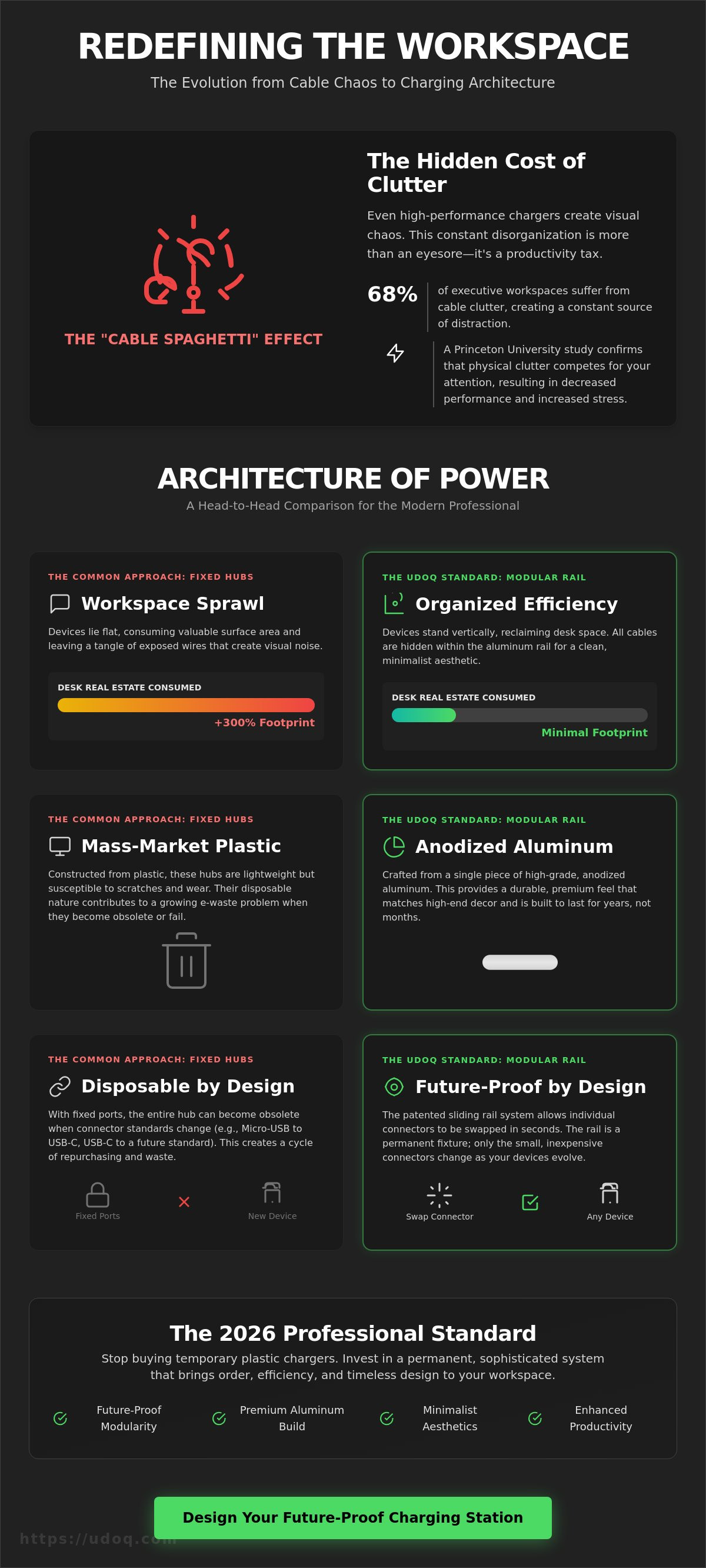
Power delivery in 2026 is no longer just about wattage. It's about the architecture of your workspace. Anker focuses on the "Fixed Hub" model. These devices are high-performance power bricks that sit on your desk or plug into a wall. They provide raw energy through a series of ports. However, this model often leaves your devices scattered. Phones and tablets usually lie flat on the surface. This creates a cluttered footprint that consumes 300 percent more desk real estate than necessary.
The udoq system utilizes a patented "Sliding Rail" model. Crafted from high-grade anodized aluminum, this rail acts as a structural backbone. It allows you to align devices vertically. By standing your tech upright, you reclaim your workspace. The difference is immediate. Anker users must manage cables that sprout from the front or back of the hub. udoq hides these cables within the rail profile itself. This minimalist approach eliminates the visual chaos of "cable spaghetti."
Durability and modularity are central to this comparison. Fixed hubs are often disposable once a port fails or standards change. This cycle contributes to the environmental impact of e-waste. udoq counters this with a sustainable design. You can swap individual connectors as your devices evolve. The rail remains stationary while the internal tech adapts. It's a long-term investment in order and efficiency.
Anker: The King of Portability
Anker is the undisputed leader for users on the move. Their GaN technology ensures that power banks and wall chargers remain incredibly compact. If you are commuting or traveling, an anker charger is a reliable companion. The trade-off is organizational. In a stationary office, these compact chargers lack the stability to hold devices securely. For those deciding between a portable hub and a permanent dock, The Ultimate Guide to Choosing a Charging Station in 2026 provides a detailed breakdown of these use cases.
udoq: The Professional Stationary Solution
The udoq rail is a professional-grade tool for organized environments. Available in lengths from 250mm to 700mm, it scales to fit any device collection. The sliding connectors move laterally to eliminate cable tension. This protects your device ports from wear. The udoq 400 review demonstrates how a mid-size rail elegantly manages multiple smartphones and tablets simultaneously. It transforms a chaotic charging corner into a sophisticated command center. You can view our full collection of charging stations to find the right fit for your desk.
The Hidden Cost of Disposable Tech: Longevity and Build Quality
Consumer electronics often follow a cycle of planned obsolescence. You buy a hub, use it for two years, and discard it when a new charging standard emerges. This is the hidden cost of disposable tech. While anker dominates the market with high-grade plastic chargers, these devices remain static. They're functional gadgets, not long-term infrastructure. udoq approaches power differently through the lens of German Engineering. Our philosophy is simple: buy once, use forever. We replace high-grade polycarbonate with milled, anodized aluminum to ensure your charging station outlasts the devices it powers.
Modularity as a Sustainability Strategy
Standard integrated chargers contribute to over 50 million metric tons of global e-waste annually. When a fixed port breaks or becomes obsolete, the entire unit is trash. udoq eliminates this waste through a patented sliding track system. You can swap connectors in seconds to accommodate USB-C, Lightning, or Micro-USB. By 2026, the universal mandate for USB-C across all mobile platforms will render millions of fixed-cable docks useless. udoq users won't need to buy a new station; they'll simply slide in a five-dollar cable and continue. This modularity isn't just a feature. It's a commitment to a clutter-free, sustainable future where your hardware adapts instead of ending up in a landfill.
Industrial Design vs. Consumer Gadgets
Aesthetics define your workspace. A plastic brick from anker functions well, but it doesn't elevate the environment. The udoq rail system uses heat-dissipating anodized aluminum to protect your device batteries from thermal stress during fast-charging cycles. Metal construction isn't just about premium feel; it's about structural integrity and thermal management. Plastic traps heat. Aluminum moves it away.
- Precision Engineering: Milled aluminum rails provide a stable, weighted base that doesn't slide across your desk.
- Thermal Health: Metal surfaces act as a passive heat sink, extending the lifespan of your smartphone batteries.
- Timeless Aesthetics: Minimalist profiles blend into high-end office environments or modern home decors.
For those seeking a professional centerpiece, the udoq 400 Premium Watch dock transforms a basic utility into a design statement. It reflects a shift from buying temporary tech accessories to investing in permanent furniture. Choose the relief of order. Choose a system that grows with you.
Decision Framework: How to Audit Your Charging Needs for 2026
Effective organization starts with an honest assessment of your digital footprint. By 2026, the average professional manages at least four personal devices daily. To move from a tangled mess to a streamlined command center, follow this four-step audit.
- Step 1: Count your daily devices. List everything that requires power. Include your smartphone, tablet, smartwatch, wireless earbuds, and e-reader. Don't forget secondary items like power banks or digital styluses.
- Step 2: Identify your primary charging location. Decide where your tech lives. A compact bedside setup requires a different footprint than a high-traffic entryway or a professional desk.
- Step 3: Evaluate your cable tolerance. Ask yourself if you want cables hidden or accessible. While a standard anker brick provides power, it often leaves cords sprawling across your surface. udoq conceals these within its patented profile.
- Step 4: Consider your device turnover rate. If you upgrade your phone or tablet every 12 to 24 months, you need a future-proof system. Modular docks adapt to new connectors; fixed stations do not.
Choosing the Right Size for Your Space
Space optimization is a hallmark of German engineering. The udoq system offers four distinct lengths to match your specific environment. The udoq 250 is the minimalist choice for nightstands, measuring just 250mm to hold two or three essential devices. For professional workstations, the udoq 400 and 550 provide ample room for tablets and smartphones side-by-side. If you're managing a household, the udoq 700 serves as a family charging command center. It keeps up to eight devices upright and organized in one central hub, reclaiming your counter space.
Power Delivery Requirements
High-performance hardware demands sophisticated power management. Understanding the udoq 400 POWER is essential for users with high-speed needs. This configuration ensures that even power-hungry tablets receive optimal current without overheating. Unlike using a multi-port anker hub that might clutter your desk with extra wires, the udoq system uses a single wall outlet to power up to ten devices simultaneously. This reduces visual noise and frees up your wall sockets for other appliances. Match your wall outlet capacity to your total device load to ensure seamless, safe operation every night.
udoq: The Sophisticated Alternative to Mass-Market Charging
Choosing a charging solution in 2026 requires a shift in perspective. Most consumers default to brands like anker for their reliability and ubiquity. These mass-market options serve a functional purpose; they provide power. However, udoq addresses the visual and physical chaos that comes with owning multiple devices. It isn't just a charger. It's a statement of order. Crafted from high-grade anodized aluminum, the udoq system replaces a tangle of cables with a sleek, unified rail. This German-engineered solution provides the relief of a seamless, wired-in-place experience.
The core advantage lies in the patented sliding track system. You don't have to replace your entire station when you upgrade your hardware. You simply swap or move the connectors. This modularity ensures your workspace remains productive and distraction-free. While an anker dock might sit on top of your desk, udoq integrates into your environment. It transforms your workspace from a collection of gadgets into a professional command center. The result is a clean, minimalist aesthetic that promotes focus.
- Precision Engineering: High-grade materials that match your premium hardware.
- Modular Versatility: A patented system that adapts to USB-C, Lightning, and wireless standards.
- Sustainable Longevity: Designed to last decades, not just a single device cycle.
Investing in Your Environment
Your smartphone is a masterpiece of industrial design. It's a high-performance tool that deserves a charging station of equal caliber. Choosing a plastic dock creates a visual mismatch in a modern office. udoq offers long-term value through its "one for all" narrative. The system adapts to every change in connector standards. It's a sustainable investment in your physical space. You can browse the full range of premium charging stations to find the length that fits your desk perfectly. Every component feels substantial. Every interaction feels intentional.
Get Started with udoq
Creating your custom setup is straightforward. Use the udoq configurator to build a rail tailored to your specific device list. Whether you carry two phones, a tablet, and a smartwatch, the system adjusts to your needs. This preparation is the first step toward a clutter-free 2026. Stop managing cables and start managing your time. The transition to a professional workspace begins with a single, elegant choice. Experience the Order of udoq and reclaim your desk today. It's time to move beyond the disposable and embrace the permanent.
Design Your Desk for the Next Decade
Choosing a charging solution in 2026 is about more than just raw power. While anker excels at portable bricks, udoq offers a permanent architectural solution for your workspace. You've seen how the patented modular sliding system replaces the chaos of tangled cords with a streamlined rail. It's a shift from disposable plastic to sustainable, high-grade materials. Every udoq dock features German engineered anodized aluminum designed to withstand years of daily use. This isn't just a gadget; it's a professional commitment to order and refined industrial design.
The logic is simple. Why settle for a cluttered desk when a single outlet can power up to 10 devices simultaneously? You can customize your setup to fit your specific inventory of tablets, phones, and e-readers. This flexibility ensures your investment remains relevant even as connector standards change. It's time to move beyond the limitations of mass-market hubs and embrace a system that prioritizes both function and form. Take control of your environment with a setup that reflects your standards for quality and precision.
Build Your Custom udoq Modular Dock
Your clutter-free future starts with a single, elegant rail.
Frequently Asked Questions
Is udoq as fast as an Anker GaN charger?
Yes, udoq matches the performance of an anker GaN charger when using our 100W Power Delivery cables. The system supports high-speed power transfer via USB-C PD 3.0 standards to deliver the exact wattage your device demands. You get the same 0 to 50% charge in 30 minutes that you expect from premium hardware. It's about combining German precision with top-tier electrical components for maximum efficiency.
Can I use my own Anker cables with a udoq docking station?
No, udoq requires its proprietary adapter cables to function correctly. The patented sliding track system relies on a specific housing to lock each connector into the 4mm anodized aluminum rail. Standard cables won't stay upright or slide smoothly within the track. This design ensures your devices remain stable and vertical while charging. It's a precise fit that eliminates the wobbling found in generic docking stations.
Does udoq support the latest iPhone and Android fast-charging standards?
Yes, udoq supports the latest USB-C PD 3.0 and Lightning fast-charging protocols. Our cables handle up to 5 amps, making them compatible with the iPhone 16 and Samsung Galaxy S24 Ultra. The hardware is designed to meet the technical specifications of 2024 and 2025 flagship devices. You'll experience maximum charging speeds without compromising battery health. It's a professional-grade solution for modern mobile tech.
How does udoq eliminate cable clutter compared to a multi-port hub?
udoq eliminates clutter by concealing 100% of the cable length within its hollow aluminum profile. Traditional multi-port hubs leave a "spider web" of wires across your desk or nightstand. With our system, only the necessary connectors emerge from the track. This modular approach organizes up to 6 devices in a single 400mm row. It transforms a chaotic charging area into a clean, minimalist workspace instantly.
Is the udoq rail compatible with thick protective phone cases?
Yes, the udoq rail is fully compatible with protective cases up to 8mm thick. Each adapter is height-adjustable, allowing the connector to reach through heavy-duty shells like those from OtterBox or UAG. You don't have to remove your case to start charging. Simply set the height during your initial setup for a perfect fit. This flexibility accommodates 99% of consumer phone cases currently available on the market.
Why is udoq more expensive than a standard Anker charging station?
udoq is a long-term investment in sustainable German engineering. While an anker station is often a fixed-port plastic device with a 2-year lifespan, udoq uses high-grade anodized aluminum that won't degrade. The modular design means you only replace a single cable when a new connector type emerges. You aren't buying a disposable gadget; you're buying a permanent fixture for your home. It’s a one-time purchase designed for decades of use.
Can I add wireless charging or MagSafe to my udoq dock?
Yes, you can integrate the udoq Wireless Adapter for MagSafe and Qi-enabled devices. This module slides into the rail alongside your wired connections for a hybrid setup. It supports 15W fast charging for compatible smartphones and wearables. You can position the wireless pad anywhere along the 250mm or 500mm track. It’s the ultimate way to customize your charging experience while maintaining a sleek aesthetic.
What happens to my udoq if I switch from iPhone to Android?
You only need to swap the individual connector module. If you switch from a Lightning iPhone to a USB-C Android, you don't throw away the dock. Just slide out the old adapter and slide in the new USB-C 3.1 version. udoq has remained compatible through every major hardware shift since 2011. This modularity makes it the most sustainable and future-proof charging solution on the market.