Your workspace reflects your professional standards, yet the average plastic desk accessory is designed to fail within 24 months. It's time to demand more from your environment. High-grade aluminium isn't just a design choice; it's a commitment to longevity and precision. This material bridges the gap between industrial-strength durability and the minimalist elegance your office deserves. It replaces the fragility of disposable tech with the permanence of German engineering.
You've likely felt the frustration of a cluttered desk or a device that overheats during a critical task. We agree that premium hardware shouldn't be held back by inferior materials. In this guide, you'll discover why choosing refined metal is the definitive move for a high-end setup. Organize your devices with confidence. We'll explore how this superior material requires 95 percent less energy to recycle than primary production and why its heat management properties make it the ultimate choice for a clutter-free, professional life.
Key Takeaways
- Understand the science behind the high strength-to-weight ratio and natural corrosion resistance that define premium tech hardware.
- Learn how superior thermal conductivity preserves your device's battery health by efficiently dissipating heat during high-powered charging.
- Discover why aluminium is the ultimate eco-conscious choice, offering infinite recyclability with a sophisticated, high-end finish.
- Explore the aesthetic synergy between anodized surfaces and modern workspace design to achieve a seamless, clutter-free environment.
- Gain insight into how German precision and patented sliding tracks create a modular, future-proof docking solution for your desk.
The Science of Superiority: Why Aluminium Dominates Modern Tech
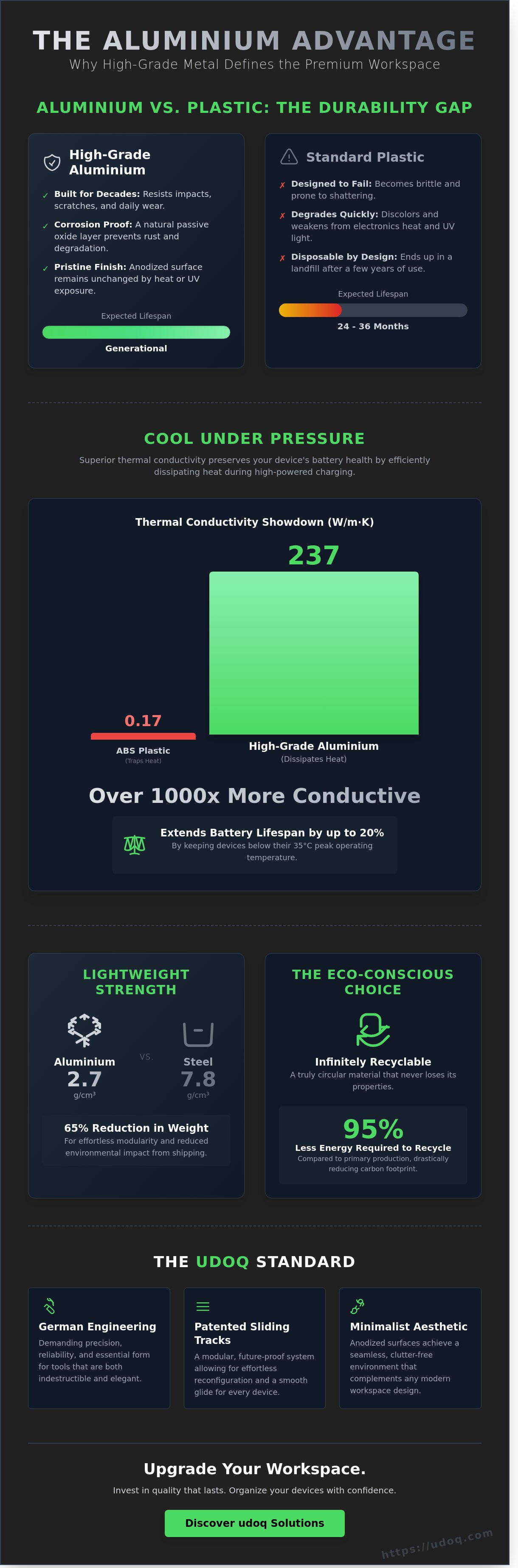
Aluminium is the third most abundant element in the Earth's crust. It's prized for a strength-to-weight ratio that outclasses almost any other industrial material. This metal doesn't just sit on a desk; it performs. A key secret to its longevity is the passive oxide layer. This microscopic film forms instantly when the metal meets oxygen. It creates a natural barrier against corrosion, ensuring your tech remains pristine for decades. This structural integrity stands in stark contrast to the fragility of high-impact plastics that dominate the budget market.
German engineering serves as the global benchmark for fabrication. It demands precision, reliability, and a focus on essential form. By understanding the fundamental properties of aluminium, designers can create tools that are both indestructible and elegant. This material choice is the first step toward a clutter-free, professional environment. It reflects a commitment to quality that transcends simple utility.
To better understand the manufacturing process behind this incredible material, watch this helpful video:
Physical Characteristics of Premium Tech Alloys
The density of this metal is approximately 2.7 g/cm³. Compare this to steel at 7.8 g/cm³. This 65% reduction in weight is critical for modular systems. It allows for effortless reconfiguration and reduces shipping energy by significant margins. Ductility is another vital trait. It allows manufacturers to extrude sleek, seamless rail designs without compromising structural strength. These rails provide the backbone for a sophisticated charging station, offering a smooth glide for every connected device.
Aluminium vs. Plastic: The Durability Gap
Polymers degrade. Over a period of 24 to 36 months, UV exposure and heat from electronics cause plastics to become brittle and discolored. The alloy remains unchanged. It handles the heat generated by fast-charging components with ease, acting as a natural heat sink. In a busy household, solid metal rails resist impacts that would shatter plastic alternatives. This is a generational material. It doesn't end up in a landfill after a few years of use. It's a sustainable choice for those who value longevity over disposable trends. Invest in quality that lasts.
Performance Beyond Aesthetics: Thermal Management and Shielding
Aluminium is more than a visual statement. It is a functional requirement for high-performance desk setups. While plastic acts as an insulator that traps heat, aluminium serves as a superior conductor. This material property is vital during simultaneous multi-device charging where energy loss often manifests as rising temperatures. By utilizing a metallic chassis, udoq ensures your hardware remains cool and efficient.
The Heat Dissipation Advantage
The technical gap between materials is vast. Common plastics like ABS have a thermal conductivity of approximately 0.17 W/m·K. In contrast, the high-grade aluminium used in udoq rails reaches nearly 237 W/m·K. This 1,000-fold difference allows the rail to act as a massive passive heat sink. It draws heat away from your devices and dissipates it into the surrounding air. High temperatures are the primary enemy of lithium-ion batteries. Keeping a smartphone below its 35 degree Celsius peak operating temperature can extend its overall lifespan by up to 20 percent.
Thermal equilibrium in a docking station occurs when the rate of heat generation from charging electronics matches the rate of heat dissipation through the metallic housing. Beyond thermal control, the material provides essential Electromagnetic Interference (EMI) shielding. The dense metallic structure blocks unwanted signals from interfering with sensitive internal electronics. This ensures a cleaner signal and more reliable data transfer for your connected peripherals. This focus on durability is supported by high aluminum recycling rates, confirming that premium materials also support long-term environmental goals.
Stability and Structural Integrity
Modern tablets like the 12.9-inch iPad Pro weigh over 680 grams. A lightweight plastic stand often fails under this load, leading to wobbling or collapse. udoq utilizes a solid metal base to establish a low center of gravity. This prevents the stand from tipping or sliding when you interact with a touchscreen. Stability is a core tenet of German engineering that plastic simply cannot replicate without excessive bulk.
The udoq 400 Premium Watch illustrates this principle perfectly. It uses its weighted profile to remain anchored even when supporting multiple heavy devices simultaneously. You can tap, swipe, and dock without the unit shifting on your desk. It is a seamless integration of weight and balance. This structural rigidity ensures that your expensive hardware is always held at the perfect viewing angle.
Organize your workspace with a premium docking solution that stays put and stays cool.
The Sustainability Factor: Aluminium as the Eco-Conscious Choice
Sustainability in technology often feels like a contradiction. Rapid release cycles and planned obsolescence create a mountain of e-waste. Choosing aluminium breaks this cycle. It isn't just a premium aesthetic choice; it's a commitment to a circular economy. Industry data confirms that aluminium is a "permanent" material. It can be recycled infinitely without losing its physical properties. This makes it the foundation of a responsible workspace.
The numbers tell a compelling story of efficiency. According to the International Aluminium Institute, approximately 75% of all aluminium ever produced is still in productive use today. This longevity is unmatched by plastics or composite materials. When we recycle this metal, it requires only 5% of the energy needed for primary production. That's a 95% energy saving, significantly reducing the carbon footprint of your desk setup. It’s not just about what you buy, but how long that material stays out of a landfill.
Infinite Recyclability in a Circular Economy
Plastic components often face a grim reality. Mixed plastics are difficult to sort and frequently "downcycled" into lower-quality items before eventually becoming waste. Aluminium is different. It’s upcycled. The recycling process restores the metal to its original quality, ready for high-precision engineering once again. At udoq, we choose materials that outlast the devices they charge. Our rails are designed to be a permanent fixture of your office, even as your smartphone or tablet evolves. By investing in high-grade metal, you’re opting out of the disposable tech culture that defines the modern era.
Future-Proofing Through Modular Design
A sustainable tech ecosystem relies on modularity. Most charging stations become obsolete the moment a manufacturer changes a connector standard. Our patented modular rails solve this problem. Instead of replacing the entire unit, you simply swap or move the charging cables within the track. It’s infrastructure, not a disposable accessory. This design philosophy ensures that your hardware remains relevant for decades.
Adapting to new standards is seamless. If you're transitioning from older connectors to the current industry standard, our Ultimate Guide to USB-C explains how modularity keeps your workspace efficient. Don't view your desk accessories as temporary tools. View them as long-term investments. A modular system made from aluminium provides the structural integrity and flexibility needed to support every device you'll own in the next ten years. It’s a sophisticated solution for the eco-conscious professional who values both form and future-proofing.
Aluminium in Design: Crafting the Minimalist Workspace
Design isn't just about how a product looks. It's about how it feels under your hand. Cold-milled aluminium provides a tactile response that plastic cannot replicate. This material defines the modern industrial aesthetic. It creates a sense of permanence and quality in a world of disposable tech. Whether you choose a specific computing environment or mix different platforms, the metal finish remains the unifying element. Consistency matters in a high-end workspace. Matching your monitor stand to your docking station creates a cohesive visual flow that signals professional intent.
Achieving this harmony requires attention to detail. Most premium tech brands now offer finishes in "Space Gray" or "Silver." These aren't just colors; they're reflections of the material's grain. When you align these finishes across your desk, you eliminate visual noise. This creates a "Sophisticated Organizer" persona. It shows you value longevity over temporary trends. The weight of the metal also matters. A heavy aluminium base prevents your devices from sliding, providing a grounded, stable foundation for your daily workflow.
The Anodization Process: Beauty and Protection
Anodization is a precise electrochemical process. It converts the metal surface into a durable, anodic oxide finish. This layer is integrated with the underlying aluminium substrate. It isn't a coat of paint. It creates a surface with a hardness comparable to sapphire, which ranks a 9 on the Mohs scale. Unlike painted plastics, these finishes never peel or flake. You can choose between a soft matte texture or a classic brushed aesthetic. Both options hide fingerprints and resist the micro-scratches common in busy office environments. This durability ensures your setup looks as pristine in five years as it does today.
Principles of Minimalist Cable Management
Chaos ruins productivity. A "nest" of tangled wires creates mental friction. Research from the Princeton University Neuroscience Institute in 2011 showed that physical clutter competes for your attention, decreasing performance and increasing stress. Minimalist design solves this through structural integration. A single, high-quality aluminium rail can replace multiple individual chargers. This provides immediate visual relief. You see clean lines instead of plastic mess. For those seeking design inspiration, explore the modularity of udoq Charging Stations. These systems use patented sliding tracks to keep every connector hidden but accessible.
Professional setups thrive on efficiency. When your hardware is organized, your mind follows. Aluminium's strength allows for thinner, sleeker profiles that still support heavy devices. This "less is more" approach isn't just an aesthetic choice; it's a functional requirement for the modern professional. By choosing materials that last, you invest in a workspace that grows with your technology. It's a sustainable, future-proof strategy for anyone who appreciates fine craftsmanship and German engineering.
The udoq Standard: Engineering Premium Aluminium Solutions
udoq represents the pinnacle of desk organization. Our foundation relies on high-grade aluminium profiles. This choice ensures every dock remains rigid and stable under the weight of multiple devices. It is not just a stand; it's a piece of German engineering. We prioritize a minimalist aesthetic that complements modern tech while providing a permanent solution to cable chaos. This material allows for a slim profile without sacrificing strength. It's the relief of a clutter-free environment, realized through industrial design.
Patented Innovation and Precision Engineering
The patented sliding track system embodies our "one for all" philosophy. We mill each rail with a precision tolerance of 0.05mm. This extreme accuracy allows connectors to slide smoothly across the track. They lock firmly into place once positioned. You won't find the wobbling common in plastic alternatives. Our German heritage demands this level of craftsmanship. Whether you choose the compact udoq 250 or a larger model for a family hub, the structural integrity is absolute. The anodized finish resists fingerprints and scratches. It is a future-proof investment. Your dock won't end up in a landfill when you buy a new phone; you simply swap the cable.
Transforming Your Workspace Today
A cluttered desk leads to a cluttered mind. Investing in a modular dock is the first step toward professional efficiency. Our systems are designed to bridge the gap between high-end lifestyle aesthetics and functional tech innovation. Before you commit, consider what your workspace needs to thrive over the next decade. Use this checklist to ensure your choice lasts:
- Material: Does it use CNC-milled aluminium for heat dissipation and weight?
- Modularity: Can you adjust the connectors for different case thicknesses?
- Longevity: Is the system adaptable to future charging standards like USB-C?
Select a size that fits your current device count while leaving room for growth. For a detailed breakdown of dimensions and compatibility, consult our Ultimate Guide to Choosing a Charging Station. Don't settle for disposable plastic accessories that fail within a year. Experience the precision of German-engineered metal. Organize your devices. Power up in style. Discover the modularity that defines the udoq standard.
Future-Proof Your Professional Environment
Choosing the right materials defines the longevity of your tech ecosystem. High-grade aluminium isn't just a design choice; it's a performance necessity. This material provides the critical thermal management required to protect sensitive electronics while offering a 100% recyclable profile that meets global sustainability standards. You're investing in a substance that outlasts plastic alternatives by decades. It's the foundation of a workspace built for endurance and efficiency.
The udoq system brings this industrial excellence directly to your desk. Every dock features patented German engineering designed to eliminate cable chaos and restore mental focus. Our modular system ensures total compatibility with all brands, meaning your setup evolves as quickly as your hardware. You don't have to settle for disposable accessories. Choose a permanent, elegant solution that reflects your commitment to superior craftsmanship and refined order.
Discover the udoq collection of premium aluminium docking stations and experience the relief of a perfectly organized workspace. Your most productive days are just one upgrade away.
Frequently Asked Questions
Is aluminium better for the environment than plastic for tech accessories?
Aluminium is significantly better for the environment because it's infinitely recyclable without losing quality. Roughly 75% of all aluminium produced since 1888 is still in productive use today. Plastic accessories often degrade within 2 to 5 years and contribute to the 350 million metric tonnes of plastic waste generated annually. Choosing aluminium ensures your desk tech remains a long-term investment rather than a disposable item.
Does an aluminium charging station help my phone charge faster?
An aluminium charging station doesn't change the electrical output, but it optimizes charging speeds through superior thermal management. Aluminium dissipates heat 15 times more effectively than standard polycarbonate plastic. This prevents your device from thermal throttling, a process where phones slow down charging to protect the battery. By keeping temperatures low, you maintain peak charging performance during intensive 30-watt fast-charge cycles.
Will an aluminium dock scratch my smartphone or tablet?
A precision-engineered aluminium dock won't scratch your devices when designed with protective interfaces. udoq utilizes smooth, anodized surfaces and specific tolerances to ensure your tech remains pristine. The anodized layer reaches a hardness of 9 on the Mohs scale, making it incredibly resistant to wear. We prioritize a seamless fit that protects your mobile hardware while providing a stable, high-end mounting solution.
What is the difference between cast aluminium and extruded aluminium rails?
Extruded aluminium rails offer much higher structural integrity and a smoother finish than cast alternatives. The extrusion process pushes metal through a die at 600 degrees Celsius to create a dense, uniform grain structure. Cast aluminium is poured into molds, which can introduce microscopic air bubbles and structural weak points. Our extruded profiles deliver the refined, minimalist aesthetic and durability expected from professional German engineering.
How do I clean and maintain an anodized aluminium surface?
Clean your anodized aluminium surface using a dry, lint-free microfiber cloth for daily maintenance. For fingerprints or light oils, apply a solution of 95% distilled water and 5% mild detergent. Never use abrasive pads or harsh alkaline cleaners, as these can damage the protective oxide layer. This simple routine preserves the sleek, matte finish and ensures your workspace maintains its sophisticated, professional appearance for decades.
Can aluminium tech accessories be recycled at home?
You can recycle aluminium tech accessories through most municipal curbside recycling programs. Aluminium is 100% recyclable and requires 95% less energy to reprocess than producing new metal from ore. Before recycling, remove any small plastic or electronic components to ensure the metal is processed correctly. It's a sustainable, future-proof material that fits perfectly into a modern, circular economy without the complexity of mixed plastics.
Why do premium brands like Apple and udoq prioritize aluminium?
Premium brands prioritize aluminium for its exceptional strength-to-weight ratio and its high-end aesthetic appeal. Apple shifted to 100% recycled aluminium for its enclosures in 2018 to balance durability with environmental responsibility. udoq utilizes this material to provide a stable, modular foundation that reflects the precision of German engineering. It's a material that communicates quality, avoids the "cheap" feel of plastic, and offers a timeless, minimalist look.
Is aluminium heavy enough to hold a large iPad without tipping?
Aluminium provides more than enough mass to stabilize a 12.9-inch iPad Pro during daily use. A standard udoq rail system uses the weight of the extruded metal to create a low center of gravity. This ensures that even a 682-gram tablet remains secure when you're tapping the screen or drawing. You get the stability of a permanent fixture with the elegant, slim profile of a modern desk accessory.