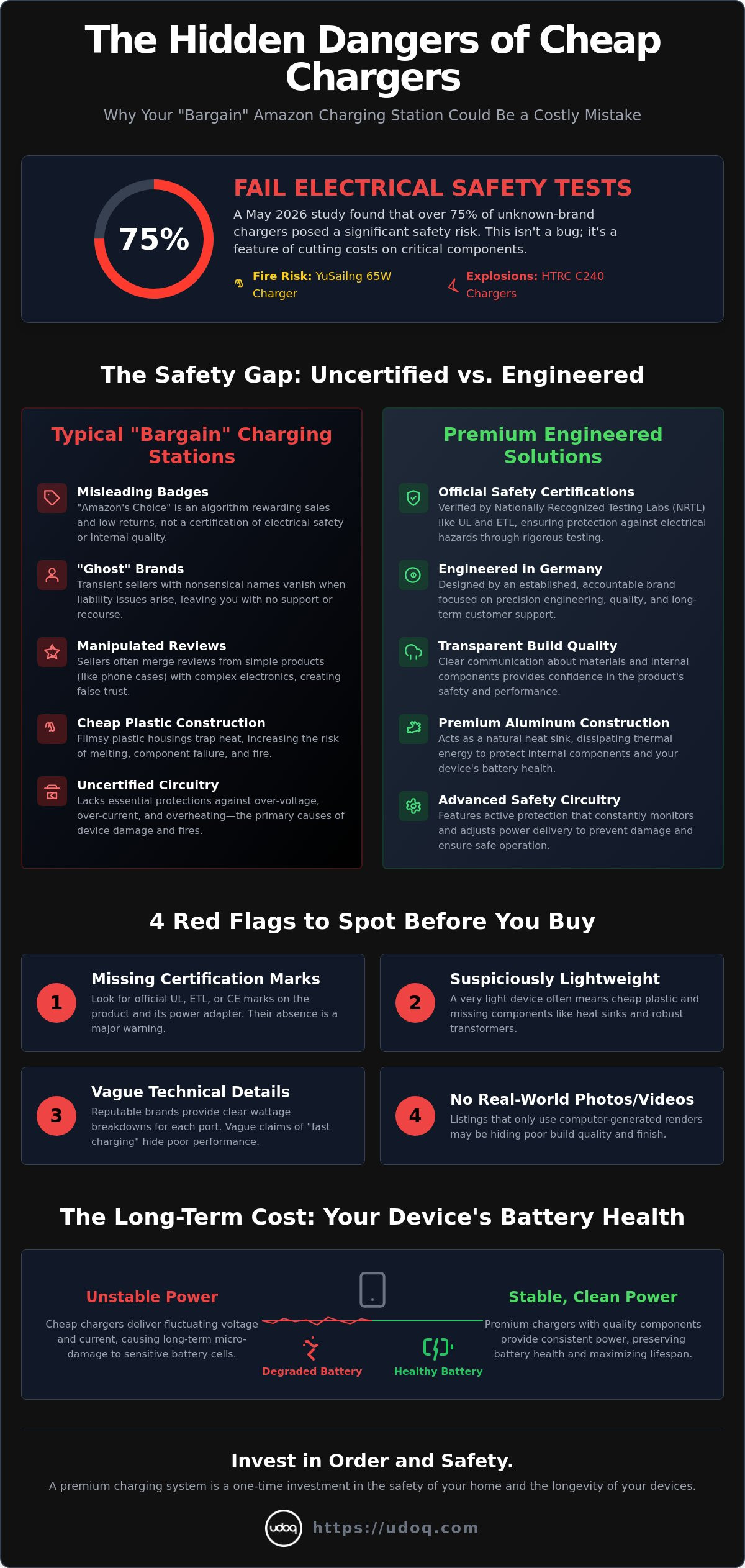
Over 75% of unknown-brand chargers failed electrical safety tests in May 2026. This data makes one question unavoidable: are cheap amazon charging stations safe for your home? While the low price is tempting, the hidden costs are often devastating. Recent recalls highlight the danger. In June 2026, the YuSailng 65W charger was flagged for fire risks. Earlier that year, the CPSC recalled thousands of HTRC units following reports of explosions and property damage. These aren't isolated incidents; they're the result of sacrificed thermal protection and uncertified circuitry.
You want an organized desk without the anxiety of a potential electrical fire. It's a reasonable expectation. This article provides a clear framework to identify safe electronics and explains why price correlates directly with internal build quality. We'll decode confusing jargon like GaN and PD while revealing how premium materials like heat-dissipating aluminum protect your battery health. Discover the critical safety differences between budget Amazon docks and premium engineered solutions. You'll learn how to choose a long-term charging system that evolves with your technology rather than becoming a fire hazard.
Key Takeaways
- Recognize that popularity badges like "Amazon's Choice" do not replace official safety certifications. Learn the difference between being sold and being verified.
- Evaluate the answer to "are cheap amazon charging stations safe" by looking for active over-voltage and over-current protection within the circuitry.
- Understand how unstable voltage and poor heat dissipation in plastic docks cause long-term micro-damage to your device batteries.
- Spot immediate red flags like suspicious lightweight construction and missing technical wattage breakdowns for individual ports.
- Transition to a modular, aluminum solution engineered in Germany for a safe and permanent organization system.
The Risk Behind the Bargain: Why Amazon Charging Stations Can Be Deceptive
Choosing a budget dock is a psychological trap. It feels like a small win to save $30 on a bedside accessory. However, this decision places high-value devices and your home’s safety at risk. The "Amazon Safety Gap" exists because the platform functions as a marketplace rather than a laboratory. A listing's presence on the site isn't a testament to its engineering. It's just a transaction waiting to happen. You're often betting your home's safety on the integrity of an unverified circuit board.
The "Amazon Choice" badge is the most dangerous misunderstanding in online shopping. Consumers see the logo and assume Amazon has vetted the product's internals. In reality, this is a purely algorithmic metric. It rewards high conversion rates, low return rates, and competitive pricing. It doesn't track if the transformer inside is prone to melting under load. To ensure a product is safe, it must be verified by a Nationally Recognized Testing Laboratory (NRTL) like UL or ETL. These organizations perform the rigorous, destructive testing that Amazon does not.
To better understand this concept, watch this helpful video:
The "Ghost Brand" Phenomenon
Many electronics on the marketplace come from "ghost brands." These entities are transient. They appear with nonsensical, algorithm-generated names and vanish once liability issues arise. By shipping directly to consumers, they often bypass the strict oversight required for traditional brick-and-mortar retail. If an electrical failure occurs, the storefront is simply deleted. Pursuing a warranty or legal claim against an anonymous overseas entity is a dead end. These brands don't offer technical support or material transparency. They provide disposable tech that circumvents the safety regulations designed to protect your family.
Popularity vs. Protection
Five-star reviews are a poor metric for electrical safety. A charger might function well for thirty days, earning a positive rating, only to fail catastrophically on day sixty. Some sellers even use "review merging" to manipulate the system. They take a listing for a simple, safe product like a silicone phone case and swap the content for a complex power station. The new, potentially dangerous product inherits the old positive reviews. High sales volume does not equal high safety standards. When questioning if are cheap amazon charging stations safe, remember that an algorithm's preference for a product is not a substitute for certified electrical protection. The question are cheap amazon charging stations safe cannot be answered by a star rating.
A better path involves investing in a permanent charging station designed for longevity and thermal efficiency. High-quality systems prioritize order and safety over a temporary bargain.
The Safety Checklist: UL, ETL, and Why Certifications Matter
Safety is not a luxury feature. It is the foundation of responsible electrical engineering. When discerning users ask are cheap amazon charging stations safe, the answer is found in the certifications etched into the chassis. Organizations like Underwriters Laboratories (UL) and Intertek (ETL) serve as the primary gatekeepers for household electronics. They don't simply review a blueprint. They subject physical units to environmental stress tests, including prolonged exposure to extreme heat and maximum electrical loads. This ensures the device won't ignite during a mid-summer power surge or a long overnight charge.
Premium solutions like the udoq 400 prioritize these certifications from the initial design phase. The engineering required to meet these strict global standards involves high-grade components and redundant safety layers. This rigorous development path naturally adds to the retail price. However, it eliminates the risk of catastrophic failure. You're investing in peace of mind and the psychological relief of a secure, organized home environment.
Understanding Safety Marks
Identify genuine safety marks by looking for laser-etched or embossed logos on the bottom of the dock. Genuine UL and ETL marks are usually accompanied by a unique control number. You can verify these numbers in official databases to ensure the product is legitimate. Many unbranded Amazon chargers use counterfeit stickers or deceptive phrases like "designed to meet standards." This language is a common legal loophole. It means the product has never been submitted to a laboratory for independent testing. It is a claim of safety without any verified evidence.
Internal Protection Circuitry
Safe charging requires a constant digital "handshake" between the dock and your device. This communication manages the flow of electricity based on real-time battery needs and temperature. Cheap docks often lack the sophisticated chips required for this interaction. If a power spike occurs, a budget dock may fail to throttle the current, sending raw voltage directly into your smartphone battery. Thermal throttling is the intentional reduction of power output to prevent internal components from reaching dangerous temperatures. Without this active protection, your battery health degrades rapidly. In extreme cases, the lack of over-voltage and over-current protection leads to the fires reported in recent marketplace recalls.
A charging station should be a long-term investment in your home’s infrastructure. Explore our range of charging stations to find a modular solution that balances minimalist design with uncompromising safety standards.
Beyond the Plug: How Cheap Materials Damage Your Devices
Materials define the boundary between a temporary accessory and a permanent investment. Most users asking are cheap amazon charging stations safe focus on the plug, but the enclosure is equally critical. Budget docks almost exclusively use thin, injection-molded plastic. This material is an insulator, not a conductor. It traps the thermal energy generated during the AC-to-DC conversion process. In contrast, premium charging stations utilize high-grade aluminum. Aluminum acts as a passive heat sink, drawing warmth away from sensitive internal components and your connected devices.
The risk extends beyond heat. Non-flame-retardant plastics are common in the "ghost brand" marketplace. If a capacitor fails or a short circuit occurs, these enclosures can ignite. Industrial-grade materials are designed to self-extinguish or resist ignition. Choosing aluminum isn't just a stylistic preference; it's a fundamental safety choice for your home environment. It provides the structural integrity and thermal management that disposable plastic cannot match.
Heat: The Silent Battery Killer
Heat is the primary catalyst for lithium-ion battery degradation. When a phone sits in a plastic cradle that traps heat, the internal chemistry destabilizes. This leads to reduced capacity and, eventually, battery swelling. Cheap plastic docks create an "insulation effect" that keeps your device at elevated temperatures for hours. Aluminum rails provide a natural path for heat dissipation. They maintain a lower ambient temperature for your hardware. This small thermal difference adds months or years to your device's lifespan. It's a simple equation: cooler charging equals a healthier battery.
The Ripple Effect of Poor Circuitry
Power quality is invisible but impactful. Cheap circuitry often produces "dirty power" or significant voltage ripple. This occurs when the station fails to smooth out the electrical signal. Your phone's internal charging controller must work harder to filter this noise. You might notice "phantom touches" where the screen reacts without being touched. Or you might experience Wi-Fi interference. These are symptoms of unshielded, low-quality components. High-end engineering ensures a clean, stable flow of energy. It protects the delicate silicon inside your smartphone. Poor shielding in budget docks can even interfere with home Bluetooth signals, creating a chaotic electronic environment. Clean power is essential for device longevity. When you consider if are cheap amazon charging stations safe, remember that the damage is often happening silently beneath the surface of your screen.
4 Red Flags to Spot Before Clicking "Buy Now"
Identifying a hazardous product requires a clinical eye for detail. When consumers ask are cheap amazon charging stations safe, the physical evidence often provides the answer before the device is even plugged in. Weight is a reliable proxy for safety. High-quality transformers, copper shielding, and aluminum heat sinks have significant mass. If a multi-device dock feels hollow or incredibly lightweight, it lacks the essential hardware required to manage high-voltage electricity. A light chassis is a warning that the manufacturer has prioritized shipping costs over electrical integrity.
The price-to-port ratio is another immediate indicator of risk. If a station offers six or more high-speed ports for the price of a single premium wall adapter, the engineering has been compromised. Safety costs money. Certified components and fire-retardant materials don't fit into a "bargain" budget. You're not just buying a stand; you're buying a power management system. If the price seems too good to be true, it's because the safety features have been removed to protect the seller's profit margins.
The "Too Many Ports" Trap
Physics doesn't compromise for marketing algorithms. A 10-port charger sold at a rock-bottom price is physically incapable of safe, sustained power delivery. You must scrutinize the total wattage versus the per-port output. Often, these stations share a single, underpowered transformer across every connection. You should check if all ports can be used simultaneously without the unit becoming hot to the touch. If the math doesn't support the claims, the station will likely overheat under a full load. This creates a direct fire risk in high-stakes environments like your bedside table or office desk.
Investigating the Manufacturer
Transparency is the hallmark of a premium brand. Legitimate manufacturers provide physical addresses, technical support, and a clear engineering heritage. To confirm if are cheap amazon charging stations safe, you can use the UL Online Certifications Directory to verify a brand's claims. This separates "ghost brands" from established innovators who stand behind their work. Engineering standards from regions with high manufacturing prestige, such as Germany, prioritize longevity and mechanical precision. A modular system is also inherently safer than a fixed plastic unit. It allows for better airflow and the ability to swap connectors as technology changes. This adaptability ensures your station remains a long-term investment rather than a disposable hazard.
Eliminate the chaos of unverified electronics. Upgrade your environment with a safe charging station engineered for performance and peace of mind.
Investing in Order and Safety: The udoq Difference
The transition from a cluttered desk to a minimalist workspace begins with a shift in perspective. A charging station should be a permanent part of your home's infrastructure, not a disposable accessory. While the market is flooded with plastic alternatives, the question remains: are cheap amazon charging stations safe for your high-value hardware? udoq provides a definitive answer through superior materials and patented mechanical innovation. Our systems utilize a high-grade aluminum rail that serves a dual purpose. It creates a sleek, industrial aesthetic and acts as a massive heat sink. This design draws thermal energy away from your devices, preventing the battery degradation common in poorly ventilated plastic docks.
Safety is also found in simplicity. A single udoq 250 or 400 series station can power multiple devices from one wall outlet. This consolidation removes the need for a chaotic tangle of unverified power bricks. By using a single, high-quality power supply, you eliminate the risks associated with "dirty power" and unstable voltage. It's the functional antidote to "Amazon clutter," providing the psychological relief of a tidy, secure environment.
German Engineering vs. Disposable Tech
Longevity is the ultimate form of sustainability. The udoq 250 and 700 series are engineered in Germany to last decades. We prioritize material durability over the planned obsolescence found in mass-market electronics. Our systems organize power internally, effectively eliminating "cable spaghetti" fire hazards. This meticulous attention to detail ensures that your charging environment remains as safe as it is beautiful. For those seeking to refine their workspace further, learn how to create a minimalist desk setup using our modular systems.
A Future-Proof Investment
Technology changes, but your docking station shouldn't have to. The udoq system is based on a modular rail that allows you to swap connectors as your device portfolio evolves. Whether you need a C-CABLE or an L-CABLE, our swappable adapters ensure a safe, direct connection every time. This reduces e-waste and protects you from the cycle of buying new, unverified docks every few years. When you evaluate if are cheap amazon charging stations safe, consider the long-term cost of replacing damaged phones or failed chargers. Investing in a proprietary, legally protected system is an investment in your home’s safety.
Explore the udoq charging station collection to find a modular, heat-dissipating solution for your home or office.
Secure Your Space with Intentional Engineering
Choosing a charging solution is a decision about home safety and device longevity. You've seen the risks: "ghost brands" with fake certifications, heat-trapping plastic enclosures, and unstable circuitry that degrades battery health. Determining if are cheap amazon charging stations safe requires looking beyond the initial bargain to the engineering standards beneath. True protection comes from active thermal management and verified electrical components that respect your hardware's delicate silicon.
Investing in a permanent, modular system eliminates the cycle of disposable electronics and the anxiety of potential fire hazards. Our systems feature a patented modular design and heat-dissipating aluminum construction. This ensures your setup evolves with new technology rather than becoming obsolete. Every unit is engineered in Germany for maximum reliability and aesthetic clarity. Stop settling for unverified accessories that compromise your environment. Upgrade to a safer, German-engineered udoq docking station and enjoy the psychological relief of a truly organized, secure home.
Frequently Asked Questions
How can I tell if a charging station is UL certified?
Look for the embossed or laser-etched UL mark on the product's base or power brick. You must verify the accompanying file number in the UL Online Certifications Directory to ensure the mark isn't counterfeit. Premium manufacturers provide this data transparently to confirm their engineering meets global safety standards. A simple sticker is rarely a reliable indicator of actual testing.
Do cheap chargers really damage phone batteries over time?
Yes, they provide unstable voltage that causes significant chemical stress within lithium-ion cells. This "dirty power" leads to premature capacity loss and reduced battery health. High-quality systems use sophisticated controllers to maintain a clean, steady flow of electricity. Proper thermal management also prevents the heat-related degradation common in budget docks.
Is it safe to leave a multi-device charging station plugged in overnight?
It is only safe if the station includes active over-voltage and thermal protection circuitry. Certified systems monitor the "handshake" with your device and throttle power once the battery reaches 100%. When asking are cheap amazon charging stations safe, the lack of these overnight safeguards is a major red flag. Always prioritize docks with verified safety certifications for bedside use.
What is the difference between a charging station and a USB hub?
The primary difference is that a charging station is engineered for high-current power delivery, while a USB hub is designed for data transfer. Hubs often split limited power between multiple ports, which can result in slow speeds and overheated circuitry. Charging stations include dedicated protection layers for safe energy management. Always use equipment designed for your device's specific power requirements.
Can a cheap charger cause a fire even if it is not in use?
Yes, internal components can fail as long as the station is connected to a live wall outlet. Low-quality transformers are prone to short-circuiting even when no device is actively charging. This "vampire" current remains a risk if the internal insulation is poor. Dispose of any unbranded station that shows signs of discoloration or excessive warmth while idle.
Why does my phone get hot when using a generic Amazon dock?
Your phone gets hot because generic docks use inefficient components and plastic enclosures that trap thermal energy. This lack of passive cooling is a primary reason why many wonder are cheap amazon charging stations safe for long-term use. Aluminum rails offer a superior thermal path for heat dissipation. Better airflow protects your device's internal chemistry from heat damage.
Are GaN chargers safer than traditional silicon chargers?
GaN technology is more efficient and produces significantly less heat than traditional silicon components. This thermal efficiency reduces the risk of overheating in compact designs. However, the safety of the unit still depends on the overall build quality and certified protection layers surrounding the GaN chip. Even GaN components require a well-engineered enclosure to dissipate heat effectively.
What should I do if my charging station starts making a high-pitched noise?
Disconnect the station from the power source immediately. This sound, often called coil whine, signals failing capacitors or a deteriorating transformer. It is a clear mechanical warning of an impending electrical failure. Don't attempt to repair it or continue using it. Replace the unit with a certified, industrial-grade solution to protect your home.