Your desk isn't just a surface; it's a high-stakes environment where every millimeter of linear real estate dictates your daily productivity. When evaluating the udoq 400 vs 550, the decision isn't merely about physical length. It's a strategic choice between personal workspace optimization and collective family utility. You've likely experienced the frustration of a cluttered desk where tangled cables mask the sleek design of your premium devices. It's a common friction point that compromises both your focus and your aesthetic standards.
We understand that a disorganized workspace is a drain on your mental energy. Our goal is to help you discover the exact differences between these two German-engineered rails so you can select the perfect hub for your device collection. This comparison previews the technical capacity of each model, the benefits of the 550's extended rail, and how to future-proof your setup against new tech acquisitions. Prepare to transform your environment into a precision-engineered sanctuary of order and efficiency.
Key Takeaways
- Master the concept of linear real estate to understand how rail length dictates your desk organization and aesthetic flow.
- Compare technical specifications in our udoq 400 vs 550 analysis to determine which footprint aligns with your available workspace.
- Identify whether your needs favor a personal workspace anchor or a high-capacity command center for shared family environments.
- Follow our five-step measurement guide to inventory your devices and ensure a precision fit for current and future tech.
- Leverage the udoq modular system to create a sustainable, future-proof charging hub that evolves with your hardware.
The udoq Ecosystem: Understanding the 400 and 550 Rails
udoq is not a static accessory. It is a patented system designed to evolve alongside your technology. Built from high-grade, heat-dissipating aluminum and engineered in Germany, the udoq rail offers a permanent solution to the temporary problem of device clutter. This modular philosophy ensures that as your hardware changes, your charging station remains a constant, functional anchor. It reflects a commitment to sustainable build quality, moving away from disposable plastic docks toward a lifetime investment in order.
We view your workspace in terms of "linear real estate." This concept measures the horizontal space your devices occupy when organized side-by-side. The udoq 400 and 550 represent the most versatile mid-range segments of this real estate. They provide the necessary width to consolidate smartphones, tablets, and e-readers into a single, sleek hub without sacrificing desk depth. These models are our most popular choices because they balance high-capacity utility with a footprint that fits standard home office desks.
To better understand how this system integrates into a modern workspace, watch this detailed overview:
What Stays the Same: Modularity and Power
Both models share the same DNA of precision and adaptability. You'll find the same interchangeable C-CABLE and L-CABLE connectors across the entire lineup. These components slide smoothly along the rail, allowing you to reposition devices with a simple movement. If you require high-speed delivery, both units are compatible with the udoq POWER series. This internal charging hub eliminates the need for multiple external bricks, powering everything from a single wall outlet. For those seeking a vertical solution, both rails can be converted using a wall mount to reclaim even more desk surface. You can explore the full range of configurations in our charging stations collection, including the specialized udoq 400 for those who prioritize a compact footprint.
The Core Difference: 150mm of Opportunity
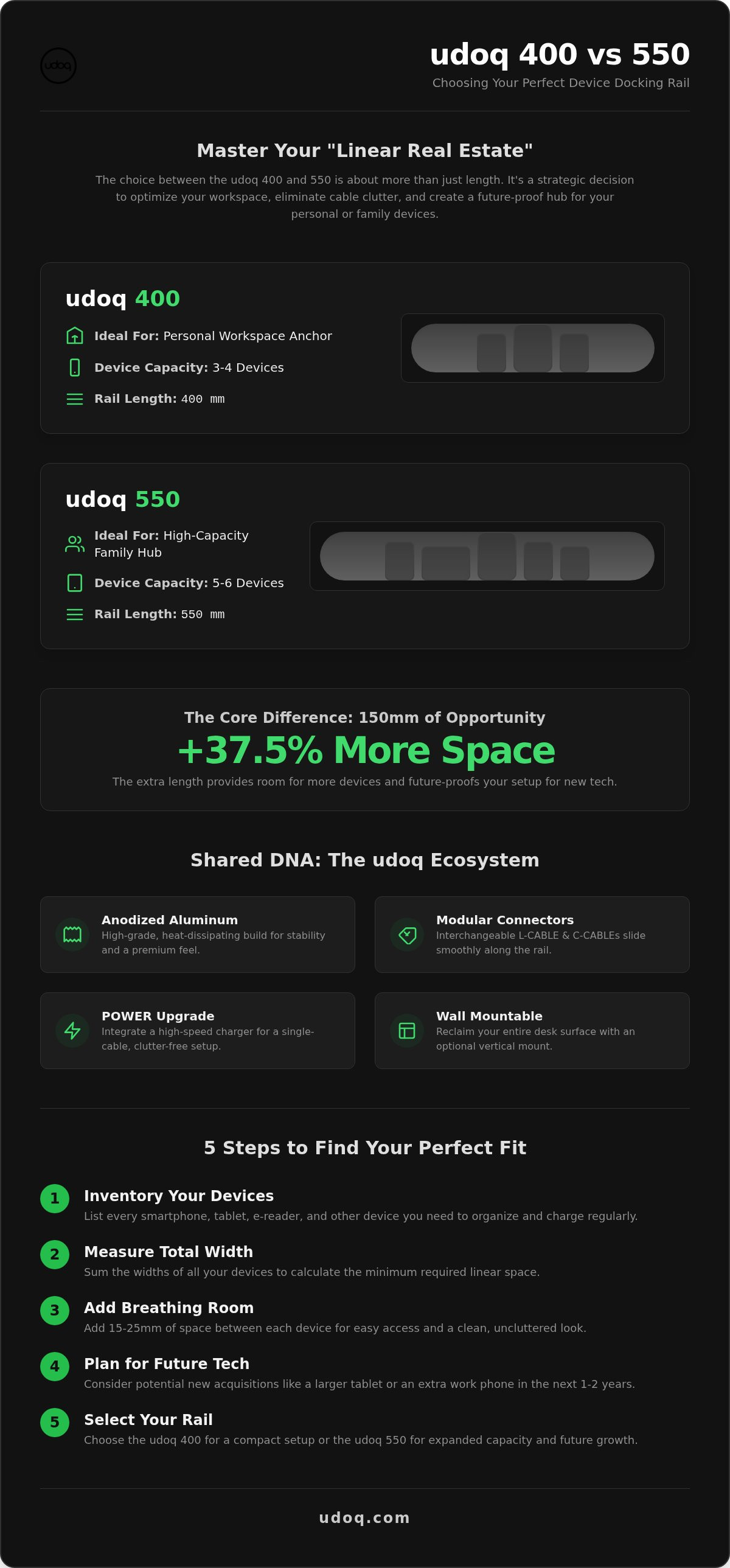
The primary differentiator in the udoq 400 vs 550 debate is exactly 150mm of physical length. While the 400mm rail is optimized for a focused collection of three to four primary devices, the 550mm model offers expanded capacity for five or more. This extra space isn't just about adding more hardware; it's about the air between them. It provides the psychological relief of a workspace that feels intentional rather than crowded. Choosing the 550mm rail offers room to grow. It ensures your investment accommodates future device upgrades, such as a larger tablet or an additional smartphone, without requiring a total system replacement. This makes the 550 a strategic choice for those who anticipate their tech ecosystem will expand.
Technical Specification Comparison: 400 vs 550
Precision starts with the specifications. Choosing between the udoq 400 vs 550 requires a detailed understanding of how physical dimensions translate into daily utility. Both models are crafted from high-grade extruded aluminum, providing a weighted base that ensures absolute stability. This mass is essential when docking top-heavy tablets. Unlike plastic alternatives, these rails won't tip or slide when you interact with your touchscreen. An iLounge review of the Udoq confirms that this build quality is a significant differentiator in the market, offering a premium feel that matches high-end mobile hardware.
| Feature | udoq 400 | udoq 550 |
|---|---|---|
| Rail Length | 400 mm | 550 mm |
| Typical Device Capacity | 3-4 Devices | 5-6 Devices |
| Build Material | Anodized Aluminum | Anodized Aluminum |
| Power Options | STARTER or POWER | STARTER or POWER |
The distinction between the STARTER and PREMIUM (POWER) configurations is functional. The STARTER kit includes the rail and your choice of connectors, requiring an external power source. The POWER version integrates a high-speed internal charger directly into the rail. This internalizes every cable, leaving only a single cord exiting the unit to reach your wall outlet. It's the ultimate choice for a clutter-free environment. If you're looking to streamline your setup, you can explore the modular configurations that best suit your current hardware.
Device Capacity: Smartphones to Tablets
The udoq 400 is the ideal personal workspace anchor. It comfortably hosts up to four smartphones or a combination of one large tablet and two phones. For users with more extensive tech needs, the 550 model acts as a central command center. It supports up to six smartphones or two large tablets alongside two phones. If your daily carry includes a smartwatch, the udoq 400 premium watch variant offers a dedicated mounting point that preserves the rest of the rail for your other devices.
Connector and Adapter Spacing
Linear real estate is the total horizontal space available for device connectors along the rail. It's the most critical metric for your organization. While a smartphone might only be 75mm wide, you must account for the "footprint" of adapters. The MAGNETIC ADAPTER and WIRELESS ADAPTER provide seamless docking but consume more linear real estate than a standard C-CABLE. Always factor in buffer space. Protective cases can add significant width to your devices. We recommend leaving a 10mm gap between docked items to ensure easy access and prevent heat buildup during high-speed charging cycles.
Choosing Your Use Case: Personal Pro vs. Family Hub
Selecting the appropriate rail length is an architectural decision for your workspace. While technical specs define the capacity, your daily habits define the utility. The choice between the udoq 400 vs 550 often comes down to one question: are you organizing a private sanctuary or a shared command center? Both models offer the same precision-engineered finish, but their presence on a desk or counter serves different psychological and functional needs. The industrial design ensures that regardless of length, the station remains a permanent fixture of your interior aesthetic.
The udoq 400: The Professional’s Choice
For the individual professional, the udoq 400 represents the minimalist sweet spot. It provides enough linear real estate to dock a primary smartphone, a tablet, and a set of AirPods without overwhelming the desk surface. This model is particularly effective on compact sit-stand desks or bedside tables where every square inch is at a premium. It maintains a low profile that complements a tidy environment rather than dominating it. If your setup includes a smartwatch, the udoq 400 premium watch variant offers a specialized solution that keeps your most essential tech within arm's reach and perfectly aligned.
The udoq 550: The Multi-User Solution
The udoq 550 is designed for high-traffic environments and tech enthusiasts with expanding ecosystems. It excels as a central hub in kitchen counters or entryways, where four or more family members need reliable charging access. The extra 150mm of length is crucial for households with multiple tablets or those who prefer to dock their devices in landscape mode. As noted in this iLounge review of the Udoq system, the modularity allows you to adjust spacing as your family's device count grows. This makes the 550 a future-proof investment for a busy household that values order over chaos.
Landscape mode is a significant factor often overlooked during the selection process. A standard iPad docked horizontally consumes approximately 250mm of width. On a 400mm rail, this leaves only 150mm for other devices, which can feel cramped and cluttered. The 550mm rail provides 300mm of remaining space, allowing for two additional smartphones and an e-reader to sit comfortably alongside a horizontal tablet. This breathing room is essential for maintaining the clean, industrial aesthetic udoq is known for. Browse our full range of charging stations to see how these different lengths impact the visual balance of a high-end office.
Aesthetic impact is the final consideration. In a high-end home office, the aluminum rail acts as a piece of functional art. The 400mm model offers a tight, focused look that appeals to those who value extreme order. In contrast, the 550mm model makes a bolder statement of utility and preparedness. It signals a workspace that is ready for any technical challenge. Because our systems are engineered in Germany to last a lifetime, choosing the larger size is often the more sustainable choice. It prevents the need for a future upgrade when you inevitably add a new device to your workflow.
Calculating Your Needs: The 5-Step Measurement Guide
Precision is the hallmark of German engineering. To ensure your station provides the psychological relief of a tidy environment, you must calculate your requirements with accuracy. Choosing between the udoq 400 vs 550 isn't a matter of estimation; it's a matter of millimeters. Use this systematic approach to determine which rail length aligns with your current and future tech ecosystem.
- Step 1: Inventory your devices. List every smartphone, tablet, and e-reader you intend to dock. Note their specific charging ports, such as USB-C or Lightning, to ensure you have the correct C-CABLE or L-CABLE connectors.
- Step 2: Measure total width. Use a ruler to find the exact width of each device. Do not rely on manufacturer screen sizes. Measure the physical outer edges.
- Step 3: Account for breathing room. Add 10mm to 20mm of space between each device. This allows for easy docking and prevents devices from rubbing against one another.
- Step 4: Factor in future upgrades. If you plan to transition to a larger tablet or add a second smartphone to your workflow, add that projected width now.
- Step 5: Compare the total. Add your device widths, case offsets, and breathing room. If the sum is under 400mm, the udoq 400 is your minimalist solution. If it exceeds 400mm, the 550mm rail is your necessary anchor.
The Case Factor
Protective housing significantly alters your rail requirements. Rugged or "life-proof" cases can add 10mm or more to a device's standard width. Device real estate is the total width of a device plus its protective housing. Fortunately, udoq's patented connectors are height-adjustable. They accommodate varying case thicknesses, ensuring a secure connection without removing the cover. However, you must still account for this extra width on the horizontal rail to avoid a cramped aesthetic. If you use thick cases on multiple devices, the 550mm model becomes the logical choice to maintain order.
Landscape vs. Portrait Docking
Orientation dictates your available linear real estate. A standard 11-inch tablet docked in portrait mode uses about 180mm. In landscape mode, that same device consumes approximately 250mm. On a 400mm rail, a horizontal iPad leaves only 150mm for other devices; barely enough for two smartphones. The 550mm rail is the functional minimum for users who prefer dual-tablet landscape setups or frequent video conferencing while charging. We recommend sketching your ideal layout on paper before finalizing your selection to visualize the spatial balance. Once you have your measurements, you can configure your personalized udoq rail today to match your exact specifications.
Final Verdict: Should You Buy the 400 or 550?
The choice between the udoq 400 vs 550 is a definitive step toward workspace mastery. This decision marks the transition from cable chaos to a precision-engineered hub. While both models share a foundation of premium materials and industrial design, they serve different organizational philosophies. Your selection should reflect both your current hardware and your long-term vision for your environment.
The udoq 400 is the compact powerhouse. It is built for the focused individual who values a tight, minimalist aesthetic. If your tech stack is stable and your desk space is limited, this rail provides a sophisticated anchor without excess. It is the ideal choice for those who prioritize a low-profile setup that performs with surgical efficiency.
The udoq 550 is the versatile anchor. It is designed for those who view their technology as an evolving ecosystem. It provides the necessary capacity for families or power users who manage multiple high-demand devices daily. If you anticipate adding new hardware or prefer the breathing room of an expanded rail, the 550 is your logical command center.
Sustainability is inherent in both models. You are not purchasing a disposable accessory; you are investing in a modular system. If industry standards shift, you simply swap a connector. You do not replace the rail. However, if you remain undecided, we recommend the 550. The extra 150mm provides the best future-proofing. It ensures that a new tablet purchase or a shift to landscape docking does not render your station obsolete.
Making the Investment
Every udoq rail is a product of meticulous German engineering. This heritage ensures that your station can handle up to 10 devices with absolute stability and safety. We encourage you to explore the full charging station collection to decide between a Starter kit or an integrated Power version. Precision organization is a choice you make once to benefit your productivity for years. Choose your udoq rail size today.
Beyond the Rail: Accessories to Consider
Modularity extends to how you interact with your devices. Adding a MAGNETIC ADAPTER enables effortless docking for compatible smartphones, further reducing wear on your ports. To maximize the utility of either size, the udoq POWER series offers high-speed internal charging that keeps your workspace clear of external bricks. Finally, the C-CABLE ensures your station remains compatible with 2026 standards and beyond. These components allow your station to grow and adapt, protecting your investment against the rapid pace of tech innovation.
Secure Your Precision-Engineered Workspace
Choosing between the udoq 400 vs 550 is an investment in long-term order. You've learned that linear real estate is the critical metric for your desk. Whether you select the compact 400mm rail for personal focus or the 550mm model for a growing family ecosystem, you are choosing a solution that evolves. Our patented modular design ensures that as your devices change, your station remains relevant. You don't replace the dock; you simply update the connector.
Every rail features high-grade aluminum build quality and reflects our proud heritage of being German engineered. This is functional art designed to eliminate chaos and restore psychological relief to your environment. It's time to reclaim your surface area and future-proof your tech collection with a system built for longevity. You deserve a workspace that matches the high standards of the technology you use every day.
Build your custom udoq 400 or 550 docking station now.
Take the final step toward a more organized, efficient home or office. We look forward to helping you create the perfect hub for your device collection.
Frequently Asked Questions
Can I upgrade from a udoq 400 to a 550 later?
You cannot physically extend the 400mm rail because each unit is a single piece of extruded aluminum. However, the modular ecosystem is entirely compatible across all sizes. You can transition your existing C-CABLE, L-CABLE, and adapters to a larger rail if your device collection outgrows your current setup. This flexibility ensures your investment in connectors remains valid even if you decide to replace the rail itself.
How many devices can the udoq 400 actually charge at once?
The udoq 400 typically accommodates three to four smartphones or a combination of one tablet and two smartphones. This model is optimized for personal use where workspace depth is a priority. While the rail is 400mm long, you must account for the width of each device including its protective case. Proper measurement ensures comfortable spacing and efficient docking for your specific daily carry.
Does the udoq 550 take up too much space on a standard desk?
The 550mm rail fits comfortably on most standard desks without dominating the surface area. It measures approximately 21.6 inches in length, which is less than the width of many modern computer monitors. It provides a significant increase in linear real estate for your devices while maintaining a slim depth. This design preserves your active workspace for keyboards and documents while keeping tech organized.
Is the udoq 550 more stable than the 400 for large tablets?
Both models offer exceptional stability due to their high-grade aluminum construction and weighted design. While the 550mm rail has more physical mass, the 400mm rail is equally capable of supporting large tablets without tipping. Our patented design ensures that even top-heavy devices remain secure during touchscreen interaction. Stability is a standard feature across the entire aluminum rail lineup, regardless of the total length.
Do the 400 and 550 use the same charging cables?
Yes, all udoq rails use the exact same interchangeable connectors and cables. Whether you're comparing the udoq 400 vs 550, you'll use the same C-CABLE and L-CABLE components. This universal compatibility is a core feature of our modular philosophy. It allows you to swap and rearrange connectors as your technology preferences evolve without needing to purchase an entirely new set of accessories.
Can I wall mount both the udoq 400 and the udoq 550?
You can wall mount both the 400 and 550 models using our specialized WALL MOUNT accessory. This is an ideal solution for reclaiming desk space or creating a central charging hub in high-traffic areas like kitchens. The mounting system is robust enough to handle the weight of multiple tablets on either rail size. It provides a clean, floating aesthetic that highlights the sleek industrial design of the aluminum.
Which size is better for a mix of Apple and Android devices?
Both sizes are equally effective for a mix of Apple and Android devices because of their modular nature. The choice between the udoq 400 vs 550 should be based on your total device count rather than the operating systems you use. You can simply slide in the required L-CABLE for your iPhone and a C-CABLE for your Android tablet. The system bridges the gap between different industry standards effortlessly.
Does the udoq 550 support wireless charging adapters?
The udoq 550 fully supports both the WIRELESS ADAPTER and the MAGNETIC ADAPTER. These accessories slide into the aluminum rail just like standard cable connectors. Because the 550 provides more linear real estate, it's often the preferred choice for users who want to include these wider adapters. This model allows you to maintain a minimalist look while benefiting from the convenience of wireless docking for multiple devices.