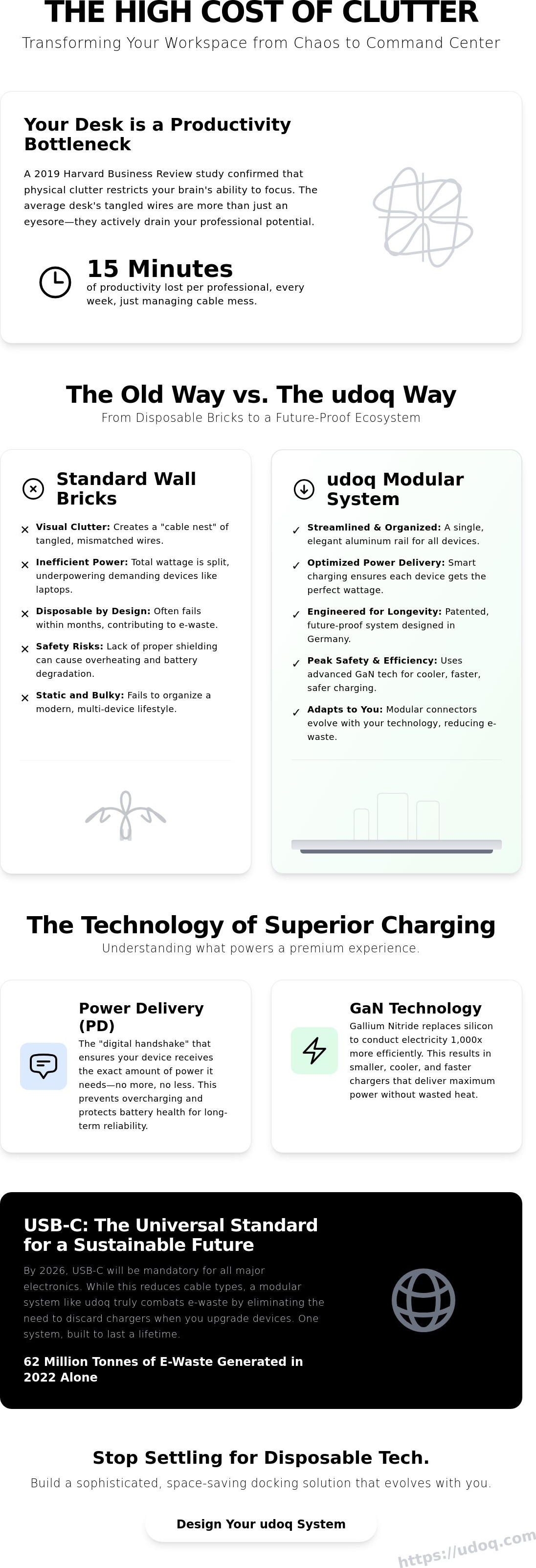
A 2019 Harvard Business Review study confirmed that physical clutter restricts your brain's ability to focus, yet the average desk remains a graveyard of tangled wires. Research suggests professionals lose roughly 15 minutes of productivity every week simply managing cable mess. Your premium devices deserve more than a generic, unreliable usb c charger that fails within months. It's time to stop settling for disposable tech that compromises your focus and your aesthetic.
You've likely felt the persistent frustration of a slow-charging adapter or a frayed cable ruining your carefully curated workspace. We agree that your environment should reflect professional excellence. This guide will show you how to transition from a chaotic tangle to a high-performance, modular ecosystem engineered for longevity. Discover the relief of a clean, minimalist setup. We'll outline the exact steps to build a docking system that adapts to your devices without ever needing replacement.
Key Takeaways
- Master the transition to a unified workspace by leveraging the universal power of USB-C connectivity.
- Decode technical specifications like Power Delivery and GaN to ensure your high-performance devices receive optimized, safe power.
- Evaluate the limitations of standard wall bricks and explore how a modular usb c charger setup transforms your desk into a clutter-free environment.
- Create a tailored charging ecosystem by matching your specific device inventory with sophisticated, space-saving docking solutions.
- Experience the longevity of German engineering with a patented, future-proof system designed to evolve alongside your technology.
The Evolution of the USB-C Charger: Why It Is the Universal Standard in 2026
USB-C is no longer a luxury; it's the mandatory baseline for modern tech. By 2026, every smartphone, tablet, and laptop sold in major global markets relies on this singular, oval port. The European Union's 2024 mandate for mobile devices and the 2026 extension to laptops effectively ended the era of proprietary connectors. You no longer need a dedicated cable for every brand. A single, high-quality usb c charger now powers your entire digital life, from your wireless earbuds to your high-performance workstation.
The "One Cable" promise has finally arrived. This unified experience replaces the frustration of hunting for specific barrel jacks or outdated micro-USB cords. The technical evolution is equally impressive. Modern USB-C ports utilize Power Delivery (PD) 3.1 standards, capable of delivering up to 240W of power. They handle 80Gbps data transfers and 8K video output simultaneously. It's a triumph of efficiency that mirrors the precision of German engineering.
The environmental impact of this shift is measurable. According to the United Nations’ Global E-waste Monitor, the world generated 62 million tonnes of electronic waste in 2022. Universal standards combat this crisis. Interoperability means fewer discarded bricks and cables when you upgrade your hardware. It's a sustainable, long-term investment in a circular economy. Order and sustainability now go hand in hand.
The Problem with the "Universal" Promise
Universal ports didn't automatically solve the clutter problem. Instead, they created a "cable nest" of mismatched lengths and tangled wires. Your minimalist workspace suffers from this constant visual noise. Clutter creates a high psychological cost, distracting you from deep work. Standard wall bricks are static and bulky. They fail to organize a modern multi-device lifestyle, leaving expensive hardware scattered across desks and nightstands. Chaos is the enemy of a premium lifestyle.
Transitioning to a Unified Charging Ecosystem
True organization requires moving beyond the simple wall adapter. A centralized charging station is the professional solution for managing your devices. The udoq 250 serves as an elegant entry point to organized power, providing a stable home for your tech. It transforms a mess of wires into a streamlined display of anodized aluminum. USB-C is the foundation of modern device connectivity. Discover the modularity of a system designed to adapt as your technology evolves. Power up in style and reclaim your workspace today.
Understanding Technical Specs: Power Delivery, GaN, and Safety
A premium usb c charger is more than a simple power source; it's a sophisticated communication hub. Power Delivery (PD) technology serves as the industry standard for high-speed charging. It allows your charger to "talk" to your device through a digital handshake. This negotiation ensures the charger identifies exactly how much power the device can safely handle. A tablet might request 30W, while a high-performance laptop demands 100W. This precision prevents the overheating and overcharging issues common in generic, uncertified hardware.
Safety hinges on internal component quality. Cheap alternatives often lack the necessary shielding and safety sensors. This leads to accelerated battery degradation or, in extreme cases, fire hazards. udoq utilizes precision German engineering to maintain strict electrical tolerances. Every component is selected to ensure long-term stability and reliability. Your devices represent a significant investment. Protecting them with a reliable power source is a logical necessity for any organized workspace. It's about more than just power; it's about peace of mind.
GaN Technology: Smaller, Cooler, Faster
Gallium Nitride (GaN) has revolutionized modern power electronics by replacing traditional silicon. It allows internal components to sit closer together without the risk of overheating. GaN conducts electrons 1,000 times more efficiently than silicon. This efficiency means less energy is lost as heat during the conversion process. You get a high-wattage usb c charger in a compact, minimalist footprint. It protects your furniture from heat marks and ensures your setup remains sleek. Efficiency is the ultimate form of sophistication in a modern office.
Wattage and Amperage: How Much Do You Really Need?
Wattage requirements are not universal. A smartphone usually requires 20W for fast charging. A professional laptop often needs 60W to 100W to maintain its battery levels under a heavy workload. Don't be misled by multi-port chargers that advertise a high "total wattage." These often split the power between ports, leaving your laptop underpowered when a second device is connected. This causes slow charging and potential hardware strain.
A dedicated power supply in a charging station provides consistent, uncompromised energy to every port. You can discover the modularity of a system designed to handle multiple high-drain devices without slowing down your workflow. Precision matters when you're powering your professional life. Avoid the chaos of fluctuating power levels and embrace a system that delivers exactly what your hardware requires.
Wall Bricks vs. Modular Docks: Which Solution Wins?
Standard multi-port wall bricks offer raw power, but they fail at organization. You often end up with a tangled mess of silicone and plastic. These chargers typically sit on the floor or hang precariously from wall outlets, creating a "cable octopus" that disrupts your environment. It's a chaotic approach to a modern necessity. The udoq system replaces this mess with a patented sliding track. Crafted from high-grade anodized aluminum, it offers a level of durability that thin plastic housings cannot match. While a typical plastic usb c charger might crack or discolor after 24 months of heat exposure, aluminum dissipates heat efficiently. It maintains its structural integrity for decades.
Loose cables also suffer from "connector fatigue." Constant bending at the cable neck leads to internal wire fraying. Research indicates that nearly 40% of charging cable failures occur at the strain relief point due to improper angles and frequent tugging. A modular dock eliminates this risk entirely. It secures the device and the connector in a fixed, vertical position. You aren't just charging; you're extending the life of your expensive hardware by removing physical stress from the port.
- Build Quality: Anodized aluminum rails vs. injection-molded plastic.
- Organization: Patented sliding tracks vs. loose, tangled cords.
- Port Protection: Fixed docking connectors vs. strained, hanging cables.
The Aesthetic Advantage of Modular Design
A dock transforms your workspace into a minimalist desk setup. It acts as a functional centerpiece rather than a hidden utility. You gain the relief of total order, knowing exactly where every device is at any given time. For a family of four, the udoq 400 provides a dedicated home for every smartphone and tablet. It turns daily chaos into a streamlined, high-end charging hub that complements your interior design.
Future-Proofing Your Investment
Fixed-port chargers become obsolete when hardware standards shift. Modular design solves this issue. You can swap a C-CABLE for a wireless adapter or a different connector in seconds. It's a sustainable choice. Instead of buying five cheap chargers over five years, you invest in one high-quality rail. This reduces electronic waste. It ensures your usb c charger setup remains relevant as your tech collection grows. German engineering ensures that as devices change, your udoq stays.
How to Choose the Right USB-C Charging Setup for Your Devices
Effective organization begins with a precise inventory. Count your hardware. While the industry is consolidating toward a universal standard, your current ecosystem likely remains a hybrid. A typical professional setup in 2024 often includes 3 USB-C devices and at least 1 legacy Lightning device. Identifying this ratio prevents cable clutter before it starts. It's about matching your dock to your reality, not just your aspirations.
Assess your power requirements with technical accuracy. A high-performance laptop requires a usb c charger capable of delivering 100W or more. Your smartphone needs significantly less, often capping at 27W. Don't waste space with oversized bricks for small accessories. Choose a solution that scales. Modular systems allow you to swap connectors as your hardware evolves, ensuring your investment remains future-proof. This adaptability is the hallmark of sophisticated design.
- Analyze your surface: A 400mm desk footprint is standard for multi-device setups.
- Audit your power: Match your charger's total output to your hungriest device.
- Plan for growth: Leave room for a second tablet or a dedicated smartwatch mount.
The Multi-Device Checklist
Prioritize devices by their duty cycle. Your primary smartphone and laptop require immediate access. Secondary items like e-readers can sit further back. Modern workflows demand speed. Utilizing a C-CABLE ensures 10 Gbit/s data transfer and rapid charging for the latest hardware. Households rarely switch standards overnight. Retaining an L-CABLE alongside your new usb c charger setup keeps older iPhones functional without extra adapters.
Wall Mounting: Saving Precious Desk Space
Reclaim your workspace by thinking vertically. When desk real estate is at a premium, move your charging hub to the wall. This is a logical shift for high-traffic zones. Kitchens and entryways benefit from a centralized power station. A wall-mounted udoq turns a chaotic pile of wires into a sleek, industrial design feature. It creates a centralized hub for the entire family. Everyone knows where their phone belongs. No more searching for cables in drawers. It's the ultimate expression of German engineering: functional, minimalist, and permanent.
Ready to eliminate the cable mess for good? Explore our premium charging stations and build your custom configuration.
udoq: The Sophisticated Alternative to Disposable Tech
The modern workspace is often defined by a quiet struggle against clutter. We collect high-end devices but lose our surfaces to a tangled web of plastic cords. udoq offers a sophisticated exit from this cycle of chaos. Born from a desire for structural order, this system combines German engineering with a minimalist aesthetic. It is much more than a standard usb c charger; it is a permanent architectural solution for your home or office. The "One for All" narrative is a functional reality. A single rail supports every device you own, from legacy tablets to the latest smartphones.
There is a tangible sense of relief that comes with an organized environment. When every device has a designated home, your mind is free to focus on the work that matters. udoq delivers that clarity. It replaces the messy pile of cables with a sleek, unified interface. This isn't a gadget you hide in a drawer. It's a centerpiece designed to be seen. You aren't just buying a dock. You are investing in a decade of organized living.
Precision Engineering from Germany
Marcus Kuchler, a renowned industrial designer based in Munich, spent years refining the udoq concept. He wanted to move beyond the disposable nature of tech accessories that fail within a year. The result of his pursuit is a dock milled from high-grade anodized aluminum. This material choice isn't just for a premium feel. Anodized aluminum provides superior heat management and a weighted stability that plastic docks cannot match. It stays where you put it.
The patented sliding track is the heart of the innovation. It allows users to position connectors exactly where they need them. You can slide, swap, or upgrade cables in seconds. If you buy a new device with a different port, you don't throw the dock away. You simply swap the internal cable. This flexibility ensures your usb c charger setup remains relevant as your hardware evolves. It is a sustainable approach to a market usually defined by planned obsolescence.
Start Your Minimalist Journey Today
Minimalism is a choice you make for your environment. Choosing udoq means choosing a life without cable mess. The udoq 400 provides 400 millimeters of space, making it a versatile starting point for most professionals. It comfortably handles multiple phones, a tablet, and an Apple Watch simultaneously. You don't have to guess if it will fit your desk; the design is intentionally compact yet highly capable.
Stop settling for cheap plastic docks that clutter your space and eventually end up in a landfill. Use the digital configurator to align the rail to your specific tech stack. You can choose the exact connectors and lengths required for your unique workflow. Build your custom udoq charging station and reclaim your workspace. It's time to invest in quality that lasts a decade, not just a season.
Master Your Charging Environment
The transition to the universal standard in 2026 simplifies your digital life. It demands hardware that matches your pace. Selecting a high-performance usb c charger is about more than just battery percentages. It's about reclaiming your desk from the chaos of tangled wires. While GaN technology and Power Delivery ensure maximum speed and safety, a collection of loose plastic bricks only creates unnecessary clutter. You've seen how modular solutions outperform static wall plugs in every professional setting.
True order requires a transition from disposable tech to lasting infrastructure. udoq delivers this through patented German engineering and anodized aluminum construction. This is a future-proof modular design built to evolve as your devices change. It's a sophisticated investment in your daily productivity. Don't settle for a messy workspace when a refined, industrial solution is available. Your environment should be as streamlined as the technology you use every day.
Eliminate cable clutter with a modular udoq charging station.
Enjoy the clarity of a perfectly organized home or office.
Frequently Asked Questions
Is a USB-C charger faster than a standard USB-A charger?
Yes, it's significantly faster. While legacy USB-A ports are generally capped at 12W, a modern usb c charger utilizing Power Delivery can provide up to 240W under the 2021 USB-IF specifications. This allows you to charge a smartphone to 50% in under 30 minutes. It's a leap in efficiency that saves hours of waiting every week.
Can I use a high-wattage USB-C charger for a small device like a phone?
Yes, you can safely use a 100W charger for a 20W smartphone. The device and charger communicate via the Power Delivery protocol to negotiate the exact voltage required. This prevents overcharging and internal heat damage. It's a smart, future-proof solution for your entire tech ecosystem, allowing one powerful brick to handle every device you own.
What is the difference between a USB-C charger and a Thunderbolt port?
USB-C refers to the physical connector shape, while Thunderbolt 4 is a high-speed data standard that uses that connector. While a standard usb c charger provides power, a Thunderbolt port supports 40Gbps data speeds and dual 4K monitor outputs. Every Thunderbolt port is a USB-C port, but not every USB-C port supports Thunderbolt's advanced features.
Why does my USB-C charger get hot during use?
Heat is a byproduct of the 10% to 20% energy loss during the AC-to-DC power conversion process. High-quality chargers use Gallium Nitride (GaN) technology to improve efficiency and reduce heat by 40% compared to traditional silicon components. If the casing exceeds 65 degrees Celsius, it's usually a sign of poor internal components or a failing unit. Choose German-engineered quality to ensure safety.
Do I need a special cable for USB-C Power Delivery (PD)?
Yes, you need a cable rated for the specific wattage you intend to draw. Standard cables often cap at 60W, while devices requiring more power need an E-Marked cable rated for 100W or 240W. Using an underrated cable will throttle your charging speed to the lowest common denominator. Always verify the cable's wattage rating to match your charger's output.
How do I organize multiple USB-C cables on my desk without a dock?
Use weighted cable anchors or magnetic clips to prevent cords from slipping behind your furniture. This simple fix manages the 3 to 5 cables typically found on a modern workstation. For a more permanent, elegant solution, consider a modular system that conceals the wiring within an anodized aluminum track. It turns a chaotic desk into a minimalist workspace instantly.
Are all USB-C chargers compatible with iPhones and Androids?
Yes, the USB-C standard is universal across 95% of new mobile devices released since 2023. Whether you use an iPhone 15 or a Samsung Galaxy S24, the charger will provide the correct voltage. It eliminates the need for separate proprietary bricks, simplifying your charging routine. One high-quality charger now serves every brand in your household.
What makes a "modular" charging station better than a multi-port wall plug?
Modularity allows you to swap and slide connectors to match your changing hardware. A multi-port plug is static, whereas a modular station adapts as you upgrade from Lightning to USB-C. This patented approach reduces electronic waste and ensures your setup remains clutter-free for years. It's a sophisticated investment in long-term organization and functional design.