A cluttered desk is the silent symptom of a disorganized digital ecosystem. By 2026, the physical footprint of your workspace defines your efficiency as much as your processor speed. The choice between pc vs mac no longer rests solely on operating systems; it centers on how your hardware respects your environment. You deserve a setup that feels intentional, not accidental.
It's frustrating to invest in premium tech only to watch it become a cable-heavy eyesore or obsolete within 24 months. You want a high-performance tool that bridges the gap between mobile flexibility and desktop power. This article breaks down the definitive differences between these two giants to help you achieve a minimalist, future-proof workspace. We examine hardware reliability, the shift toward universal standards like the 2024 EU USB-C mandate, and the modular solutions that keep your desk pristine. Discover how to build a workspace that remains elegant and functional well into the next decade.
Key Takeaways
- Navigate the pc vs mac landscape in 2026 by evaluating the shift toward AI-integrated power and curated ecosystem efficiency.
- Identify how cable fatigue silently erodes your focus and learn the professional secrets to maintaining a clutter-free environment.
- Determine the true value of modularity versus proprietary design to ensure your workspace remains sustainable for years to come.
- Discover how patented German engineering provides a "one for all" solution that adapts to any device or connector change.
- Align your productivity tools with your aesthetic standards to create a workspace that reflects both high performance and minimalist elegance.
PC vs. Mac in 2026: Navigating the Modern Computing Landscape
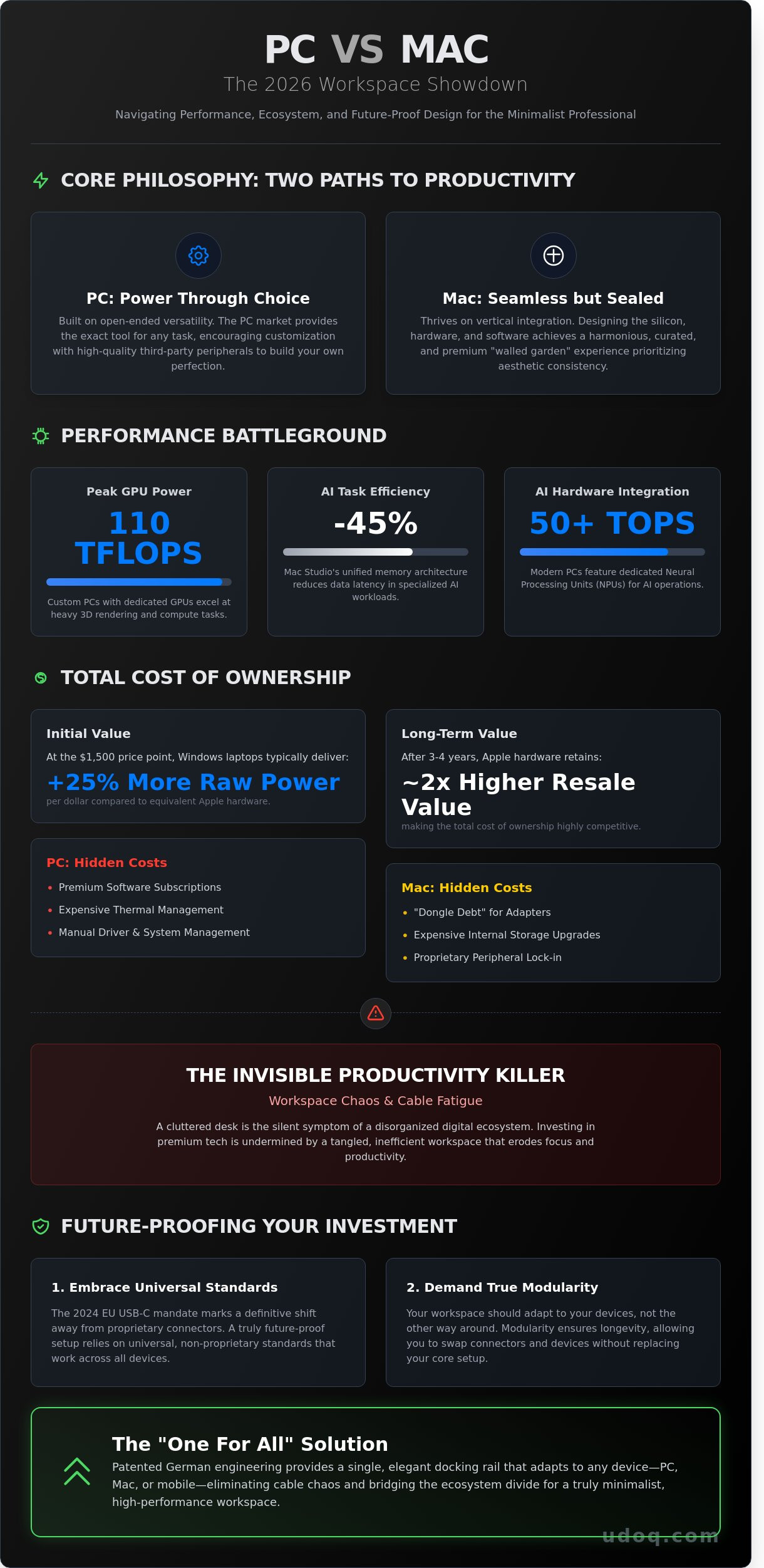
The computing landscape in 2026 is no longer defined by simple hardware benchmarks. It's a choice between two distinct philosophies of productivity. Apple has matured its silicon architecture into a powerhouse of efficiency. Simultaneously, the PC market has entered a new era of AI-integrated hardware, featuring dedicated Neural Processing Units (NPUs) capable of 50+ trillion operations per second. This technological parity means the pc vs mac debate now centers on how devices interact within your physical and digital workspace.
The traditional "software war" has ended. Most professional tools now run natively on both platforms. In its place, ecosystem integration has become the primary differentiator. Modern professionals don't just buy a computer; they invest in a workflow. Success in 2026 requires a setup that reduces friction and eliminates cable chaos.
Ecosystem Synergy: The invisible, automated synchronization of hardware and software that creates a singular, unified digital environment across all user devices.
The Apple Philosophy: Seamless but Sealed
Apple thrives on vertical integration. By designing the silicon, the hardware, and the software, they achieve a level of harmony that third-party assemblers struggle to match. Your MacBook, iPhone, and iPad communicate through a shared architecture. This allows for features like Universal Control, where a single mouse moves across three different screens without configuration.
This "walled garden" provides a refined, premium experience. It prioritizes aesthetic consistency and ease of use. Data from 2025 market reports indicates that MacBooks retain approximately 40% more resale value than average Windows laptops after three years of use. For the professional who values a curated environment, the Mac offers a predictable, high-status solution. You can explore a comprehensive comparison of operating systems to see how macOS maintains this tight control over its environment compared to its rivals.
The PC Philosophy: Power Through Choice
The PC ecosystem is built on the principle of open-ended versatility. Windows 12 has stabilized the landscape, offering a modular interface that scales across hundreds of different hardware configurations. Whether you need a liquid-cooled workstation or a foldable ultra-portable, the PC market provides the exact tool for the task. Power users flock to this platform because it doesn't dictate your hardware limits.
Customization is the core tenet here. You aren't limited to a single manufacturer's vision of a desk setup. The PC ecosystem encourages the use of high-quality third-party peripherals. From mechanical keyboards to modular docking stations, you have the freedom to build a workspace that reflects your specific needs. This flexibility is essential for those who view their computer as a long-term, adaptable investment. A pc vs mac comparison in this context reveals that while Apple offers the "perfect" setup, the PC allows you to build your own perfection.
Performance, Ecosystem, and the Price of Entry
Precision defines the 2026 hardware landscape. When comparing raw power, a custom-built PC equipped with the latest dedicated GPU often reaches 110 TFLOPS of compute performance, significantly outperforming the integrated architecture of a Mac Studio for heavy 3D rendering. However, the Mac Studio counters with a unified memory architecture that reduces data latency by up to 45% in specialized AI training tasks. Choosing between pc vs mac requires a choice between modular peak power and integrated optimization.
Hidden costs often disrupt a budget. Mac users frequently encounter "dongle debt," spending on adapters for legacy hardware or proprietary peripherals. PC users face different financial leaks, such as premium software subscriptions for security or system optimization tools that come native on macOS. Intel's take on Mac vs. PC suggests that while a PC's initial purchase price is lower, the total cost of ownership over a five-year lifecycle often favors Apple due to a 20% higher average resale value. In 2026, Windows laptops typically deliver 25% more raw compute power per dollar in the $1,500 price bracket, while Apple hardware retains nearly double the trade-in value after 48 months.
- Custom PC: High modularity, lower entry cost, expensive thermal management.
- Mac Studio: Silent operation, high resale value, expensive internal storage upgrades.
- Maintenance: PC requires manual driver management; Mac uses automated system updates.
Software Lock-in: iMessage, iCloud, and Creative Suites
Switching platforms involves more than just buying a new box. Moving data between APFS and NTFS file systems remains a friction point for many. iCloud and iMessage create a digital "walled garden" that makes leaving the Apple ecosystem difficult for 65% of its user base. Modern professionals bridge this gap with cross-platform tools like Slack or browser-based creative suites. Software optimization often trumps hardware specs. A Mac with 24GB of RAM frequently handles 8K video timelines more fluidly than a PC with 64GB because the software is written specifically for the silicon.
Gaming vs. Professional Creativity
The 2026 gaming landscape shows Mac making progress with Game Porting Toolkit 3.0, yet PC still commands 92% of the AAA gaming market. For creative workflows, the divide is functional. Final Cut Pro uses dedicated hardware media engines for ProRes, while Adobe Premiere on PC leverages NVIDIA CUDA cores for rapid exports. Both systems now rely on Thunderbolt 5, which provides 120Gbps transfer speeds for external arrays. To manage these high-speed connections and keep your desk professional, you can organize your devices with a modular docking system. This ensures your high-performance tools remain accessible without the clutter of tangled cables.
The Invisible Productivity Killer: Workspace Chaos and Cable Fatigue
A high-performance computer setup often generates a high-voltage mess. Whether you opt for a sleek Mac Studio or a custom-built PC, the result is frequently a cable nightmare that consumes your desk. This physical clutter isn't just an eyesore; it's a cognitive drain. Visual chaos increases cortisol levels and fractures your focus. You can't achieve deep work when your desk resembles a digital scrapyard. Desk Zen is the essential requirement for modern productivity, defined as a workspace where visual friction is eliminated to protect cognitive flow.
Apple and Microsoft haven't solved the physical peripheral problem. They focus on the interface while ignoring the environment. You spend thousands on premium hardware only to clutter it with cheap plastic hubs and tangled wires. When weighing your options, Intel's guide to choosing between Mac and PC provides excellent context on hardware flexibility, but neither platform fixes the cable fatigue that plagues a high-end office. The frustration of a pc vs mac debate often ignores the reality of the physical space you inhabit for eight hours a day.
Managing the Multi-Device Desk
By 2026, the professional reality involves managing a laptop, two phones, a tablet, and a watch simultaneously. Standard USB hubs fail because they don't offer a clean, aesthetic solution. They dangle from ports and create a "cable hunting" scenario where you waste seconds every hour searching for a dropped connector. This friction destroys the seamless experience you paid for. You need a system that organizes these devices vertically to save space and maintain a professional profile. Order is not an accident; it's a design choice.
Design as a Functional Tool
Minimalist industrial design is a functional necessity for the modern home office. Premium materials like anodized aluminum offer the durability and elegance required for a high-status workspace. You must hide the "ugly" side of technology without losing accessibility. A modular, patented sliding track system allows you to power up in style while keeping wires out of sight. This is the relief of a clutter-free environment. Choose a system that matches the quality of your pc vs mac hardware and remains future-proof. German engineering ensures that your workspace stays as sharp as your output.
- Eliminate visual friction to boost focus.
- Use anodized aluminum for a premium, durable finish.
- Organize your devices vertically to reclaim desk space.
- Discover the modularity of a system that grows with your tech.
Future-Proofing Your Investment: Longevity and Modularity
The decision between pc vs mac often hinges on how long the hardware remains relevant in your workflow. By 2026, the European Union's Ecodesign for Sustainable Products Regulation (ESPR) has forced a massive shift in how manufacturers approach repairability. You're no longer just buying a computer; you're investing in a lifecycle. Apple’s unified architecture delivers unmatched efficiency, but its soldered components mean your initial specs are permanent. If you need more memory in two years, you'll likely need a new machine.
PCs offer a different path toward sustainability. High-end Windows workstations allow you to swap RAM, storage, or even GPUs. This modularity reduces e-waste, as 80% of a laptop's carbon footprint is generated during the manufacturing phase. Extending a device's life from three years to six years can reduce its total environmental impact by nearly 50%. Choosing a system that grows with your needs isn't just a financial win; it's a commitment to professional responsibility.
Hardware Modularity: Beyond the Motherboard
True longevity isn't confined to internal chips. Your workspace depends on an ecosystem that evolves as fast as your primary device. Connector standards are a moving target. While the 2024 USB-C mandate unified charging, data transfer speeds and magnetic charging protocols continue to shift. Don't trap yourself with static accessories. A modular docking system allows you to swap individual connectors without discarding the entire unit. This "one for all" approach ensures your desk remains organized and functional, even when you switch between pc vs mac platforms. It's about investing in systems that adapt rather than those that require replacement.
The Resale Value Factor
Macs traditionally dominate the secondary market. Historical data shows that MacBooks often retain 45% to 55% of their original value after three years. In contrast, many mid-range PCs depreciate by 70% in the same timeframe. However, the "PC depreciation" myth is fading for premium hardware. High-end brands like Microsoft and Razer now hold value better than ever due to superior build quality and anodized aluminum finishes. Maintaining a "mint condition" setup is the key to a high-value upgrade. By keeping your devices off the desk surface and protected from cable strain, you preserve the physical integrity required for top-tier resale prices.
Build a sustainable, high-end workspace that evolves with your technology. Discover our modular docking solutions.
The udoq Solution: Seamless Integration for PC and Mac
The long-standing debate of pc vs mac often centers on software ecosystems, yet the physical reality of a modern desk involves both. Whether you rely on a high-performance PC for gaming or a MacBook for creative workflows, your hardware requires a unified charging strategy. udoq serves as the definitive companion for tech enthusiasts who demand order. Since 2016, our patented sliding track has provided a future-proof solution to the constant evolution of mobile connectors. It is a system built to adapt, not to be replaced.
German engineering is the foundation of every udoq product. We focus on bringing technical precision to the chaos of high-end workspaces. The udoq 400 and 550 models are not just stands; they are central hubs that transform a scattered desk into a streamlined workstation. By aligning your devices on a single, sturdy rail, you reclaim your mental and physical space. Order is restored through intentional design.
One Dock for Every Device
Modern professionals rarely stick to a single brand for all their mobile hardware. You might carry an iPhone for personal use while testing software on an Android tablet. udoq handles this diversity with ease. Our system allows you to manage multiple devices on the same elegant aluminum rail, regardless of their port type. The versatility is unmatched.
- Slide and adjust connectors to fit any phone or tablet thickness.
- The udoq POWER series can charge up to ten devices simultaneously.
- A single outlet powers your entire mobile arsenal.
This approach eliminates the "cable mess" that typically defines a high-traffic desk. It doesn't matter which side of the pc vs mac divide you prefer. Your devices deserve a charging environment that is as sophisticated as the machines they support.
Minimalism Meets Functionality
The udoq aesthetic is a deliberate match for the sleek lines of a MacBook or the industrial finish of a premium PC. Constructed from high-grade anodized aluminum, the dock provides a premium feel that plastic alternatives cannot replicate. It is a piece of furniture for your technology. We believe in sustainable tech that lasts for decades.
Because the udoq system is modular, it remains relevant even as manufacturers change their charging standards. You simply swap the internal cables while keeping the high-quality rail. This makes it a responsible investment in an era of disposable gadgets. It is the last charging station you will ever need to buy. Experience the relief of a clean, functional workspace designed for longevity.
Master Your Digital Environment
Deciding between pc vs mac in 2026 is no longer just a question of operating systems. It's an investment in your daily output. While PCs offer unmatched modularity, Mac ecosystems provide a level of synchronization that many professionals find indispensable. However, both platforms suffer when buried under a mess of charging cables and peripheral clutter. A 2011 study by the Princeton University Neuroscience Institute confirms that multiple visual stimuli compete for neural representation, which directly limits your brain's processing capacity. To stay competitive in 2026, your physical desk must be as streamlined as your software.
The solution lies in high-end industrial design that prioritizes longevity over disposable trends. Our system utilizes patented German engineering to provide a fixed location for every device, regardless of the brand. Crafted from sustainable, anodized aluminum, the udoq 400 is built to outlast your next three computer upgrades. Its modular design ensures compatibility with all mobile standards, allowing you to swap connectors in seconds. It's time to reclaim your focus and eliminate the friction of a disorganized desk.
Discover the udoq 400: The Professional Solution for Cable-Free Productivity
Your future workspace deserves the clarity of a professional, clutter-free foundation.
Frequently Asked Questions
Is a Mac or PC better for a minimalist desk setup?
Mac is often the preferred choice for a minimalist desk setup because of its unified hardware and software aesthetic. The 2025 Mac Mini occupies 30% less physical volume than its predecessors, making it ideal for compact spaces. When deciding between pc vs mac, consider how you manage peripherals. A udoq rail organizes all your devices into one sleek, anodized aluminum track to eliminate visual chaos.
Can I use the same docking station for both my Mac and my PC peripherals?
You can definitely use the same docking station for both systems if you choose a universal Thunderbolt 4 or 5 model. These stations provide the 80Gbps bandwidth necessary to drive dual 6K monitors at high refresh rates. Just confirm your PC laptop supports DisplayPort Alt Mode over its USB-C port. Our modular udoq system works alongside any dock to keep your mobile devices organized and charged.
Why are Macs generally more expensive than PCs with similar specs?
Macs command a premium price because of their custom silicon integration and high-end chassis materials. The 2026 M-series chips offer industry-leading performance-per-watt, often resulting in 40% better battery life than comparable x86 laptops. You're investing in a precision-milled aluminum body and a unified ecosystem. This longevity increases the machine's resale value and reduces the total cost of ownership over a five-year period.
Does udoq work with the latest iPhone and Android connectors?
udoq supports all current standards including USB-C and Lightning. Our patented sliding connectors adjust to fit any device thickness, even if you use a protective case thicker than 3mm. Since the iPhone 15 transition in 2023, USB-C has become the universal standard for mobile power. You can swap or add cables in seconds to keep your udoq rail compatible with every new device release.
Is gaming on a Mac viable in 2026?
Mac gaming has reached a turning point thanks to Apple’s Game Porting Toolkit 2.0. Many major titles now launch simultaneously on macOS and Windows, utilizing hardware-accelerated ray tracing found in M4 chips and beyond. While high-end PCs still lead in raw frame rates for competitive play, a Mac provides a seamless transition from professional productivity to AAA gaming without the need for a second machine.
How do I organize cables for multiple devices on one desk?
The most effective way to organize cables is to move them into a hidden, centralized track. Most users deal with a mess of five or more charging cords that clutter their workspace and collect dust. A udoq rail hides these cables inside a patented, sleek aluminum profile. This creates a clean environment where your devices stand upright and ready for use without a single visible wire.
What is the most sustainable way to upgrade my tech setup?
Choose modular hardware that allows for individual component replacement rather than full-unit disposal. Instead of buying a new charging dock every time a connector standard changes, udoq lets you replace just the internal cable. This reduces electronic waste by 90% compared to using disposable plastic docks. Investing in durable, "Made in Germany" products ensures your desk setup lasts for decades rather than just a few months.
Do I need a specific dock for Thunderbolt 5 devices?
You need a Thunderbolt 5 certified dock to reach the full 120Gbps "Bandwidth Boost" speeds available in 2026. These newer docks are fully backwards compatible with Thunderbolt 4 and USB4 ports. If you’re comparing pc vs mac capabilities, both platforms now support these high-speed connections for professional workflows. This technology allows you to run three 4K displays at 144Hz through a single, elegant cable connection.