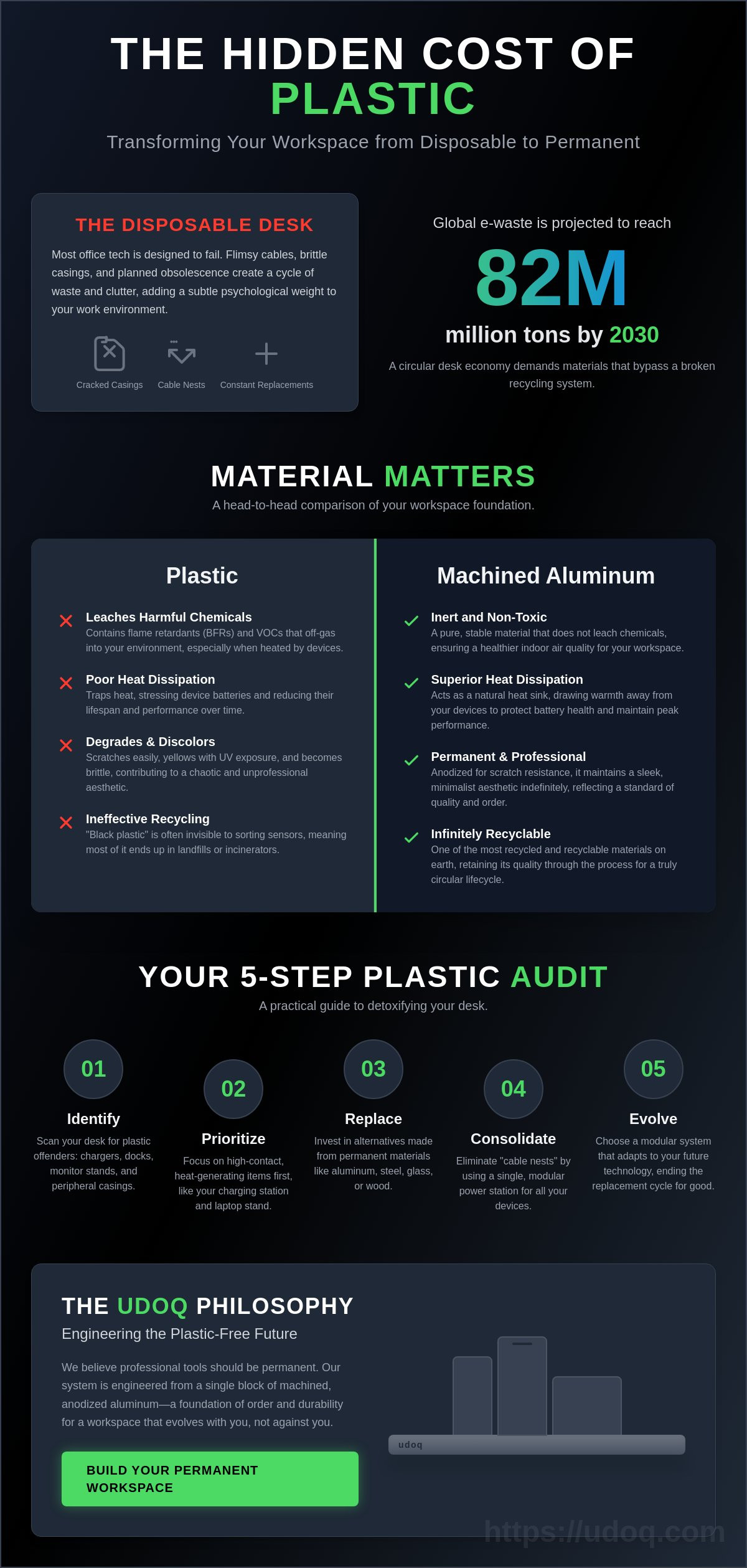
Your desk is likely covered in a material designed to fail. Most home offices are cluttered with flimsy cables and brittle casings that feel disposable because they are. It's a subtle psychological weight to work in an environment defined by planned obsolescence. Avoiding plastic in home office electronics is no longer just an environmental choice; it's a commitment to professional excellence and long-term health. With global e-waste projected to reach 82 million tons by 2030, the shift toward permanent materials is both necessary and sophisticated.
You don't have to settle for the "disposable" tech culture that litters your workspace with chaos. We'll show you how to eliminate toxic flame retardants and microplastics from your immediate environment. This guide explores the transition to high-performance, sustainable alternatives like machined aluminum that offer superior durability. You'll discover how a modular, minimalist setup creates a professional aesthetic that evolves with your technology. It is time to invest in a workspace that reflects your standards for quality, order, and longevity.
Key Takeaways
- Identify the hidden costs of disposable tech. Transitioning to permanent materials like aluminum provides professional durability and reduces e-waste.
- Protect your health and your hardware. Learn how high-grade materials prevent chemical leaching while offering superior heat dissipation for your device batteries.
- Master the art of avoiding plastic in home office electronics. Use our five-step audit to identify plastic offenders and replace them with sleek, modular alternatives.
- Simplify your workspace. Eliminate the psychological weight of clutter by replacing "cable nests" with a single, high-performance power station engineered for longevity.
The Hidden Plastic Footprint of the Modern Home Office
Most office desks are unintentional graveyards for low-grade polymers. We buy peripherals with a single-use mindset, often without realizing the long-term impact of these choices. These products aren't designed to last; they're designed to be replaced within a year or two. This disposable culture creates a hidden footprint that extends far beyond your desktop. It's a cycle of perpetual consumption that clutters your space and your mind.
Cheap plastic tech actually costs more over time. You pay in frequent replacements, lost productivity, and environmental degradation. Avoiding plastic in home office electronics requires a shift toward heirloom-quality hardware. True professional tools should evolve with your needs, not end up in a bin because a casing cracked or a port became loose. High-performance alternatives offer a sense of permanence that plastic simply cannot match.
To better understand the challenges of removing plastic from our daily lives, watch this perspective on workspace and home environments:
Beyond the Bin: Why Recycling Tech Isn’t Enough
Recycling is a flawed safety net for the tech industry. Most consumer electronics ends up as electronic waste because sorting facilities struggle with "black plastic." These carbon-black pigments absorb infrared light, making them invisible to automated sensors. They aren't recycled; they are landfilled or incinerated. A circular desk economy demands materials that don't depend on a broken recycling system. By choosing aluminum or high-grade metals, you bypass the "buy-toss" cycle entirely. You create a workspace that respects global resources while serving your daily workflow.
The Aesthetic Cost of a Plastic Workspace
Plastic degrades. It scratches, yellows, and loses its structural integrity under the heat of daily use. This physical decay creates a sense of chaos that stifles professional focus. A workspace should be a reflection of your standards. High-quality materials like those found in premium charging stations don't just look better; they provide the psychological relief of a tidy, permanent environment. Mastering the art of avoiding plastic in home office electronics is about more than aesthetics. It is about positioning your office as a temple of order and precision. A minimalist desk free from flimsy plastic cables allows for deeper concentration and signals that you value longevity over temporary convenience.
Understanding the Risks: Toxins and Microplastics in Tech
Electronic plastic toxicity is a silent variable in many home offices. Most device casings are infused with brominated flame retardants (BFRs) and heavy metals to meet safety standards. While these chemicals prevent fires, they don't stay locked within the material. Avoiding plastic in home office electronics is the only definitive way to eliminate this exposure at the source. It is a choice that prioritizes your health as much as your hardware.
Heat is the primary driver of chemical migration. Your laptop, monitor, and charging docks generate significant thermal energy during operation. This heat accelerates the leaching of volatile organic compounds (VOCs) from plastic surfaces directly into your workspace. In a standard plastic dock, your devices are essentially resting on a surface that off-gasses more as it warms up. This creates a feedback loop where the tech meant to empower you simultaneously compromises your environment.
The conversation around BPA-free products has reached the kitchen, but it's often ignored in the office. Tech plastics involve a much broader spectrum of endocrine-disrupting chemicals. These substances don't just stay on the desk; they contribute to the microplastics found in indoor air. Protecting your space requires looking beyond basic labels and examining the fundamental materials of your setup.
The Problem with Flame Retardants in Electronic Casings
Black plastic remains a critical concern for the industry. Much of it is sourced from recycled e-waste that already contains high concentrations of restricted chemicals. Research from the UCLA Luskin Center for Innovation in The Perils of Plastics highlights how these additives can persist through multiple lifecycles. When these casings heat up, they compromise indoor air quality. Choosing inert, non-plastic materials for high-heat environments is a logical step for any health-conscious professional. It ensures your office remains a clean, productive sanctuary.
Health Impacts of Microplastics in the Workspace
Microplastics aren't just an ocean problem. They are a desk problem. Nanoplastics enter the body through skin contact and the inhalation of contaminated dust. Long-term exposure to these endocrine-disrupting chemicals can interfere with hormonal balance. Protecting your home environment requires a shift toward materials that do not shed or off-gas. Switching to a high-grade aluminum charging station ensures your tech setup remains chemically inert. You can explore how a precision-engineered workspace helps reduce your daily toxic load while maintaining a professional aesthetic.
Aluminum vs. Plastic: Why Material Science Matters
Material choice defines the lifespan of your workspace. Avoiding plastic in home office electronics isn't just about ethics; it's about superior engineering. Plastic is an insulator. It traps heat. Aluminum is a conductor. It breathes. When you choose metal over molded polymers, you're opting for a material that works with your technology rather than against it. This distinction is the difference between a temporary accessory and a permanent tool.
The tactile experience of your office affects your productivity. Cold-milled metal provides a sense of weight and stability that plastic cannot replicate. It doesn't creak under pressure or scratch with light use. German engineering focuses on this intersection of high-end aesthetics and functional durability. You aren't just buying a dock; you're investing in a 10-year desk setup that remains relevant as your devices evolve.
Thermal Management and Device Longevity
Plastic casings act as thermal blankets. They trap the heat generated by your phone, tablet, and power adapters. This heat buildup is the primary enemy of lithium-ion batteries. Aluminum functions as a natural heat sink, drawing warmth away from sensitive internal components and dissipating it into the air. Technical data suggests that every 10°C drop in temperature can double a battery’s lifespan. By managing thermal loads effectively, you protect your primary tech investments from premature degradation.
Material stability also impacts air quality. Plastic wear and tear releases particles into your immediate environment. Citing the dangers of microplastics from electronics illustrates why inert materials are essential for a healthy office. Aluminum doesn't shed. It doesn't off-gas when it gets warm. It provides a clean, stable foundation for your daily work without contributing to indoor pollution.
The Sustainability of Milled Aluminum
Recyclability is often misunderstood in the tech world. Most plastics are downcycled, meaning they lose quality until they eventually become waste. Aluminum is a permanently available material. It can be recycled infinitely without any loss of its mechanical properties. This makes it the cornerstone of a circular office economy. It requires significantly less energy to recycle aluminum than it does to produce new plastic, making it the responsible choice for a sustainable workspace.
Longevity is the ultimate form of sustainability. A "cheap" plastic accessory that breaks within a year is far more expensive than a precision-engineered metal dock that lasts a decade. Learn why aluminum is the superior material for desk tech to understand how material science dictates the future of office design. Transitioning to high-grade materials eliminates the "buy-toss" cycle and establishes a professional environment built on quality, order, and performance.
5 Steps to Auditing and Reducing Plastic at Your Desk
Audit your workspace today. Most desks are crowded with accessories that don't meet professional standards. Avoiding plastic in home office electronics starts with a meticulous inventory of your peripherals. Look for the brittle casings and flimsy connectors that characterize disposable tech. These items are the primary sources of the chemical leaching and microplastics discussed earlier.
Identify the biggest offenders first. These are often the "free" cables and cheap plastic docks that scratch easily and trap heat. Replace these with high-quality alternatives made from metal, wood, or glass. These materials offer a superior tactile experience and eliminate the off-gassing associated with heated polymers. Transitioning to permanent materials is a commitment to both your health and your professional aesthetic.
- Inventory your peripherals: Locate every plastic accessory and evaluate its durability.
- Swap cables: Replace standard plastic cords with high-quality, durable alternatives.
- Consolidate charging: Replace multiple plastic power bricks with one systemic solution.
- Choose modular hardware: Opt for tools that adapt to new device standards.
- Prioritize premium surfaces: Use metal and glass for frequent touchpoints to reduce wear.
Cable Management and Clutter Reduction
Consolidate your power source. A single, high-grade charging station can eliminate the need for ten separate plastic cables and bulky power bricks. This systemic approach reduces visual noise and creates immediate physical order. Discover our cable management solutions for a truly clutter-free desk. A fixed-rail system ensures every device has a dedicated home, removing the chaos of a "cable nest" and protecting your hardware from unnecessary heat buildup.
Investing in Modular Longevity
Avoid the trap of "fixed" docks. Most plastic accessories become obsolete the moment you upgrade your phone or tablet. This leads to more plastic waste and constant reinvestment. Choose modular hardware that adapts to changing industry standards. Precision-engineered sliding connectors allow a dock to evolve with your tech. This adaptability is a unique signature of high-end industrial design.
Prioritize products with a patented, future-proof design. By selecting a precision-engineered charging station, you ensure your workspace remains functional for years. This is the essence of the German engineering approach: creating products that solve problems permanently. Transitioning to a minimalist, aluminum-based setup is the final step in refining your professional environment and successfully avoiding plastic in home office electronics.
The udoq Philosophy: Engineering the Plastic-Free Future
The udoq 250 is a masterclass in minimalist aluminum design. It represents the final step in your transition to a permanent, professional workspace. Avoiding plastic in home office electronics requires a move away from fragmented accessories toward a unified system. By housing your devices on a single, milled aluminum rail, you eliminate the visual and physical chaos of the "cable nest." This isn't just about charging; it's about establishing a foundation of order that lasts for decades.
German engineering defines our approach to material selection and mechanical precision. Every udoq station is built to endure. While plastic docks succumb to heat and wear, our cold-milled surfaces remain inert and aesthetically perfect. This commitment to quality ensures your desk reflects your professional standards. You're investing in a system designed to outlast multiple generations of mobile technology.
Modular Design as the Ultimate Sustainability
Adaptability is the enemy of waste. Most charging solutions are discarded when a new device standard emerges. Our modular system solves this problem by allowing you to swap connectors instead of the entire dock. You can mix and match L-CABLE and C-CABLE adapters on a single rail to support smartphones, tablets, and e-readers simultaneously. Explore our full collection of charging stations to find the configuration that fits your specific workflow. This future-proof design ensures you're never forced back into the cycle of buying disposable plastic peripherals.
A Sophisticated Solution for the Design-Conscious
Your workspace should be a sanctuary of focus. High-grade aluminum matches the premium finish of modern hardware, creating a seamless aesthetic across your desk. This visual harmony provides immediate psychological relief from the clutter of traditional setups. For those who value meticulous organization, the udoq 400 Premium Watch offers a specialized solution for keeping your essential tech visible and secure. Avoiding plastic in home office electronics is the most effective way to build a sustainable, high-status environment. Choose hardware that evolves with you and experience the clarity of a truly minimalist desk.
Refine Your Professional Environment
Your desk is a direct reflection of your standards. You've seen how material choice dictates everything from battery health to indoor air quality. Transitioning to permanent materials like aluminum isn't just a trend. It's a strategic investment in a workspace that respects both your time and the environment. Avoiding plastic in home office electronics is the definitive path to a cleaner, more efficient desk. You can eliminate the cycle of planned obsolescence and replace it with a system built for longevity.
It's time to replace flimsy chaos with precision. Our systems leverage patented German engineering and milled high-grade aluminum to provide a stable, chemically inert foundation for your tech. The modular design is compatible with all brands, ensuring your setup evolves as fast as your technology does. Upgrade to a Plastic-Free, Aluminum Docking Station and reclaim your focus today. Build a workspace that reflects your commitment to quality, order, and a sustainable future.
Frequently Asked Questions
Is plastic in electronics really harmful to my health?
Plastic casings often contain flame retardants and heavy metals that can leach into your environment. Heat from active devices accelerates this process, releasing volatile organic compounds into your immediate indoor air. Choosing inert materials for your desk setup reduces your daily exposure to endocrine-disrupting chemicals. It's a proactive step toward maintaining a healthier, cleaner home office that reflects your professional standards.
Why is black plastic harder to recycle than other colors?
Automated sorting facilities use near-infrared sensors to identify and categorize waste. Carbon black pigments absorb these rays, making the material invisible to the machinery. This results in black plastic being landfilled or incinerated rather than recycled. Avoiding these materials ensures your hardware doesn't contribute to the global e-waste crisis. It is a critical factor when selecting sustainable peripherals for a professional workspace.
How does an aluminum dock help my phone battery last longer?
Aluminum functions as a natural heat sink that draws thermal energy away from your mobile devices. Excessive heat is the primary cause of battery degradation in smartphones and tablets. By keeping your hardware cool during charging cycles, you preserve long-term battery health and performance. This material science approach provides a clear advantage over plastic docks that trap heat and accelerate wear on internal components.
What are the best non-plastic materials for a home office desk?
Aluminum, solid wood, tempered glass, and stainless steel are the premier choices for a sustainable workspace. These materials offer superior durability and a high-end aesthetic that plastic cannot replicate. They provide a stable, tactile foundation for your daily work. Metal and glass are particularly effective for high-touch surfaces because they don't scratch or degrade like molded polymers over years of use.
Can I really eliminate all plastic from my electronic setup?
Total elimination is difficult because internal circuit boards and wiring require some polymers for insulation. However, you can remove nearly all visible plastic by focusing on device casings, charging docks, and cable management. Avoiding plastic in home office electronics is about targeting the high-volume waste items first. Replacing these with modular aluminum systems significantly reduces your environmental footprint and improves your office aesthetic.
Does udoq use any plastic in its docking stations?
We use high-grade aluminum for the primary structural rail to ensure maximum stability and heat dissipation. Small amounts of high-quality plastic are used for internal insulation and the mechanical sliding components of our adapters. This hybrid approach prioritizes longevity while maintaining essential safety standards. Our goal is to minimize polymer use in favor of permanent, recyclable materials that provide a premium feel.
How does modularity reduce electronic waste?
Modularity stops the cycle of planned obsolescence by allowing you to upgrade individual parts. Instead of replacing an entire dock when a new charging standard arrives, you simply swap a connector. This system ensures your hardware remains functional across multiple device generations. It's a sophisticated solution that values long-term utility over disposable trends, keeping your workspace efficient and your waste production minimal.
Are aluminum charging stations compatible with all phone brands?
Our aluminum stations are designed for universal utility through a system of interchangeable connectors. You can charge any smartphone, tablet, or smartwatch by sliding the appropriate adapter into the rail. This adaptability makes udoq compatible with all major brands and charging standards. It provides a single, organized power source for your entire tech ecosystem without the need for multiple flimsy plastic accessories.